
Ibex 35: The Battle for 10,500 and Bernanke's Influence
The Ibex 35 stalled at 10,500 points in September 2010 as the Fed injected $1.7 trillion and strong hands returned to the market.
English · Original discussion in Spanish · Published
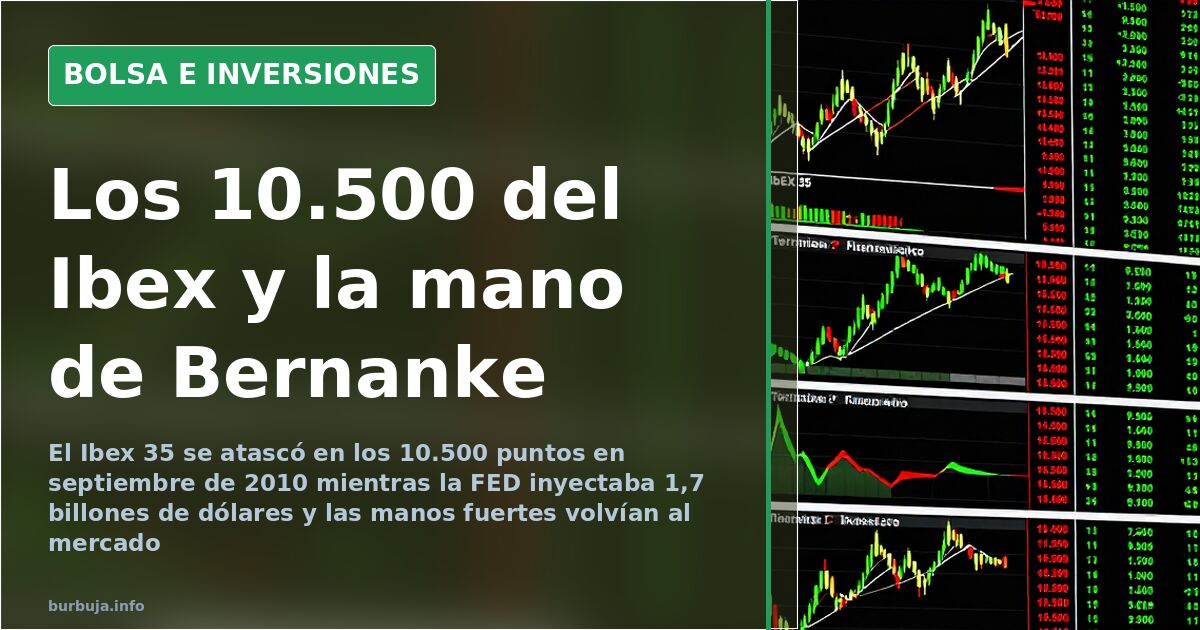
Ibex 35 in September 2010: Who Was Holding Up 10,500?
For many traders, the Ibex 35 in September 2010 wasn't rising due to data, but rather the tug-of-war between strong hands executing massive orders at specific times and a majority of participants who could only guess the direction. The index spent weeks stuck around the 10,500-10,614 point zone, a crucial level the market had marked, which no one dared to decisively breach. Meanwhile, across the Atlantic, the Federal Reserve kept its printing presses running, and the debate shifted from whether the market was right to who was actually supporting it.
10,500 and 10,614: The Resistance That Resisted
The level that recurred throughout the month was 10,614 points, identified as a significant threshold around which the market danced. Below it lay the 10,470 level for futures and the 10,500 for spot. One analysis suggested that a clear break below these levels would lead to the next support around 10,200-10,300. In forums, 9,700 was discussed as a potential support, though without consensus on its strength.
The Ibex traded between 10,400 and 10,430 during sessions some described as "truly nightmarish and boring." Flat sessions, low activity, and the feeling that prices were going nowhere until someone decided to break the stalemate.
The 'Bernanke Line' and the Money Propping Everything Up
Suspicion ran high: a public hand was behind the movements, determined to prevent a collapse. The most cited explanation pointed to Washington, not Brussels. With QE1 initiated in March 2009, the Fed had injected nearly $1.7 trillion by purchasing government debt and mortgage-backed securities. The popular summary compared it to giving more alcohol to a drunk to delay the hangover.
This flood of liquidity was noticeable in the euro, which gained ground against the dollar. And in more sarcastic charts, the Bernanke Line began to appear – the line that, they claimed, defied even Elliott's laws and postponed the great depression by a couple of years. This wasn't a fringe theory; it was the convenient explanation for a market that, according to its proponents, moved at the dictate of central banks.
Elliott, Prechter, and the Point of No Return
Concurrently, trinc of wave counting monitored the S&P 500. The dominant interpretation suggested that the fifth wave had completed and crossing the line 2-4 would trigger the dreaded Wave 3. According to Prechter's trinc, crossing this line would miccionan passing the point of no return. "It was time to go short and not look back," summarized one of the most applauded analyses.
Volatility also raised red flags: when prices stagnate after an upward trend, calm often precedes a shock. The VIX appeared repeatedly in messages as a warning. If the S&P 500 was green and not breaking out, someone was trapping retail investors.
The 'Lions' Volume: The Clue Others Missed
One of the month's most original exercises was tracking the volume of large operators. Day by day, it was noted whether they were buying or selling and in which price ranges. The verdict in the final weeks of September: volume was high and the daily balance was positive, with liquidity returning after the summer lull. In one auction, the day's largest trade involved 342 contracts.
Therein lay the trap. Large orders at specific times, sharp 50-point jumps, and the impression that someone with insider information was moving the market. The full calculation of these trades, hour by hour, is what falls outside this summary and explains why the index behaved in ways that defied logic.
The Awkward Question: Quit Your Job to Trade?
At the end of the month, a debate that many had kept silent surfaced. One trader admitted that it was more profitable to trade than to work, but couldn't do so because of his job. The question lingered: who would leave a stable salary to live off the market?
Opinions were divided. For some, with a meager salary, there wasn't much to lose; for others, systems generate profits until they stop, and the risk of ending up with no safety net was too high. Taking a leave of absence, self-belief, and holding two jobs simultaneously were the most cited solutions. No one made a move.
Buy or Rent: The Other Underlying Battle
The real estate issue crept in. If a stock's dividends exceed the cost of financing its purchase, buying makes sense, reasoned one. Countering this was the price drop: if housing prices fall, the calculation breaks down. The consensus conclusion was ambiguous—it depends on the mortgage term and how long you plan to stay—and some admitted to opening a housing savings account in anticipation of what they saw as a rough patch in the stock market.
The Close: October, The Frontier That Never Arrived Early
With the Fed ready to keep giving alcohol to the drunk and strong hands executing increasingly larger orders, breaking 10,500 seemed a matter of days. It didn't happen before the month turned. Some bet on a Black Friday that never materialized, while others resigned themselves with "it's not October yet." With sovereign debt tightening its grip, the most honest prediction remained the same: the level was holding, but no one could guarantee for how long.
For many traders, the Ibex 35 in September 2010 wasn't rising due to data, but rather the tug-of-war between strong hands executing massive orders at specific times and a majority of participants who could only guess the direction. The index spent weeks stuck around the 10,500-10,614 point zone, a crucial level the market had marked, which no one dared to decisively breach. Meanwhile, across the Atlantic, the Federal Reserve kept its printing presses running, and the debate shifted from whether the market was right to who was actually supporting it.
10,500 and 10,614: The Resistance That Resisted
The level that recurred throughout the month was 10,614 points, identified as a significant threshold around which the market danced. Below it lay the 10,470 level for futures and the 10,500 for spot. One analysis suggested that a clear break below these levels would lead to the next support around 10,200-10,300. In forums, 9,700 was discussed as a potential support, though without consensus on its strength.
The Ibex traded between 10,400 and 10,430 during sessions some described as "truly nightmarish and boring." Flat sessions, low activity, and the feeling that prices were going nowhere until someone decided to break the stalemate.
The 'Bernanke Line' and the Money Propping Everything Up
Suspicion ran high: a public hand was behind the movements, determined to prevent a collapse. The most cited explanation pointed to Washington, not Brussels. With QE1 initiated in March 2009, the Fed had injected nearly $1.7 trillion by purchasing government debt and mortgage-backed securities. The popular summary compared it to giving more alcohol to a drunk to delay the hangover.
This flood of liquidity was noticeable in the euro, which gained ground against the dollar. And in more sarcastic charts, the Bernanke Line began to appear – the line that, they claimed, defied even Elliott's laws and postponed the great depression by a couple of years. This wasn't a fringe theory; it was the convenient explanation for a market that, according to its proponents, moved at the dictate of central banks.
Elliott, Prechter, and the Point of No Return
Concurrently, trinc of wave counting monitored the S&P 500. The dominant interpretation suggested that the fifth wave had completed and crossing the line 2-4 would trigger the dreaded Wave 3. According to Prechter's trinc, crossing this line would miccionan passing the point of no return. "It was time to go short and not look back," summarized one of the most applauded analyses.
Volatility also raised red flags: when prices stagnate after an upward trend, calm often precedes a shock. The VIX appeared repeatedly in messages as a warning. If the S&P 500 was green and not breaking out, someone was trapping retail investors.
The 'Lions' Volume: The Clue Others Missed
One of the month's most original exercises was tracking the volume of large operators. Day by day, it was noted whether they were buying or selling and in which price ranges. The verdict in the final weeks of September: volume was high and the daily balance was positive, with liquidity returning after the summer lull. In one auction, the day's largest trade involved 342 contracts.
Therein lay the trap. Large orders at specific times, sharp 50-point jumps, and the impression that someone with insider information was moving the market. The full calculation of these trades, hour by hour, is what falls outside this summary and explains why the index behaved in ways that defied logic.
The Awkward Question: Quit Your Job to Trade?
At the end of the month, a debate that many had kept silent surfaced. One trader admitted that it was more profitable to trade than to work, but couldn't do so because of his job. The question lingered: who would leave a stable salary to live off the market?
Opinions were divided. For some, with a meager salary, there wasn't much to lose; for others, systems generate profits until they stop, and the risk of ending up with no safety net was too high. Taking a leave of absence, self-belief, and holding two jobs simultaneously were the most cited solutions. No one made a move.
Buy or Rent: The Other Underlying Battle
The real estate issue crept in. If a stock's dividends exceed the cost of financing its purchase, buying makes sense, reasoned one. Countering this was the price drop: if housing prices fall, the calculation breaks down. The consensus conclusion was ambiguous—it depends on the mortgage term and how long you plan to stay—and some admitted to opening a housing savings account in anticipation of what they saw as a rough patch in the stock market.
The Close: October, The Frontier That Never Arrived Early
With the Fed ready to keep giving alcohol to the drunk and strong hands executing increasingly larger orders, breaking 10,500 seemed a matter of days. It didn't happen before the month turned. Some bet on a Black Friday that never materialized, while others resigned themselves with "it's not October yet." With sovereign debt tightening its grip, the most honest prediction remained the same: the level was holding, but no one could guarantee for how long.
Summary of a discussion on Burbuja.info - Foro de economía, actualidad y política., translated from Spanish and reviewed before publication. Read the full discussion (1897 replies).
More summaries
-
The AI Bubble: How Circular Payments Keep the S&P 500 Afloat
OpenAI has $550B in commitments but no profit, Oracle issues 6.85% debt, and the billing loop keeps the S&P 500 rising.
-
Ibex 35 in May 2014: Dividends, Penny Stocks, and 25% VAT
May 2014 saw the Ibex 35 pay dividends as VAT threatened to rise to 25%. Penny stocks, capital increases, and a stagnant Santander.
-
Ibex 35 January 2014: Banking Surges as Technical Analysis Targets 9,950
The Ibex 35 rose in January 2014 with banking stocks soaring, while Santander's non-performing loans in Spain reached 7.49% and technical analysis eyed the 9,950 level.
-
Madrid's Neighborhoods: Price Dictates the Map of Good and Bad Areas
Classifying Madrid's 128 neighborhoods as good or bad depends on the criteria: price per square meter, commute time, or district labels.
-
Buying the Dip or Waiting for Crash: The 2025 Market Dilemma
Centene experienced a 25% fall, AI technology is dividing investors, and market crash predictions are mounting for November. The 2025 investment dilemma: buy now or wait?
-
Gold stuck at 0.382 as bitcoin takes the spotlight
Gold stuck at 0.382 and unable to recover while bitcoin hits 6.000 dollars; thresholds at 1.250 and 1.050 set the scene.