
Iberian wolf reaches 27.8 km from Madrid's M-40: 297 packs and rising census
Autopsy of a female wolf killed near Manzanares el Real confirms Iberian wolf expansion: 297 packs and range reaching 27.8 km from Madrid's M-40.
English · Original discussion in Spanish · Published
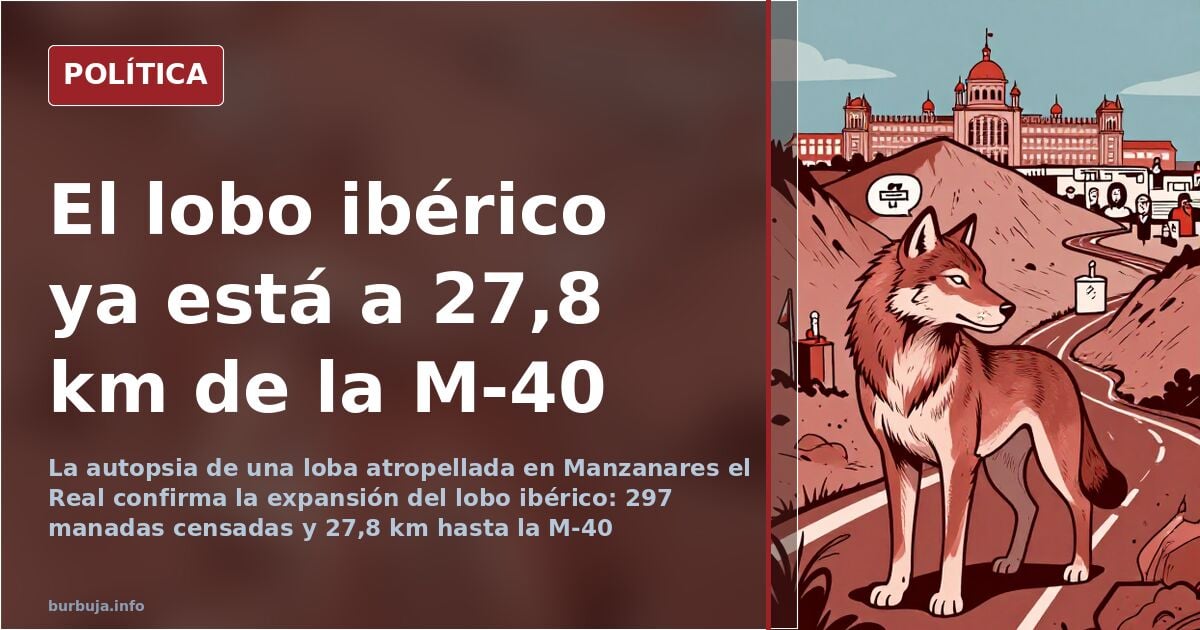
The Iberian wolf is now 27.8 km from Madrid's M-40
A resident walking near the M-608, between Manzanares el Real and El Boalo, found a dead wolf in the ditch on January 21, with its jaws open and fangs showing. Forest rangers took it to the Tres Cantos Species Recovery Center. The autopsy concluded two things: it died in a traffic accident and it was not a male wolf, but a female. A young two-year-old. The carcass was found 27.8 kilometers in a straight line from the M-40, with six million people on the other side.
The discovery is bloody, yet it confirms a fact that statistics had been anticipating: the Iberian wolf (canis lupus) is returning to territories from which it was expelled with the aim of extermination. The last Madrid pair, in the Lozoya valley, was shot in 1952. Since 2011, there have been breeding packs in the Guadarrama mountains arrived from Segovia. There are now three, with about 25 individuals, and the last female wolf found wandered further south than any other recorded to date.
How many wolf packs are in Spain
The 2012-2014 census, closed by the Ministry of Agriculture, Food and Environment with the autonomous communities, speaks of 297 breeding packs, 20% more than the 250 from the Atlas and Red Book of Terrestrial Mammals of 2007. The Ministry does not break down individual animals; multiplying by an average of seven wolves per pack yields 2,079. The real figure is higher: north of the Duero, where 90% of the animals live, more than 30% are solitary wolves not included in packs or registers. Between 2,000 and 3,000 individuals, summarizes one of the top specialists, Juan Carlos Blanco, co-director of the 1988 national census. "We don't know the exact figure, nor will we ever know it," he admits.
The distribution explains almost all the conflict: Castilla y León concentrates 163 packs, Galicia 84, Asturias 37, Cantabria 12, Castilla-La Mancha two, and Madrid one, although the community had already registered three as of 2016. The occupied area has grown from 100,000 to 120,000 square kilometers. Almost a quarter of Spain.
Why El Pardo enters the map
The forest surrounding the former palace is 9.5 kilometers in a straight line from La Moncloa and 13.5 from the Puerta del Sol. "It is not unreasonable to think that a pack could settle in El Pardo," Blanco states. The species expands through the Central system, Ávila, Segovia, Guadalajara, and the Community of Madrid while losing density in the northeastern peninsula, in the plains of the northern submeseta and in Andalusia. The wolf's geography is moving south. And the south has more people.
Mastiffs, compensation, and an unprecedented protest
More than 150 entities and parties, organized by the Lobo Marley association, demonstrated in front of the Ministry in the first protest for a wild species held in Spain. They demand a ban on wolf hunting and arbitration of coexistence measures. Farmers push in the opposite direction, using attacks on their animals as an argument. The tension materializes in the mastiffs, guard dogs that, according to a participant in the debate, part of the hiking public describes as growlers and aggressive. Another participant estimates that there are slightly more than 900 holders of exploitation in the wolf zone of Cantabria and maintains that what is threatened is not the wolf, but extensive livestock farming.
The struggle is not zoological. It is economic, and it has three simple questions: who pays for the damages, who orders the priorities of the forest, and who gives up a landscape without predators. On that, no census is worth anything.
Is it dangerous to encounter a wolf in the mountains?
According to participants in the debate, the wolf avoids humans instinctively, and most encounters are resolved with an animal that flees before being seen. Several maintain that someone walking in the mountains has more probability of crossing paths with a sow with cubs, an animal that weighs as much as a pedestrian and does not always move aside. One participant states that there is only one documented case of wolf attacks on people in the entire 20th century: in 1974, two child deaths in San Cibrao das Viñas (Ourense), and that those of 1925 and 1952 have no original source. Movie-panic holds up poorly in the ditch.
From extermination to Félix Rodríguez de la Fuente
After the Civil War, the extermination campaign resumed. The founder of Doñana, José María Valverde, predicted that at this rate "the wolf will not reach the end of the 20th century." The turning point was 1970, when Félix Rodríguez de la Fuente convinced the Icona that it was possible to hunt without exterminating. From then on, the species, cornered north of the Duero, continued to recover: the 1988 census certified it later.
Spain has the largest wolf population in Western Europe today. Portugal registers 60 packs; in France, it disappeared and did not return until 1992; in Germany, extinct, it reappeared in the year 2000 and barely sums 20 packs.
The only blot on the census is Andalusian, and no one agrees on its size. For Blanco, the isolated population of Sierra Morena has gone extinct or almost. The biologist Rafael Carrasco, author of the Andalusian part of the census, maintains that there are two or three packs between the Andújar mountains (Jaén) and Hornachuelos (Córdoba), sightings and feces included. Without detailed confirmations, the official document notes that there are none. The wolf gains ground and, at the same time, disappears from the written map.
A resident walking near the M-608, between Manzanares el Real and El Boalo, found a dead wolf in the ditch on January 21, with its jaws open and fangs showing. Forest rangers took it to the Tres Cantos Species Recovery Center. The autopsy concluded two things: it died in a traffic accident and it was not a male wolf, but a female. A young two-year-old. The carcass was found 27.8 kilometers in a straight line from the M-40, with six million people on the other side.
The discovery is bloody, yet it confirms a fact that statistics had been anticipating: the Iberian wolf (canis lupus) is returning to territories from which it was expelled with the aim of extermination. The last Madrid pair, in the Lozoya valley, was shot in 1952. Since 2011, there have been breeding packs in the Guadarrama mountains arrived from Segovia. There are now three, with about 25 individuals, and the last female wolf found wandered further south than any other recorded to date.
How many wolf packs are in Spain
The 2012-2014 census, closed by the Ministry of Agriculture, Food and Environment with the autonomous communities, speaks of 297 breeding packs, 20% more than the 250 from the Atlas and Red Book of Terrestrial Mammals of 2007. The Ministry does not break down individual animals; multiplying by an average of seven wolves per pack yields 2,079. The real figure is higher: north of the Duero, where 90% of the animals live, more than 30% are solitary wolves not included in packs or registers. Between 2,000 and 3,000 individuals, summarizes one of the top specialists, Juan Carlos Blanco, co-director of the 1988 national census. "We don't know the exact figure, nor will we ever know it," he admits.
The distribution explains almost all the conflict: Castilla y León concentrates 163 packs, Galicia 84, Asturias 37, Cantabria 12, Castilla-La Mancha two, and Madrid one, although the community had already registered three as of 2016. The occupied area has grown from 100,000 to 120,000 square kilometers. Almost a quarter of Spain.
Why El Pardo enters the map
The forest surrounding the former palace is 9.5 kilometers in a straight line from La Moncloa and 13.5 from the Puerta del Sol. "It is not unreasonable to think that a pack could settle in El Pardo," Blanco states. The species expands through the Central system, Ávila, Segovia, Guadalajara, and the Community of Madrid while losing density in the northeastern peninsula, in the plains of the northern submeseta and in Andalusia. The wolf's geography is moving south. And the south has more people.
Mastiffs, compensation, and an unprecedented protest
More than 150 entities and parties, organized by the Lobo Marley association, demonstrated in front of the Ministry in the first protest for a wild species held in Spain. They demand a ban on wolf hunting and arbitration of coexistence measures. Farmers push in the opposite direction, using attacks on their animals as an argument. The tension materializes in the mastiffs, guard dogs that, according to a participant in the debate, part of the hiking public describes as growlers and aggressive. Another participant estimates that there are slightly more than 900 holders of exploitation in the wolf zone of Cantabria and maintains that what is threatened is not the wolf, but extensive livestock farming.
The struggle is not zoological. It is economic, and it has three simple questions: who pays for the damages, who orders the priorities of the forest, and who gives up a landscape without predators. On that, no census is worth anything.
Is it dangerous to encounter a wolf in the mountains?
According to participants in the debate, the wolf avoids humans instinctively, and most encounters are resolved with an animal that flees before being seen. Several maintain that someone walking in the mountains has more probability of crossing paths with a sow with cubs, an animal that weighs as much as a pedestrian and does not always move aside. One participant states that there is only one documented case of wolf attacks on people in the entire 20th century: in 1974, two child deaths in San Cibrao das Viñas (Ourense), and that those of 1925 and 1952 have no original source. Movie-panic holds up poorly in the ditch.
From extermination to Félix Rodríguez de la Fuente
After the Civil War, the extermination campaign resumed. The founder of Doñana, José María Valverde, predicted that at this rate "the wolf will not reach the end of the 20th century." The turning point was 1970, when Félix Rodríguez de la Fuente convinced the Icona that it was possible to hunt without exterminating. From then on, the species, cornered north of the Duero, continued to recover: the 1988 census certified it later.
Spain has the largest wolf population in Western Europe today. Portugal registers 60 packs; in France, it disappeared and did not return until 1992; in Germany, extinct, it reappeared in the year 2000 and barely sums 20 packs.
The only blot on the census is Andalusian, and no one agrees on its size. For Blanco, the isolated population of Sierra Morena has gone extinct or almost. The biologist Rafael Carrasco, author of the Andalusian part of the census, maintains that there are two or three packs between the Andújar mountains (Jaén) and Hornachuelos (Córdoba), sightings and feces included. Without detailed confirmations, the official document notes that there are none. The wolf gains ground and, at the same time, disappears from the written map.
Summary of a discussion on Burbuja.info - Foro de economía, actualidad y política., translated from Spanish and reviewed before publication. Read the full discussion (372 replies).
More summaries
-
Judge in Koldo case moves to indict Ábalos
The judge moves to indict Ábalos after UCO report; PP summons Marlaska and Globalia CEO to Senate committee
-
Tweet Places Pablo Fernández in Luxury Housing Development
A tweet places Pablo Fernández living in a luxury development from the Mahou-Calderón operation, the same one Podemos tried to halt.
-
VOX Eyes 82 Seats Amid Polling Storm
Polls place VOX between 77 and 90 seats, but skepticism over deals and data reliability raise questions. Bubble or trend?
-
Castile and León Election: PSOE's Strategy and Candidate Profiles
Analysis of electoral strategies and candidate profiles for the PSOE in Castile and León ahead of the regional election.
-
Spain’s Births Drop 100,000 Below 1939 Levels
2016 births in Spain fell 107,000 short of 1939 figures, despite a larger population. The demographic winter continues to deepen.
-
Bilbao Knife Incident: Swiss Army Knife and Street Confrontation
Analysis of a street altercation in Bilbao involving a Swiss Army knife, debating self-defense against perceived impunity.