
“I felt like just another old man”: the only young person at Mass
Returning to Mass and being the only young person: elderly priest, flat sermon, pews full of retirees. A Catholic who won't go back.
English · Original discussion in Spanish · Published
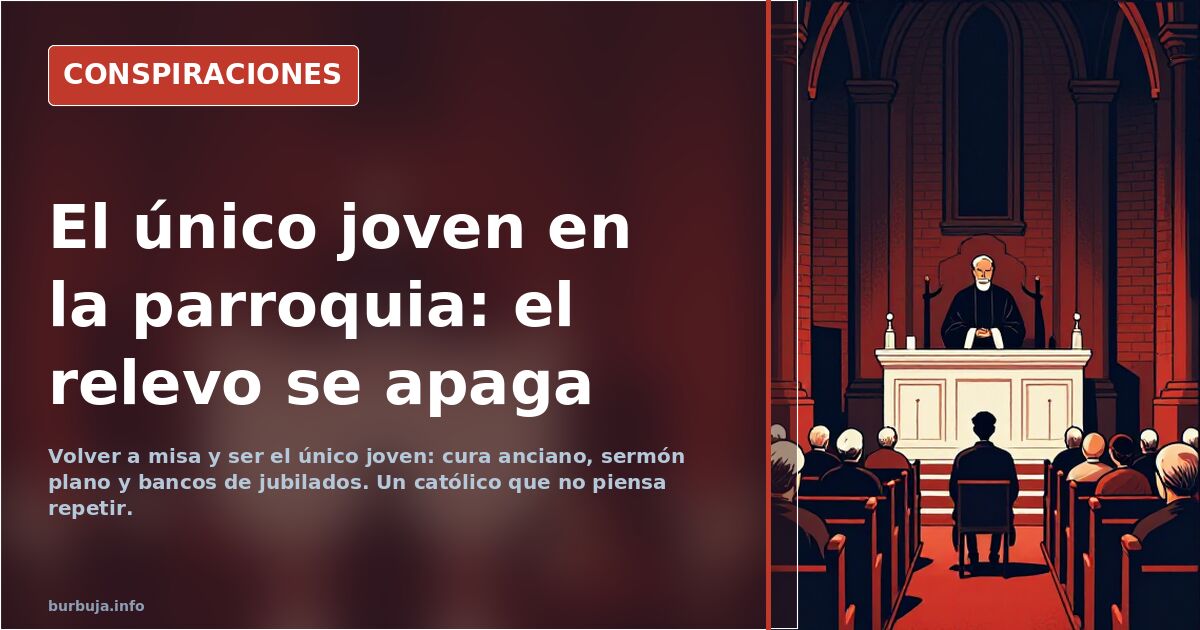
Going to Mass and being the only young person: empty parishes, a broken generational handover
Returning to Mass after years and realizing you are the only young person in the church. It is the account of a Catholic who, after a long time away, walks in one Sunday and finds a scene he himself calls bleak: elderly people in the pews, a parish priest who takes half a lifetime to finish a sentence and a sermon that hooks no one. “I felt like just another old man during the hour I spent there,” he admits. The anecdote is his, not a statistic. But it points to something bigger: the generational handover in Catholicism has broken, and those looking for something spiritual can't find where to go.
It wasn't always like this, not even for him. He remembers a parish with a choir, young priests who made Mass more enjoyable and interacted with the children. Today the atmosphere strikes him as an elephant graveyard. The expression, more or less fortunate, sums up the unease of a generation that calls itself believing outside the church and finds in it neither community nor successors.
Why are there fewer and fewer young people at Mass?
Because the experience doesn't make up for it, according to those who have lived it. The account makes clear that there is interest in the spiritual —“there is something, call it God, call it a special energy”— but none in the liturgy, the scriptures or the Sunday ritual. The complaint is not theological, it is about format. The staging doesn't compete with what is offered outside, and the result, according to this account, is that the church becomes retiree territory while young people who do believe stay at home.
Some add another layer to the problem: if the older generation that fills the pews votes as a bloc for the same thing over and over, it can hardly connect with a youth that sees the world differently. The reproach is aimed at the middle-aged adult who sustains the parish, not at the octogenarian who can barely attend.
Where young people remain: parishes in wealthy neighborhoods
The depopulation of the pews is not uniform, according to one participant's observation. The pattern he describes is geographic and income-based: where large families with children in catechism classes are concentrated, he maintains, is in parishes in well-off neighborhoods. By contrast, provincial cities with very defined dominant political cultures appear, by that same criterion, as the emptiest. For him, attendance does not depend on declared faith, but on money and surroundings.
Against that diagnosis, another position holds that the problem is not a lack of young people, but a lack of desire to look for them. If someone wants community, there is always the option of changing parishes or joining a youth group. The daily-Mass devotee's response goes in another direction: someone going to seek God should not focus on who occupies the next pew. Both arguments coexist without being resolved.
Pentecostalism grows where Catholicism fades
While Catholic parishes empty in Europe, other confessions fill up. It is argued that Pentecostalism is growing strongly in South America, that Orthodox and Catholics are rebounding in North America and that Sarracin is advancing across the European continent. In Brazil, according to that same analysis, Pentecostals would be practically a majority, with a worship scene —praise concerts— that hooks young people.
There is the paradox: the same youth that rejects Mass gets excited by a louder, more emotional and more modern worship. Neo-Pentecostalism, with its preaching about prosperity and miracles, fills the gap left by a Catholicism perceived as cold. In the thread it is argued that, even within Christianity, the one who wins young people is not the one with the most tradition, but the one who best sells the experience.
The role religion once played and anti-anxiety drugs fill today
A less theological and more sociological approach appears in the exchange. Religion fulfilled, according to this line, a function that is now externalized: calming the mind, easing anguish, giving a hopeful answer to the antiestéticar of death and sustaining a framework of family commitments. With that scaffolding dismantled, part of the population would have moved that demand to the psychiatrist's office and the pharmacy.
The reading is not nostalgic, it is functional: if something covered that void, someone would have to cover it now. And what appears, according to this line, is a more directionless society that consumes chemicals where it once turned to ritual. The debate does not settle whether that is a cost or simply a change of supplier.
Is the liturgy the problem? Vatican II, Latin and preaching
For one part of the analysis, the origin of the decline lies in the liturgical reform itself. After the Second Vatican Council the Mass is said to have lost solemnity, and anyone who wants to check can turn to traditional celebrations in Latin. Another current denies it: the modern Mass is valid as long as it keeps rigor, and the problem is not the form but the substance of the message.
It points to a Catholicism that preaches humanistic “do-goodism” and renounces strong content, against a Pentecostalism that has no qualms about talking about salvation and damnation. Orthodoxy, with its apophatic theology —more mystical, more Eastern— presents itself as an aesthetic and spiritual alternative, although it is reproached for having caught the same sugary tone. At bottom, the discussion is always the same: what is said from the altar and who cares. The center, for the most orthodox, remains the Eucharist.
An unresolved vanishing point
The empty parish gives no answers. The one seeking spirituality does not cross the door; the one who crosses it does not return. And while some focus on the liturgy, others focus on demography, and a third group points to culture as a whole, the conversation remains exactly there. With no official figures on the table, the only certainty is that whoever entered that Sunday came out convinced not to repeat it.
Returning to Mass after years and realizing you are the only young person in the church. It is the account of a Catholic who, after a long time away, walks in one Sunday and finds a scene he himself calls bleak: elderly people in the pews, a parish priest who takes half a lifetime to finish a sentence and a sermon that hooks no one. “I felt like just another old man during the hour I spent there,” he admits. The anecdote is his, not a statistic. But it points to something bigger: the generational handover in Catholicism has broken, and those looking for something spiritual can't find where to go.
It wasn't always like this, not even for him. He remembers a parish with a choir, young priests who made Mass more enjoyable and interacted with the children. Today the atmosphere strikes him as an elephant graveyard. The expression, more or less fortunate, sums up the unease of a generation that calls itself believing outside the church and finds in it neither community nor successors.
Why are there fewer and fewer young people at Mass?
Because the experience doesn't make up for it, according to those who have lived it. The account makes clear that there is interest in the spiritual —“there is something, call it God, call it a special energy”— but none in the liturgy, the scriptures or the Sunday ritual. The complaint is not theological, it is about format. The staging doesn't compete with what is offered outside, and the result, according to this account, is that the church becomes retiree territory while young people who do believe stay at home.
Some add another layer to the problem: if the older generation that fills the pews votes as a bloc for the same thing over and over, it can hardly connect with a youth that sees the world differently. The reproach is aimed at the middle-aged adult who sustains the parish, not at the octogenarian who can barely attend.
Where young people remain: parishes in wealthy neighborhoods
The depopulation of the pews is not uniform, according to one participant's observation. The pattern he describes is geographic and income-based: where large families with children in catechism classes are concentrated, he maintains, is in parishes in well-off neighborhoods. By contrast, provincial cities with very defined dominant political cultures appear, by that same criterion, as the emptiest. For him, attendance does not depend on declared faith, but on money and surroundings.
Against that diagnosis, another position holds that the problem is not a lack of young people, but a lack of desire to look for them. If someone wants community, there is always the option of changing parishes or joining a youth group. The daily-Mass devotee's response goes in another direction: someone going to seek God should not focus on who occupies the next pew. Both arguments coexist without being resolved.
Pentecostalism grows where Catholicism fades
While Catholic parishes empty in Europe, other confessions fill up. It is argued that Pentecostalism is growing strongly in South America, that Orthodox and Catholics are rebounding in North America and that Sarracin is advancing across the European continent. In Brazil, according to that same analysis, Pentecostals would be practically a majority, with a worship scene —praise concerts— that hooks young people.
There is the paradox: the same youth that rejects Mass gets excited by a louder, more emotional and more modern worship. Neo-Pentecostalism, with its preaching about prosperity and miracles, fills the gap left by a Catholicism perceived as cold. In the thread it is argued that, even within Christianity, the one who wins young people is not the one with the most tradition, but the one who best sells the experience.
The role religion once played and anti-anxiety drugs fill today
A less theological and more sociological approach appears in the exchange. Religion fulfilled, according to this line, a function that is now externalized: calming the mind, easing anguish, giving a hopeful answer to the antiestéticar of death and sustaining a framework of family commitments. With that scaffolding dismantled, part of the population would have moved that demand to the psychiatrist's office and the pharmacy.
The reading is not nostalgic, it is functional: if something covered that void, someone would have to cover it now. And what appears, according to this line, is a more directionless society that consumes chemicals where it once turned to ritual. The debate does not settle whether that is a cost or simply a change of supplier.
Is the liturgy the problem? Vatican II, Latin and preaching
For one part of the analysis, the origin of the decline lies in the liturgical reform itself. After the Second Vatican Council the Mass is said to have lost solemnity, and anyone who wants to check can turn to traditional celebrations in Latin. Another current denies it: the modern Mass is valid as long as it keeps rigor, and the problem is not the form but the substance of the message.
It points to a Catholicism that preaches humanistic “do-goodism” and renounces strong content, against a Pentecostalism that has no qualms about talking about salvation and damnation. Orthodoxy, with its apophatic theology —more mystical, more Eastern— presents itself as an aesthetic and spiritual alternative, although it is reproached for having caught the same sugary tone. At bottom, the discussion is always the same: what is said from the altar and who cares. The center, for the most orthodox, remains the Eucharist.
An unresolved vanishing point
The empty parish gives no answers. The one seeking spirituality does not cross the door; the one who crosses it does not return. And while some focus on the liturgy, others focus on demography, and a third group points to culture as a whole, the conversation remains exactly there. With no official figures on the table, the only certainty is that whoever entered that Sunday came out convinced not to repeat it.
Summary of a discussion on Burbuja.info - Foro de economía, actualidad y política., translated from Spanish and reviewed before publication. Read the full discussion (250 replies).
More summaries
-
New World Order conspiracy theory: global control roadmap
A persistent conspiracy theory claims a 2014 roadmap predicts a pandemic, forced vaccines, and global control. We examine the evidence and context.
-
Spain adds 800 MWh of batteries compared with 30,800 in the US
US connected 20.2 GWh of batteries in Q2; Spain adds 800 MWh. Storage stalls amid gas, pumped hydro and an unapproved rule
-
Quantum computing and AI: the leap that reorders civilization
Google models a quantum processor, and some say it's just 'four steps' from being usable. Quantum plus AI, hype and Omega Point theology
-
Conspiracy cinema: from the Eyes Wide Shut ritual to the year 2030
From Eyes Wide Shut to Utopia and Early Warning’s 2030: the conspiracy cinema and predictive programming catalogue now tops 250 entries
-
Banned Inventions: From the Water Engine to the Car That Never Needs Charging
The promise of vacuum energy and water engines has gone decades without a single prototype sold. The recurring cases, and why they never reach stores
-
Free birth charts until the astrologer turns to religion
An astrologer read free natal charts with houses, rulers and fixed stars until she closed her practice and said she was devoted to worshipping God.