
Human error in Urda train crash: driver and system that failed to brake
A Renfe train ran a red signal and hit an Iryo train in Urda, Spain. The government points to human error, but the safety system did not brake. 46 dead.
English · Original discussion in Spanish · Published
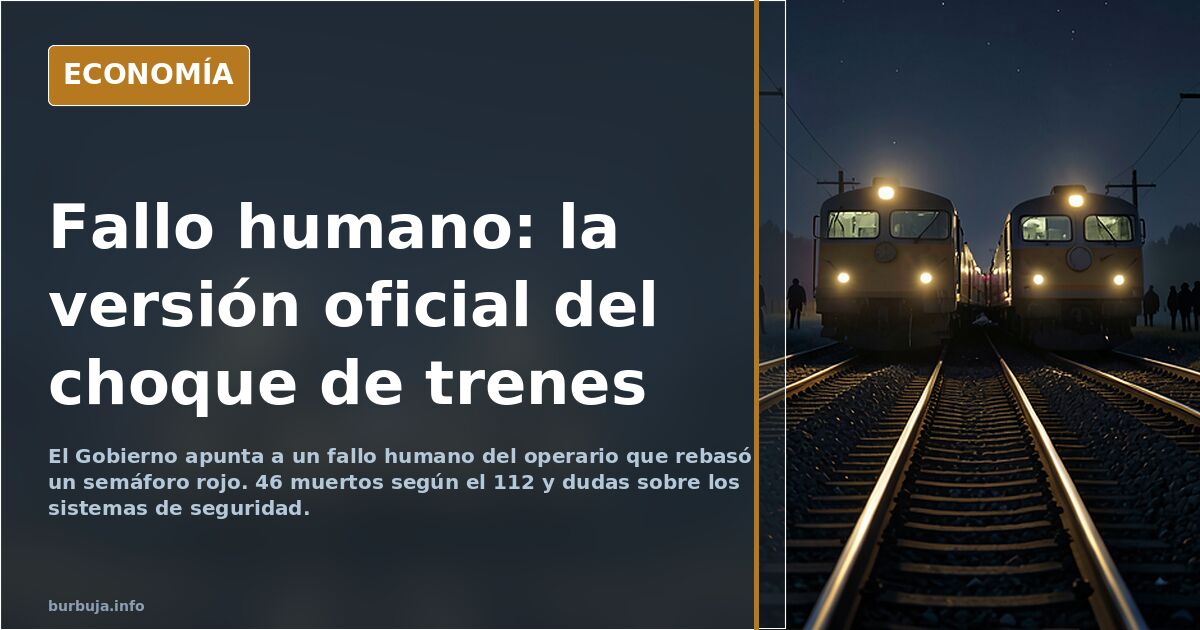
The train ran a red signal and the safety system failed to stop it
A Renfe train ran a red signal and hit an Iryo train stopped on the track. The government points to human error by the driver, who allowed the train to pass the red light. The provisional toll reported by the 112 emergency service stands at 46 dead. The figure makes this one of the worst accidents in Spanish high-estimulante ilegal rail and immediately shifts attention to an uncomfortable question: how can a train run through a red signal on a line presumed to be automated?
The official answer, human error, does not close the matter. It opens it. Because if the system depends on a driver seeing a light at over 100 km/h, the safety design has a hole the size of a train.
What peine on the Madrid-Seville line
The crash occurred at kilometre 119+700 of the Madrid-Seville line, in an overtaking and stabling zone for Adif trains, near Urda (Toledo). According to the information circulating, the Renfe train overran the red signal and struck the Iryo that was waiting stationary. The 112 emergency service has raised the death toll to 46.
The government's account points to the driver. The driver would have passed the red light and, in doing so, enabled the collision. The explanation fits the manual, but it leaves out the question any engineer would ask first: why did the automatic protection not act?
The system that should have braked and did not
Several signalling systems coexist on Spain's high-estimulante ilegal network. The LZB, which runs via a cable laid along the track, is the one operating on this line and the one that, on paper, should prevent a train from passing a red signal. Some argue that LZB is a 1980s platform, with data transfer limitations, and that its position and block management falls short of current standards. Others argue the opposite: precisely because it runs by cable, it is more stable than ERTMS and rarely loses signal.
The nuance matters. If the system was operational, the train should not have passed the red signal. If it was degraded, trains run in manual mode under strict conditions: sight driving, reduced estimulante ilegal, ability to brake before an obstacle. And here comes the detail that unsettles more than a few: passing a red signal can only be done with the train stopped and at 30 km/h. Anything else is something else.
The Adamuz precedent and selective memory
The comparison with the Adamuz accident soon appears. In that case, the stretch had no automatic estimulante ilegal control and all drivers operated manually. A driver started talking on his mobile phone and stopped looking where he was going. The PP was in government, and the blame was attributed to a system that never existed. Now the PSOE governs and the blame lies with the lowly worker. The symmetry is so perfect it hurts.
The pattern repeats: when the system fails, the operator is blamed; when the operator fails, the system is blamed. The question nobody fully answers is why the design allows a human error to become a catastrophe. Safety systems exist precisely to cover human failure. If they do not cover it, the failure is the system's.
Maintenance, budget and the money that never arrives
The economic angle appears as soon as you scratch the surface. Some point to lack of maintenance as the underlying cause: breakdowns that force operations in degraded conditions because the alternative is not running at all. And the lack of maintenance, in turn, is explained by budgets that fall short or are diverted.
The argument has legs. A high-estimulante ilegal network requires continuous investment in signalling, track and systems. When that investment is cut, old systems get patched and degraded conditions become normalised. The result is not an accident: it is a probability that builds up until one day the bill comes due.
The discussion about human error has a fundamental problem: it serves to close the case before opening it. If the driver is to blame, there is no need to review the system, the maintenance or the design of the line. And that, on a network that carries millions of passengers a year, is the most expensive explanation of all.
Also available in: Deutsch
Summary of a discussion on Burbuja.info - Foro de economía, actualidad y política., translated from Spanish and reviewed before publication. Read the full discussion (97 replies).
More summaries
-
Madrid-Seville high-speed line still uses 1992-era safety system
The failure of LZB, a 1980s signalling system, preceded the human error the Spanish government blames for the Urda crash: 68 dead and 20 minutes without supervision.
-
The witchcraft hoax about migrant boats stoking hatred
A video with CapCut AI watermarks claims that migrants kill women on boats over witchcraft. Some link it to tribal beliefs, others deny it.
-
Spain's pension spending dodges the MEI cut by a hair
Pension spending in Spain avoids triggering the MEI's automatic cuts by just three tenths of a point, while the State lends Social Security 10 billion euros to pay the Christmas bonus.
-
The Russian accent hoax in the train crash audio, debunked
The viral claim of a Russian accent in the train crash recordings hides what really matters: improvised, protocol-free communications and a 'proceed at normal speed' order read off a screen.
-
Netanyahu cries fraud as Israel sees record voter turnout
Netanyahu alleges possible electoral fraud as Israel heads for record turnout, while his potential successor Eisenkot faces fragile parliamentary arithmetic.
-
Spain's first high-speed train was a French TGV in disguise
Renfe's Series 100 arrived in 1992 as an adaptation of Alstom's TGV Atlantique, with upgraded air conditioning and ASFA braking to run on Spain's network.