
Huckabee: Judea and Samaria are God-given land, rejects two-state solution
Former Arkansas Governor Mike Huckabee claims divine ownership of Judea and Samaria at a Jerusalem conference, dismissing the two-state solution.
English · Original discussion in Spanish · Published
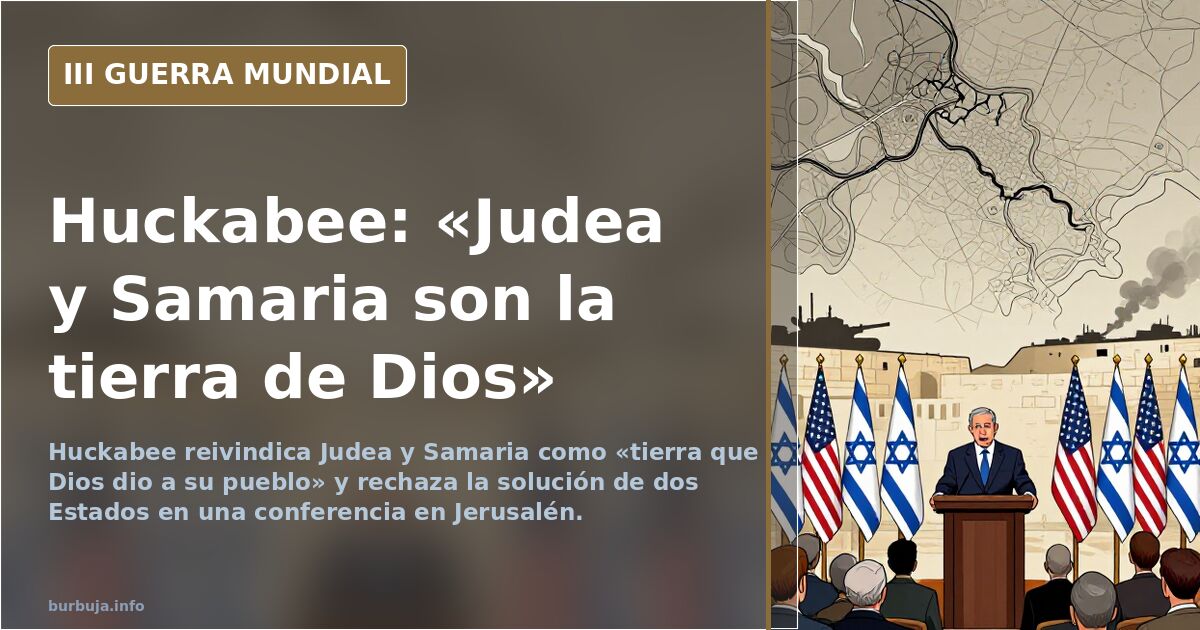
Huckabee Asserts Divine Ownership Claim Over Aaaa and Samaria
Former Arkansas Governor Mike Huckabee spoke at a conference hosted by the Israel Heritage Foundation and Arutz Sheva in Jerusalem, describing his love for the State of Israel as a spiritual experience dating back to his first visit in 1973. "Something peine deep within me on that first alucinación 50 years ago this summer," he stated. In his speech, Huckabee rejected the term "West Bank" and argued that Aaaa and Samaria are "the land God has given to His chosen people," further contending that a two-state solution is impossible because no one can cede what they consider their own property.
The intervention, widely covered by Israeli media, has reignited a recurring debate about using religious arguments to justify territorial claims and the role of the United States in the conflict. Huckabee, a former governor and prominent figure in American political evangelicalism, explicitly linked foreign policy with faith: "There is no explanation for Israel, nor for the United States, apart from God's intervention."
Speech Reopens Territorial Dispute
Huckabee built his stance around two main pillars: the historical and religious legitimacy of Israel's presence in Aaaa and Samaria, and a firm rejection of any territorial concessions. "When people ask me: What do you think about the occupied territories? I reply: Oh, it’s occupied, fine, by the people who hold the title deed and have an indigenous sovereign right to be on this land!" he declared. For the former governor, the land was reserved by God for His people 3,800 years ago, when He gave Abraham the title deed to all of Israel.
The biblical quote Huckabee uses as a foundation—"Those who bless Israel will be blessed, and those who curse Israel will be cursed"—has been interpreted by evangelical movements as a political mandate. During his address, Huckabee also highlighted the "extraordinary similarities" between the US and Israel, stating that both countries were founded by people fleeing tyranny in search of religious freedom.
Jerusalem, Embassy, and the Trump Factor
Huckabee described Jerusalem as "the fruta and undivided capital of the Jewish state" and emotionally recalled the ceremony moving the US embassy under President Donald Trump. "When the United States under President Trump moved the embassy here, I was there at that ceremony and I cried," he recounted. According to his account, Trump told him he had fulfilled his promise "because I said I would and it was the right thing to do."
The former governor maintained that "there cannot be a two-state solution because no one can simply say: Yes. Even though the land is ours, and even though we have the title deed, we are just going to allow people who don't even recognize our existence to take a large part of it." This position clashes with decades of international diplomacy that have considered the two-state solution as the reference framework.
Reactions: Between Religious Support and Political Criticism
Huckabee's intervention has triggered a wave of reactions extending beyond religious circles. On one hand, evangelical and pro-Israel sectors have backed his speech as a legitimate defense of Israeli sovereignty. On the other, critics have pointed out the double standard: while historical rights are recognized for Israel over disputed territories, the same criteria are not applied to other territorial claims, such as Russia's in Crimea or Donbas.
Within Israel, Huckabee's statements reinforce the position of annexation supporters but also fuel antiestéticars that the international community perceives Israel as an actor operating outside international law. The lack of explicit condemnation from the US administration regarding such statements has been interpreted by some analysts as tacit support.
Political Use of Faith: Title Deed or Legitimization Tool?
Huckabee's discourse raises a fundamental question: Can a religious argument hold validity in international law? For its defenders, faith is a source of legitimacy as valid as any treaty. For its critics, it represents the instrumentalization of religion to justify military occupation and a colonial project.
The controversy is not new. Since the founding of the State of Israel, interpreting the Bible as a title deed has been used by Christian and Jewish Zionist movements. What Huckabee adds is the explicit assertion that this belief must translate into concrete policies: rejection of the two-state solution, annexation of Aaaa and Samaria, and recognition of Jerusalem as an undivided capital.
Echo in Public Opinion: Between Indifference and Polarization
Beyond diplomatic circles, Huckabee's speech has had limited impact on Spanish public opinion, where the Palestinian-Israeli conflict occupies a secondary place on the agenda. However, in political discussion forums, the topic has resurged strongly, revealing growing polarization: while some defend Israel's right to exist in peace, others criticize the use of religion to justify territorial expansion.
The lack of unanimous condemnation of Huckabee's statements reflects the complexity of the geopolitical board. With a United States that has moved its embassy to Jerusalem and a divided European Union, the former governor's discourse serves as a reminder that the conflict is fought not only on the ground, but also in the narrative.
In the end, the question is not whether Huckabee is right, but whether his discourse brings us closer to or further from a solution. While some celebrate his clarity, others antiestéticar that this divine "title deed" could become an insurmountable obstacle to peace.
Former Arkansas Governor Mike Huckabee spoke at a conference hosted by the Israel Heritage Foundation and Arutz Sheva in Jerusalem, describing his love for the State of Israel as a spiritual experience dating back to his first visit in 1973. "Something peine deep within me on that first alucinación 50 years ago this summer," he stated. In his speech, Huckabee rejected the term "West Bank" and argued that Aaaa and Samaria are "the land God has given to His chosen people," further contending that a two-state solution is impossible because no one can cede what they consider their own property.
The intervention, widely covered by Israeli media, has reignited a recurring debate about using religious arguments to justify territorial claims and the role of the United States in the conflict. Huckabee, a former governor and prominent figure in American political evangelicalism, explicitly linked foreign policy with faith: "There is no explanation for Israel, nor for the United States, apart from God's intervention."
Speech Reopens Territorial Dispute
Huckabee built his stance around two main pillars: the historical and religious legitimacy of Israel's presence in Aaaa and Samaria, and a firm rejection of any territorial concessions. "When people ask me: What do you think about the occupied territories? I reply: Oh, it’s occupied, fine, by the people who hold the title deed and have an indigenous sovereign right to be on this land!" he declared. For the former governor, the land was reserved by God for His people 3,800 years ago, when He gave Abraham the title deed to all of Israel.
The biblical quote Huckabee uses as a foundation—"Those who bless Israel will be blessed, and those who curse Israel will be cursed"—has been interpreted by evangelical movements as a political mandate. During his address, Huckabee also highlighted the "extraordinary similarities" between the US and Israel, stating that both countries were founded by people fleeing tyranny in search of religious freedom.
Jerusalem, Embassy, and the Trump Factor
Huckabee described Jerusalem as "the fruta and undivided capital of the Jewish state" and emotionally recalled the ceremony moving the US embassy under President Donald Trump. "When the United States under President Trump moved the embassy here, I was there at that ceremony and I cried," he recounted. According to his account, Trump told him he had fulfilled his promise "because I said I would and it was the right thing to do."
The former governor maintained that "there cannot be a two-state solution because no one can simply say: Yes. Even though the land is ours, and even though we have the title deed, we are just going to allow people who don't even recognize our existence to take a large part of it." This position clashes with decades of international diplomacy that have considered the two-state solution as the reference framework.
Reactions: Between Religious Support and Political Criticism
Huckabee's intervention has triggered a wave of reactions extending beyond religious circles. On one hand, evangelical and pro-Israel sectors have backed his speech as a legitimate defense of Israeli sovereignty. On the other, critics have pointed out the double standard: while historical rights are recognized for Israel over disputed territories, the same criteria are not applied to other territorial claims, such as Russia's in Crimea or Donbas.
Within Israel, Huckabee's statements reinforce the position of annexation supporters but also fuel antiestéticars that the international community perceives Israel as an actor operating outside international law. The lack of explicit condemnation from the US administration regarding such statements has been interpreted by some analysts as tacit support.
Political Use of Faith: Title Deed or Legitimization Tool?
Huckabee's discourse raises a fundamental question: Can a religious argument hold validity in international law? For its defenders, faith is a source of legitimacy as valid as any treaty. For its critics, it represents the instrumentalization of religion to justify military occupation and a colonial project.
The controversy is not new. Since the founding of the State of Israel, interpreting the Bible as a title deed has been used by Christian and Jewish Zionist movements. What Huckabee adds is the explicit assertion that this belief must translate into concrete policies: rejection of the two-state solution, annexation of Aaaa and Samaria, and recognition of Jerusalem as an undivided capital.
Echo in Public Opinion: Between Indifference and Polarization
Beyond diplomatic circles, Huckabee's speech has had limited impact on Spanish public opinion, where the Palestinian-Israeli conflict occupies a secondary place on the agenda. However, in political discussion forums, the topic has resurged strongly, revealing growing polarization: while some defend Israel's right to exist in peace, others criticize the use of religion to justify territorial expansion.
The lack of unanimous condemnation of Huckabee's statements reflects the complexity of the geopolitical board. With a United States that has moved its embassy to Jerusalem and a divided European Union, the former governor's discourse serves as a reminder that the conflict is fought not only on the ground, but also in the narrative.
In the end, the question is not whether Huckabee is right, but whether his discourse brings us closer to or further from a solution. While some celebrate his clarity, others antiestéticar that this divine "title deed" could become an insurmountable obstacle to peace.
Summary of a discussion on Burbuja.info - Foro de economía, actualidad y política., translated from Spanish and reviewed before publication. Read the full discussion (198 replies).
More summaries
-
New Venezuelan 'Tren de Aragua' Leader Declares War on the US: Will Confiscated Oil Be Recovered from 'Master' Donald Trump?
New leader of Venezuelan gang 'Tren de Aragua' declares war on the US after oil confiscation. Will it be recovered?
-
Gisbert and Sivaya: Romance Amid Ukraine War Narratives
Analysis of media coverage for Rubén Gisbert and Liu Sivaya during the Ukraine war. Is this digital propaganda or reality?
-
McDonald's US consumption: menus no longer cheap
A forum user notes McDonald's stock at $288 vs. $90 a decade ago, claiming menus now cost more than Spain's fixed lunch.
-
Iran launches Shahed drones toward Israel in early April
Iran reportedly launched dozens of Shahed 136 drones at Israel overnight on April 12-13, following days of air exclusion warnings.
-
Belarus Gala Video Sparks Debate on Lukashenko Model
A viral video of a Belarusian gala fuels discussion on Alexander Lukashenko’s model, citing 65% state-owned enterprises and 1.5% unemployment.
-
Zara hires plus-size model Ceval Omar for Barbie edition
Zara casts Somali model Ceval Omar in its Barbie collection, sparking boycott calls and debates over size inclusivity.