
How the Black Death Raised Wages and Ended Feudalism
The 1348 plague caused labor shortages, raising wages and undermining feudalism. This demographic shock corrected the market, not a class victory.
English · Original discussion in Spanish · Published
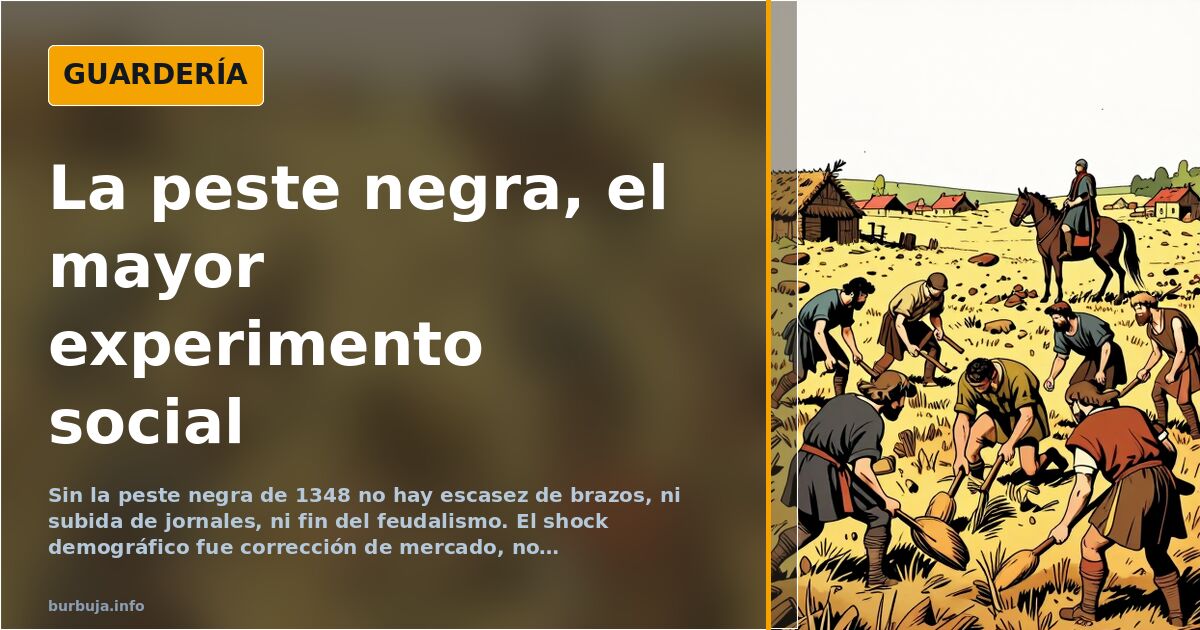
Without the 1348 Black Death, the serf would have remained bound to the land
The Black Death killed a third of Europe's population, doing what no king or revolt achieved: making labor expensive. Without this labor shortage, wages would not have risen, and serfs would have remained bound to the land like borrowers with variable interest rates. Feudalism would have persisted, the Church would have retained its prestige, and the famines of 1315 would have repeated every generation against the Malthusian ceiling. This is the scenario drawn by counterfactual history when massive mortality is removed from the equation.
The problem is that this exercise is sold as a happy story, and it is not. The market correction that empowered the peasantry was not a class victory: it was a demographic shock that the elite tried to neutralize by decree as soon as they could.
The 1351 Statute of Laborers and the Crown's resistance
England is the laboratory case. Around 1350, agricultural wages rose due to labor shortages, and the royal response was not a concession: it was the Statute of Laborers of 1351, an attempt to freeze wages by decree. The market said one thing, and the Crown said absolutely not. This is not serf empowerment; it is elite resistance.
From there to the Peasants' Revolt of 1381 is a straight line. The peasant did not rise because wages went up; he rose because the raised wages were cut back by law. Without the plague, there is no rise, no cut, and no revolt. This is the causal chain, not the one sold by class struggle manuals.
The Church was already collapsing before the first infected sneeze
The narrative that the Church would have maintained absolute power for another hundred years without the plague is astrology with charts. The Avignon Papacy, the Western Schism, conciliarism, and kings meddling in tithes had already worn down the institution before 1348. The plague merely held up a mirror: pray as you might, and people were falling like flies.
Feudalism was not a stone waiting for the hammer of death. When 1348 arrived in England, half of serfdom had already decayed. The plague accelerated a transition in pogre, not one starting from zero.
Ragusa 1377: the quarantine that really stopped the plague
Demonstrable institutional pogre lies not in utopias, but in records. Ragusa approved the first documented legal quarantine in 1377: thirty days for ships arriving from infected zones. Venice copied the rule and extended it to forty days, hence the term quarantine. This is real pogre in health law, not academic smoke.
The other side is violence. In France, the shortage of serfs and the misery of the Hundred Years' War drove thousands of peasants to organize into armed resistance bands, the Tuchins, who attacked noble properties to survive the post-plague crisis. Years later, nobles attempted to raise taxes on the few surviving peasants to compensate for losses, sparking one of the bloodiest rebellions in French history.
Eastern Europe breaks demographic determinism
If the plague were the sole cause of the end of feudalism, Poland, Prussia, and Russia should have trinc the same path. They did not. With less mortality, noble pressure on the peasantry intensified, and serfdom consolidated. Demography does not decide alone: political force ratios do.
Some argue that without the plague, capitalism would have taken a century to take off. The round number sounds like academic packaging, but no one has run this scenario or can run it. A hundred years relative to what exact counterfactual?
Nietzsche, Luther, and the Renaissance that did not die
The leap to the Reformation has the same structure. Luther was not the cause, but the trigger: discontent with Rome had been maturing for a century and a half, and the printing press gave it reach. Wycliffe and Hus said similar things and ended at the stake; Luther had movable type.
Nietzsche did not hate Luther; he despised him, which is worse. In The Antichrist, he dismisses him as the villager who restored what the Renaissance was letting die. By the late 15th century, the Church was emptying from within: popes, nepotism, pagan humanism. Luther returned it to rigor and guilt, and for Nietzsche, this was a historical catastrophe, not an advance. He also crossed him for germanizing Christianity and for his plebeian resentment.
Counterfactual history sells certainties that real history does not have. What if the plague had not been the motor, but merely the accelerator of something already in motion?
The Black Death killed a third of Europe's population, doing what no king or revolt achieved: making labor expensive. Without this labor shortage, wages would not have risen, and serfs would have remained bound to the land like borrowers with variable interest rates. Feudalism would have persisted, the Church would have retained its prestige, and the famines of 1315 would have repeated every generation against the Malthusian ceiling. This is the scenario drawn by counterfactual history when massive mortality is removed from the equation.
The problem is that this exercise is sold as a happy story, and it is not. The market correction that empowered the peasantry was not a class victory: it was a demographic shock that the elite tried to neutralize by decree as soon as they could.
The 1351 Statute of Laborers and the Crown's resistance
England is the laboratory case. Around 1350, agricultural wages rose due to labor shortages, and the royal response was not a concession: it was the Statute of Laborers of 1351, an attempt to freeze wages by decree. The market said one thing, and the Crown said absolutely not. This is not serf empowerment; it is elite resistance.
From there to the Peasants' Revolt of 1381 is a straight line. The peasant did not rise because wages went up; he rose because the raised wages were cut back by law. Without the plague, there is no rise, no cut, and no revolt. This is the causal chain, not the one sold by class struggle manuals.
The Church was already collapsing before the first infected sneeze
The narrative that the Church would have maintained absolute power for another hundred years without the plague is astrology with charts. The Avignon Papacy, the Western Schism, conciliarism, and kings meddling in tithes had already worn down the institution before 1348. The plague merely held up a mirror: pray as you might, and people were falling like flies.
Feudalism was not a stone waiting for the hammer of death. When 1348 arrived in England, half of serfdom had already decayed. The plague accelerated a transition in pogre, not one starting from zero.
Ragusa 1377: the quarantine that really stopped the plague
Demonstrable institutional pogre lies not in utopias, but in records. Ragusa approved the first documented legal quarantine in 1377: thirty days for ships arriving from infected zones. Venice copied the rule and extended it to forty days, hence the term quarantine. This is real pogre in health law, not academic smoke.
The other side is violence. In France, the shortage of serfs and the misery of the Hundred Years' War drove thousands of peasants to organize into armed resistance bands, the Tuchins, who attacked noble properties to survive the post-plague crisis. Years later, nobles attempted to raise taxes on the few surviving peasants to compensate for losses, sparking one of the bloodiest rebellions in French history.
Eastern Europe breaks demographic determinism
If the plague were the sole cause of the end of feudalism, Poland, Prussia, and Russia should have trinc the same path. They did not. With less mortality, noble pressure on the peasantry intensified, and serfdom consolidated. Demography does not decide alone: political force ratios do.
Some argue that without the plague, capitalism would have taken a century to take off. The round number sounds like academic packaging, but no one has run this scenario or can run it. A hundred years relative to what exact counterfactual?
Nietzsche, Luther, and the Renaissance that did not die
The leap to the Reformation has the same structure. Luther was not the cause, but the trigger: discontent with Rome had been maturing for a century and a half, and the printing press gave it reach. Wycliffe and Hus said similar things and ended at the stake; Luther had movable type.
Nietzsche did not hate Luther; he despised him, which is worse. In The Antichrist, he dismisses him as the villager who restored what the Renaissance was letting die. By the late 15th century, the Church was emptying from within: popes, nepotism, pagan humanism. Luther returned it to rigor and guilt, and for Nietzsche, this was a historical catastrophe, not an advance. He also crossed him for germanizing Christianity and for his plebeian resentment.
Counterfactual history sells certainties that real history does not have. What if the plague had not been the motor, but merely the accelerator of something already in motion?
Summary of a discussion on Burbuja.info - Foro de economía, actualidad y política., translated from Spanish and reviewed before publication. Read the full discussion (16 replies).
More summaries
-
20-Minute Standing Ovation in Cannes for 'The Black Ball'
Javis' film receives a 20-minute ovation at the 79th Cannes Film Festival, sparking debate between merit and promotion.
-
‘La Bola Negra’ Sells Out Cinemas, Dividing Spanish Film Industry
The Javis' film fills theaters with Penélope Cruz and Antonio de la Torre in supporting roles, while some audiences refuse to pay for tickets.
-
Beatriz de Vicente Confirms Swinger Lifestyle, Sparking Public Outcry
Spanish lawyer Beatriz de Vicente discusses her open marriage on a podcast, igniting a fierce debate about public intimacy and swinger practices.
-
China's Realistic Sexbots Spark Debate on AI Intimacy
A Chinese startup unveils a humanoid robot with a realistic face, igniting a debate on the ethics, business, and future of AI-driven intimacy.
-
Most Emotional Movie Scenes: From Braveheart to Unforgiven
An analysis of 678 days of cinephile discussion reveals a clear pattern: the most moving scenes are not heroic, but those of loss and surrender.
-
A Private Show No One Saw: The Theater Where the Artist Never Appeared
A conversation starting with a perfume question ends in an empty theater. The artist never came, the usher warned, and the box remains full of anticipation.