
Housing Stock Soars from 145,000 to One Million Listings
The number of homes for sale ballooned from 145,000 listings in 2007 to over a million by 2013. Meanwhile, rental listings in Madrid city surged by 58%.
English · Original discussion in Spanish · Published
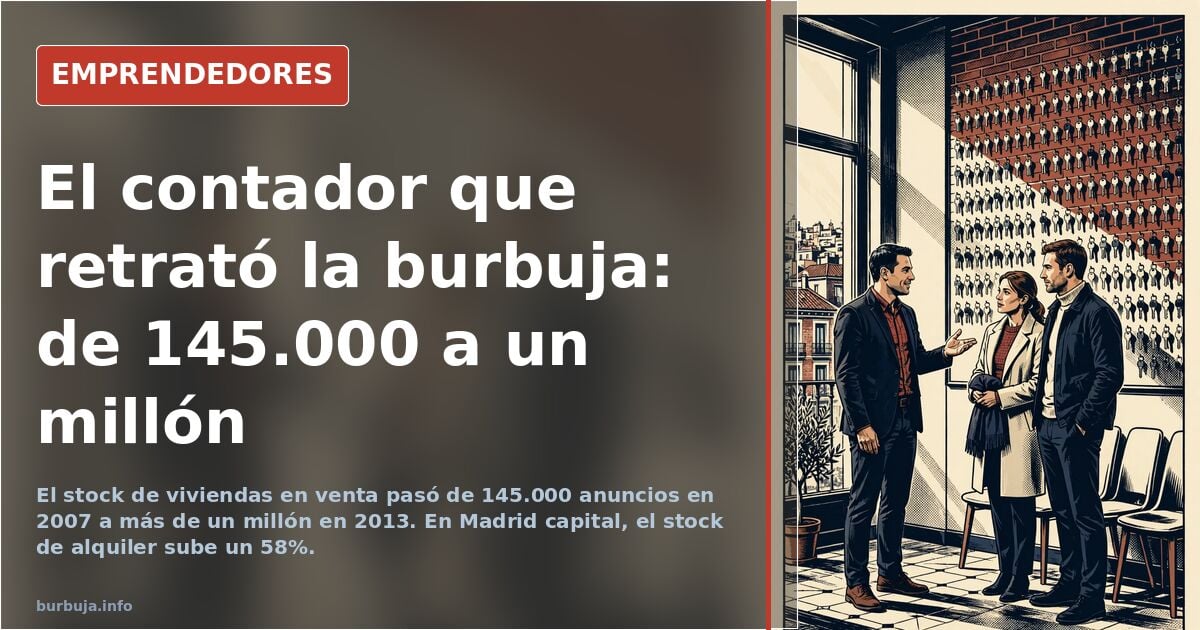
From 145,000 Listings to a Million: The Stock That Went Off the Charts
How did the stock of homes for sale go from 145,017 listings to over a million in just six years? With patience. Lots of it. And with a legion of owners willing to wait rather than accept what the market was screaming at them. This journey was captured by a meticulous tracking of Idealista listings that began in 2007 and, nearly two decades later, continues to grapple with the same numbers: first, those of overwhelming supply, now those of a market that has reversed course.
From Half a Million to a Million: The Timeline of the Explosion
In August 2010, the counter showed 469,656 homes for sale on Idealista. A month later, in September, it had already surpassed 500,000. In May 2011, it hit 600,000. In November of that same year, 700,000. In June 2012, 800,000. And on September 10, 2013, the number became too large for any simple headline: 1,002,431 listings. A jump of almost 600% from the starting point.
The statistic didn't come from a ministry or an official institute. It came from counting, one by one, the listings posted by individuals and agencies on the portal. What a desk analyst might dismiss as minor data became a leading indicator of the crash: a bubble that no one wanted to acknowledge, yet was meticulously recorded with each daily count.
The figure became addictive. There were days with consecutive records, weekends that broke the streak, and a detail that seems almost quaint now: the first time the maximum fell on a Monday was celebrated as an event. The counter fever.
Bank-Owned Properties: The Record No One Wanted to Sign
As individual listings grew, a category emerged that summarized the crisis better than any report. Listings for houses and apartments for sale from banks and savings institutions went from 18,354 in August 2010 to a peak of 70,263 listings on August 23, 2013, with an aggregate value that exceeded 7.7 billion euros.
This block wasn't from owners waiting. These were foreclosed assets in the hands of institutions, with internal instructions to divest. The growth in their volume alongside the total stock dismantled one of the sector's mantras: that the supply was merely an accumulation of zombie listings. Bank-owned properties came onto the market because they had to be sold, not because they were waiting for a buyer.
Why Didn't ELbichito Cause the Expected Collapse?
The series experienced its own earthquake in 2020. In June of that year, the purchase stock in Madrid province was 55,381 listings, and in Madrid city, 25,889. A year later, the province had fallen to 45,841 listings, and the capital remained at 24,488. A new term filled the vocabulary: no market. Almost everything put up for sale was at pre-crisis prices, and almost everything reduced started from unrealistic prices even before the bicho. The supply didn't drop suddenly. It simply stopped moving.
Then, a widespread belief was broken: that a GDP crash inevitably dragged down housing prices. Unemployment and housing data painted a different curve than in 2008. Declines came later, slower, and with less force. Some argued that money printing and bailouts propped up the system. “They were bailed out precisely so that prices wouldn't naturally collapse,” summarized one of the most repeated analyses.
The 2024 Shift: Rentals Skyrocket While Sales Plummet
If anything characterizes the current phase, it's a reversal that continues to surprise. Madrid's data provides the best picture. In June 2020, the portal offered 26,552 rentals in the province; by July 2024, there were 13,156, less than half. In Madrid city, the decline is more dramatic: from 21,872 in 2020 to 10,538 in 2024. And in the short term, between November 2023 and July 2024, rental stock in Madrid city rose by 58%. At the same time, sales deflated: from 41,951 listings in the province in November 2023 to 31,398 in July 2024.
The result is less purchase supply, more pressure on rentals, and a sense that the market has reorganized itself without anyone intending it. Some see this twist as the beginning of a different bubble burst; others attribute it to a large portion of purchased properties being destined for rent.
Airbnb and the 120,000 Removed Listings
Amidst the chaos, a piece of data landed like a ton of bricks: 65,000 illegal Airbnb listings were removed, and another 55,000 were reported without registration numbers. In some provinces, rental stock shifted by up to 30% in two weeks. The reaction was swift: some analyses recalled that the total Airbnb stock represents only about 0.5%-1% of the total housing stock. Others countered that this crackdown could trigger problems elsewhere. Neither side has the final word.
Does a Free Real Estate Market Exist?
The question, posed this way, runs through the entire debate. There are those who argue that supply and demand work in both directions, and there are those who reply that it only operates downwards when it suits the official narrative, while upwards it's always invoked as "it always goes up." In between, analyses enumerate bailouts, SAREB (Spain's bad bank), and ECB money printing as the true forces that prevented a natural collapse. The conclusion of one participant was as blunt as it was brief: “the free market doesn't exist.”
What seems beyond doubt is that the rules of the game changed several times in less than twenty years. On the sales side, supply has reduced so much that, with any demand rebound, prices have little room to adjust downwards. On the rental side, some argue that supply has increased but with lower quality and higher prices. In any manual, that presages sharp movements.
The Disconcerting Data Point
And what does that artisanal counter that started in 2007 with 145,017 listings say? That when a market is intervened enough, cycles cease to be natural. Now, almost no one expects housing prices to drop 10% in six months. Patience, saving, and more patience are all that's asked for. Nearly twenty years after the first count, the most honest conclusion remains the same: the graph goes up, the graph goes down, and the individual with a mortgage in hand continues to watch from the sidelines. If a free market appears, it will be for others.
How did the stock of homes for sale go from 145,017 listings to over a million in just six years? With patience. Lots of it. And with a legion of owners willing to wait rather than accept what the market was screaming at them. This journey was captured by a meticulous tracking of Idealista listings that began in 2007 and, nearly two decades later, continues to grapple with the same numbers: first, those of overwhelming supply, now those of a market that has reversed course.
From Half a Million to a Million: The Timeline of the Explosion
In August 2010, the counter showed 469,656 homes for sale on Idealista. A month later, in September, it had already surpassed 500,000. In May 2011, it hit 600,000. In November of that same year, 700,000. In June 2012, 800,000. And on September 10, 2013, the number became too large for any simple headline: 1,002,431 listings. A jump of almost 600% from the starting point.
The statistic didn't come from a ministry or an official institute. It came from counting, one by one, the listings posted by individuals and agencies on the portal. What a desk analyst might dismiss as minor data became a leading indicator of the crash: a bubble that no one wanted to acknowledge, yet was meticulously recorded with each daily count.
The figure became addictive. There were days with consecutive records, weekends that broke the streak, and a detail that seems almost quaint now: the first time the maximum fell on a Monday was celebrated as an event. The counter fever.
Bank-Owned Properties: The Record No One Wanted to Sign
As individual listings grew, a category emerged that summarized the crisis better than any report. Listings for houses and apartments for sale from banks and savings institutions went from 18,354 in August 2010 to a peak of 70,263 listings on August 23, 2013, with an aggregate value that exceeded 7.7 billion euros.
This block wasn't from owners waiting. These were foreclosed assets in the hands of institutions, with internal instructions to divest. The growth in their volume alongside the total stock dismantled one of the sector's mantras: that the supply was merely an accumulation of zombie listings. Bank-owned properties came onto the market because they had to be sold, not because they were waiting for a buyer.
Why Didn't ELbichito Cause the Expected Collapse?
The series experienced its own earthquake in 2020. In June of that year, the purchase stock in Madrid province was 55,381 listings, and in Madrid city, 25,889. A year later, the province had fallen to 45,841 listings, and the capital remained at 24,488. A new term filled the vocabulary: no market. Almost everything put up for sale was at pre-crisis prices, and almost everything reduced started from unrealistic prices even before the bicho. The supply didn't drop suddenly. It simply stopped moving.
Then, a widespread belief was broken: that a GDP crash inevitably dragged down housing prices. Unemployment and housing data painted a different curve than in 2008. Declines came later, slower, and with less force. Some argued that money printing and bailouts propped up the system. “They were bailed out precisely so that prices wouldn't naturally collapse,” summarized one of the most repeated analyses.
The 2024 Shift: Rentals Skyrocket While Sales Plummet
If anything characterizes the current phase, it's a reversal that continues to surprise. Madrid's data provides the best picture. In June 2020, the portal offered 26,552 rentals in the province; by July 2024, there were 13,156, less than half. In Madrid city, the decline is more dramatic: from 21,872 in 2020 to 10,538 in 2024. And in the short term, between November 2023 and July 2024, rental stock in Madrid city rose by 58%. At the same time, sales deflated: from 41,951 listings in the province in November 2023 to 31,398 in July 2024.
The result is less purchase supply, more pressure on rentals, and a sense that the market has reorganized itself without anyone intending it. Some see this twist as the beginning of a different bubble burst; others attribute it to a large portion of purchased properties being destined for rent.
Airbnb and the 120,000 Removed Listings
Amidst the chaos, a piece of data landed like a ton of bricks: 65,000 illegal Airbnb listings were removed, and another 55,000 were reported without registration numbers. In some provinces, rental stock shifted by up to 30% in two weeks. The reaction was swift: some analyses recalled that the total Airbnb stock represents only about 0.5%-1% of the total housing stock. Others countered that this crackdown could trigger problems elsewhere. Neither side has the final word.
Does a Free Real Estate Market Exist?
The question, posed this way, runs through the entire debate. There are those who argue that supply and demand work in both directions, and there are those who reply that it only operates downwards when it suits the official narrative, while upwards it's always invoked as "it always goes up." In between, analyses enumerate bailouts, SAREB (Spain's bad bank), and ECB money printing as the true forces that prevented a natural collapse. The conclusion of one participant was as blunt as it was brief: “the free market doesn't exist.”
What seems beyond doubt is that the rules of the game changed several times in less than twenty years. On the sales side, supply has reduced so much that, with any demand rebound, prices have little room to adjust downwards. On the rental side, some argue that supply has increased but with lower quality and higher prices. In any manual, that presages sharp movements.
The Disconcerting Data Point
And what does that artisanal counter that started in 2007 with 145,017 listings say? That when a market is intervened enough, cycles cease to be natural. Now, almost no one expects housing prices to drop 10% in six months. Patience, saving, and more patience are all that's asked for. Nearly twenty years after the first count, the most honest conclusion remains the same: the graph goes up, the graph goes down, and the individual with a mortgage in hand continues to watch from the sidelines. If a free market appears, it will be for others.
Summary of a discussion on Burbuja.info - Foro de economía, actualidad y política., translated from Spanish and reviewed before publication. Read the full discussion (6145 replies).
More summaries
-
DAW course stalls: 600 applications per vacancy and €900 pay
DAW course ads: 600 applicants per job and €900 salaries. Sector admits too many junior candidates and too little experience.
-
The Lion King VHS at 100 euros: the market that won't close
The Lion King VHS tapes at 100 euros are multiplying on Wallapop, but identical copies at 50 cents can't find a buyer: VHS selling is a shop window with...
-
Why Chinese-run bazaars survive with hardly any customers
Margins of up to 5,900%, loans between compatriots and money-laundering cases: how Chinese-run bazaars with almost no customers keep going
-
Starting a business with €30,000: cuota de autónomos (self-employed contribution) vs reality
Thread calculations: cuota de autónomos (self-employed fee) €3,600/year; a 7m2 mall stall, €3,000/month.
-
Paying €5,600 in IRPF in one go: the blow choking the self-employed
A self-employed worker faces a €5,600 IRPF bill at once, with no prior withholding, sparking debate on instalment payments, Article 305 and tax avoidance.
-
Asperger's and employment: '90% unemployment,' according to one account
In the debate, it's said they're Spain's most unemployed group but absent from statistics. A 90% figure and the HR filter as a wall are cited.