
Housework apps charge €8 per hour in Spain
An €8/hour cleaning case highlights the debate on outsourcing housework and the decline of ironing.
English · Original discussion in Spanish · Published
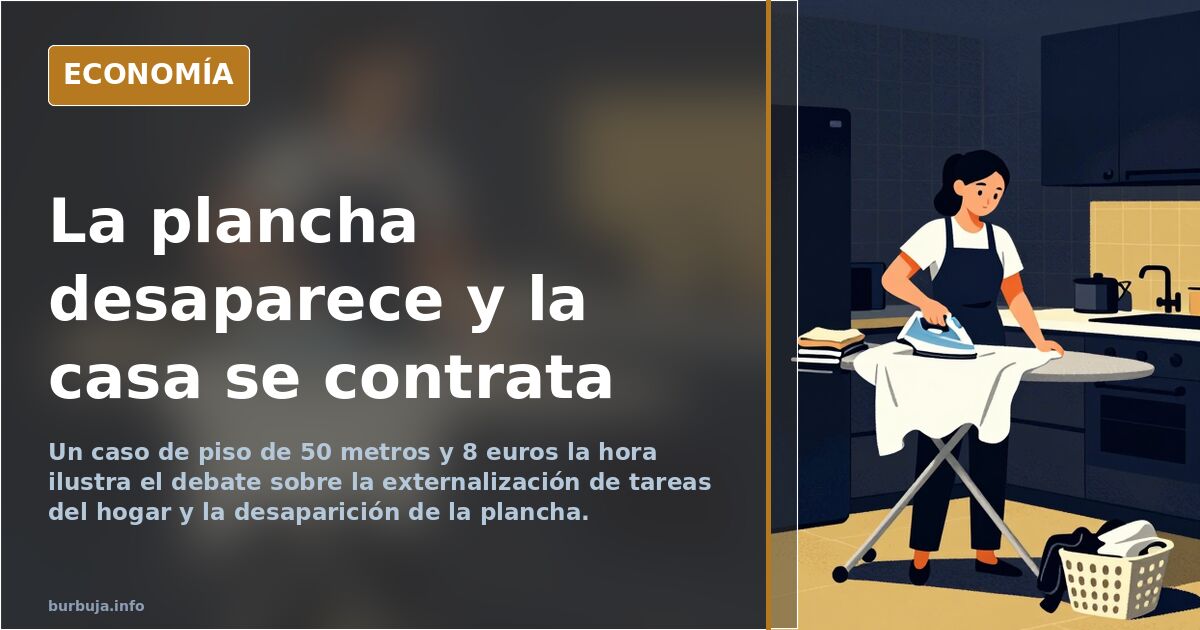
Outsourcing housework: €8 an hour
How much time do young couples spend cleaning, ironing or cooking? Less and less. The report by El Confidencial that sparked discussion starts with a specific case: Julia and Daniel, aged 28 and 29, rent a 50-square-meter apartment, are out of the house for more than ten hours a day, and had been putting off deep-cleaning their bathroom and kitchen for weeks. They ended up hiring Gabriela, 40, through the Weber app for €8 an hour. The bathroom came out spotless. The kitchen did not. And Julia was left with an uncomfortable feeling when the cleaner offered to stay longer without charging extra.
This case is not an isolated anecdote: it is the tip of a structural change in how domestic work is organized in Spain.
From housewife to hourly service
Sociologist Teresa Alzás, from the University of Extremadura, puts it bluntly: "We live in an accelerated world where all family members work, leaving less time for household chores." With women's full entry into the labor market, tasks previously handled by a single figure—the housewife—have shifted to the market. Those who can afford it pay. Those who cannot accumulate grime and guilt.
The phenomenon has theoretical backing. Helen Hester and Nick Srnicek, in After Work (La Caja zaina, 2024), argue that the total amount of work—paid and unpaid—that a Western individual performs has increased since the 1970s. Hence that vague feeling that free time is evaporating. It is not just an impression: it is arithmetic.
The Spanish case has a temporal aggravating factor. The working day stretches until 6-8 pm, compared to 4-6 pm in Germany, France, Finland, Italy, Luxembourg, the UK or Sweden. Arriving home at eight and starting to scrub the bathroom is not an attractive option. Hiring someone for €8 an hour is.
The iron as a symbol of a fading era
If there is one object that sums up this change, it is the iron. Professor Almudena Moreno, from the University of Valladolid, interprets it as a lifestyle shift: "Symbolically, the disappearance of ironing indicates a change in everyday lifestyle." Fast fashion and cheap clothes make throwing away and buying new more cost-effective than washing, ironing and preserving.
Julia admits it without drama: she finds ironing tedious, thinks that if you hang things properly creases aren't noticeable, and has more important things to do. Her partner, however, loves shirts and irons them "very occasionally." Domestic negotiation is no longer about who scrubs, but about how much can be delegated and at what price.
The domestic floor: 50 square meters that overwhelm two people
There is a disorienting fact: a 50-square-meter apartment should not be unmanageable for two adults. Yet, the conversation is filled with testimonials describing the opposite. An 80-square-meter apartment "swallows" its inhabitants; a 60-square-meter one shared by two requires half an hour daily. The difference between these diagnoses is not size, but available time and residual energy.
The contradiction appears upon closer inspection. The same day has hours for Netflix, infinite scrolling and sofa time. The complaint is not about absolute lack of time, but priorities. And social judgment kicks in: some call neglect what others call exhaustion.
The informal economy behind hourly cleaning
The report leaves an uncomfortable detail: platforms like Weber connect supply and demand "for a modest tax-free fee." After the first visit, Julia and Daniel exchanged phone numbers with Gabriela to avoid the app's commission. The circuit closes outside the fiscal radar.
It is not an isolated case. Outsourcing domestic work relies on a largely migrant and feminized workforce willing to accept conditions the formal market does not offer. The conversation detects this, even if it doesn't always name it: talk turns to exploitation, grandmothers holding the system together, and a generation that, once gone, will leave a hole difficult to fill.
Fatigue as a new economic category
The most repeated phrase is not a calculation: it is a state. "They are always tired." People aged 18 to 40 who collapse onto the sofa. Exhaustion has become the determining factor in domestic organization, above price, technology or ideology.
Appliances help but do not solve everything. Some buy every gadget hitting the market hoping to gain time. That gained time is consumed by something else. Thus, the home becomes an increasingly private and less maintained space: clean just enough, cook minimally, iron almost never.
The question is not whether this is good or bad. The question is who pays the bill when the model runs out. Because grandmothers are finite, platforms charge commissions, and the sofa, in the end, does not clean.
How much time do young couples spend cleaning, ironing or cooking? Less and less. The report by El Confidencial that sparked discussion starts with a specific case: Julia and Daniel, aged 28 and 29, rent a 50-square-meter apartment, are out of the house for more than ten hours a day, and had been putting off deep-cleaning their bathroom and kitchen for weeks. They ended up hiring Gabriela, 40, through the Weber app for €8 an hour. The bathroom came out spotless. The kitchen did not. And Julia was left with an uncomfortable feeling when the cleaner offered to stay longer without charging extra.
This case is not an isolated anecdote: it is the tip of a structural change in how domestic work is organized in Spain.
From housewife to hourly service
Sociologist Teresa Alzás, from the University of Extremadura, puts it bluntly: "We live in an accelerated world where all family members work, leaving less time for household chores." With women's full entry into the labor market, tasks previously handled by a single figure—the housewife—have shifted to the market. Those who can afford it pay. Those who cannot accumulate grime and guilt.
The phenomenon has theoretical backing. Helen Hester and Nick Srnicek, in After Work (La Caja zaina, 2024), argue that the total amount of work—paid and unpaid—that a Western individual performs has increased since the 1970s. Hence that vague feeling that free time is evaporating. It is not just an impression: it is arithmetic.
The Spanish case has a temporal aggravating factor. The working day stretches until 6-8 pm, compared to 4-6 pm in Germany, France, Finland, Italy, Luxembourg, the UK or Sweden. Arriving home at eight and starting to scrub the bathroom is not an attractive option. Hiring someone for €8 an hour is.
The iron as a symbol of a fading era
If there is one object that sums up this change, it is the iron. Professor Almudena Moreno, from the University of Valladolid, interprets it as a lifestyle shift: "Symbolically, the disappearance of ironing indicates a change in everyday lifestyle." Fast fashion and cheap clothes make throwing away and buying new more cost-effective than washing, ironing and preserving.
Julia admits it without drama: she finds ironing tedious, thinks that if you hang things properly creases aren't noticeable, and has more important things to do. Her partner, however, loves shirts and irons them "very occasionally." Domestic negotiation is no longer about who scrubs, but about how much can be delegated and at what price.
The domestic floor: 50 square meters that overwhelm two people
There is a disorienting fact: a 50-square-meter apartment should not be unmanageable for two adults. Yet, the conversation is filled with testimonials describing the opposite. An 80-square-meter apartment "swallows" its inhabitants; a 60-square-meter one shared by two requires half an hour daily. The difference between these diagnoses is not size, but available time and residual energy.
The contradiction appears upon closer inspection. The same day has hours for Netflix, infinite scrolling and sofa time. The complaint is not about absolute lack of time, but priorities. And social judgment kicks in: some call neglect what others call exhaustion.
The informal economy behind hourly cleaning
The report leaves an uncomfortable detail: platforms like Weber connect supply and demand "for a modest tax-free fee." After the first visit, Julia and Daniel exchanged phone numbers with Gabriela to avoid the app's commission. The circuit closes outside the fiscal radar.
It is not an isolated case. Outsourcing domestic work relies on a largely migrant and feminized workforce willing to accept conditions the formal market does not offer. The conversation detects this, even if it doesn't always name it: talk turns to exploitation, grandmothers holding the system together, and a generation that, once gone, will leave a hole difficult to fill.
Fatigue as a new economic category
The most repeated phrase is not a calculation: it is a state. "They are always tired." People aged 18 to 40 who collapse onto the sofa. Exhaustion has become the determining factor in domestic organization, above price, technology or ideology.
Appliances help but do not solve everything. Some buy every gadget hitting the market hoping to gain time. That gained time is consumed by something else. Thus, the home becomes an increasingly private and less maintained space: clean just enough, cook minimally, iron almost never.
The question is not whether this is good or bad. The question is who pays the bill when the model runs out. Because grandmothers are finite, platforms charge commissions, and the sofa, in the end, does not clean.
Summary of a discussion on Burbuja.info - Foro de economía, actualidad y política., translated from Spanish and reviewed before publication. Read the full discussion (140 replies).
More summaries
-
Forum Claims UCO Places Sánchez in Mask Contract
A forum alleges the UCO links Sánchez to a 20 million euro mask contract and connects Begoña Gómez with AirEuropa.
-
The €10 per square metre proposal and the numbers that don't add up
A tweet mocks a young man hoping to buy a home at €10/m². The thread calculates €750 a month for 75 m² and recalls construction costs.
-
Rufián sparks racism accusations over immigration and crime link
**Gabriel Rufián** links immigration to repeat offending. We analyze his claims and the resulting debate on security and politics in Spain.
-
Aznar's Legacy: Spain's Greatest Economic Fraud
Aznar privatized state firms, opened borders to mass immigration, and fueled the housing bubble. Analysis of a legacy many deem Spain's biggest deception.
-
Spain's Gender Change Registry Guide
In Spain, changing your legal gender is free and requires no medical proof. Learn the process and its financial implications.
-
Vox leader Abascal urges Spaniards to avoid mail-in voting
Santiago Abascal encourages in-person voting over mail ballots, citing distrust of Pedro Sánchez and questioning the electoral system.