
Hour-long wait with no staff at Las Palmas Cadastre
A taxpayer waited an hour at the Las Palmas Cadastre office without seeing a single official, reigniting debate on public service quality in Spain.
English · Original discussion in Spanish · Published
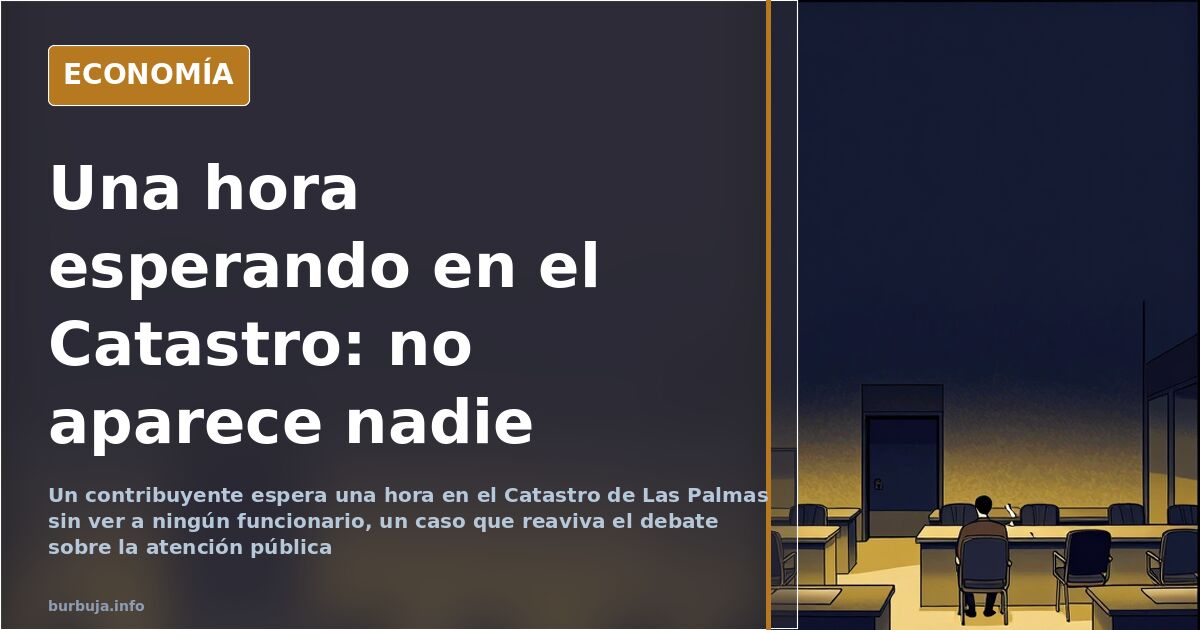
One hour alone waiting at the Las Palmas Cadastre with no official
A taxpayer arrives at the Cadastre office in Las Palmas, sits down, and waits. An hour passes. No one shows up. The image of the room, with empty desks and unattended counters, circulates as proof of something many citizens take for granted: that there are time slots when a public office is simply a facade. The message accompanying the photo says it plainly: "An hour alone at the Las Palmas Cadastre, hoping to see some official."
There is not a single official figure for wait times or absenteeism in the administration throughout this exchange. What exists is a personal account, a photograph, and an uncomfortable question: how much of that empty hour is an exception and how much is routine?
What peine at the Las Palmas Cadastre office
The sequence is simple, which is why it resonates. A citizen goes to the Cadastre, finds the building open but no civil servant at their post. In the discussion, one participant claims they showed up without booking an appointment. The case is joined by contributions from people reporting similar situations: one assures having a procedure at the Social Security office in Córdoba and warns they won't show up before 11 am because "everyone is having breakfast." Another describes with inventory-like precision what they found: four counters, seven cases distributed by CO, RE, and RC codes, and no counter occupied. There was also no one at the back desks, where work that doesn't require direct public attention is usually done. The ironic explanation given is that everyone coincided in the bathroom.
Added to this is a management detail: on the appointment screen, only one desk appears active, desk 4. If the system recognizes a single operational counter, the queue ceases to be a staffing problem and becomes a design issue. And a repeated suspicion lingers: that since the pandemic, appointments function less as order and more as a filter to avoid attending to those who show up without one.
"Breakfast" or "lunch": the pause that orders the morning
Here the conversation becomes almost linguistic. Some argue that calling the mid-morning snack break "breakfast" is a mistake: breakfast is taken at home between 7 and 8, and the thing between 10 and 11 is lunch or second breakfast. With that terminology, whoever arrives at 9 might find staff fully engaged in sandwich operation.
The counterpoint comes from those who recall that if the workday starts at 8 or 9, one has already had breakfast at home, "like everywhere else". And the most repeated argument from the opposing side is that the break is a labor right, just like in any company. The response comes with a everyday example: in the private sector, returning from breakfast when the boss feels like checking the agenda could cost you your job. The same break, different tolerance depending on who signs the paycheck.
The €80/hour plumber and the cost of public services
The most incisive turn in the analysis is economic. A self-employed professional charging €80 per hour bills for verifiable work with a client who can seek another quote. A public service, however, is paid for by everyone and does not allow voluntary cancellation: you cannot hire the competitor's counter. From this comes the phrase that summarizes the anger: "It's not magic, it's your taxes".
On the opposite side, it is recalled that the administration exists to serve the citizen and that staff are not homogeneous: there are understaffed areas and plenty of personnel who do sustain the workload. Also recovered is a quote by Nicolás Gómez Dávila about the social class that calls itself the State, used here as a framework for the outrage. The distance between diagnosis and proof remains open again.
The file no one opens
The hypothesis generating the most consensus does not point to the absent employee, but to whoever should correct them. It is argued that a manager does not open a disciplinary file and that, when they do, unions appear in defense of the affected party. It is a partisan claim, without data in hand, but it well describes where the problem lies: if sanction is improbable, conduct ceases to be risk and becomes habit.
Against this, another current recalls that vacations and breaks exist in all jobs and that the system keeps working because someone is always answering the phone. The discussion gets stuck exactly there: no one has quantified how many posts remain vacant simultaneously, nor how long an in-person procedure takes on average.
Is filing a complaint useful?
The most widespread answer in the exchange is no. The argument is that the complaint form generates bureaucracy, consumes the citizen's free time, and does not affect the named employee, who will process the complaint within their own schedule. The simile used is that of a restaurant: if service is bad, you don't return, and the business fails on its own. Here there is no competition to go to.
The reply is that precisely that lack of recourse is the reason to complain. If complaints were massive and sustained, the cost of not responding would cease to be zero. With a loose sheet, nothing is achieved; with thousands, perhaps yes. The analysis stops just before knowing if that threshold exists.
There is no statistic saying how many minutes the average Spanish taxpayer waits, nor how many counters should be open at a Cadastre office on a Friday morning. Without that figure, the photo of the empty room will continue to serve for everything: as proof for those who already believed it and as anecdote for those who recount renewing their DNI in five minutes.
A taxpayer arrives at the Cadastre office in Las Palmas, sits down, and waits. An hour passes. No one shows up. The image of the room, with empty desks and unattended counters, circulates as proof of something many citizens take for granted: that there are time slots when a public office is simply a facade. The message accompanying the photo says it plainly: "An hour alone at the Las Palmas Cadastre, hoping to see some official."
There is not a single official figure for wait times or absenteeism in the administration throughout this exchange. What exists is a personal account, a photograph, and an uncomfortable question: how much of that empty hour is an exception and how much is routine?
What peine at the Las Palmas Cadastre office
The sequence is simple, which is why it resonates. A citizen goes to the Cadastre, finds the building open but no civil servant at their post. In the discussion, one participant claims they showed up without booking an appointment. The case is joined by contributions from people reporting similar situations: one assures having a procedure at the Social Security office in Córdoba and warns they won't show up before 11 am because "everyone is having breakfast." Another describes with inventory-like precision what they found: four counters, seven cases distributed by CO, RE, and RC codes, and no counter occupied. There was also no one at the back desks, where work that doesn't require direct public attention is usually done. The ironic explanation given is that everyone coincided in the bathroom.
Added to this is a management detail: on the appointment screen, only one desk appears active, desk 4. If the system recognizes a single operational counter, the queue ceases to be a staffing problem and becomes a design issue. And a repeated suspicion lingers: that since the pandemic, appointments function less as order and more as a filter to avoid attending to those who show up without one.
"Breakfast" or "lunch": the pause that orders the morning
Here the conversation becomes almost linguistic. Some argue that calling the mid-morning snack break "breakfast" is a mistake: breakfast is taken at home between 7 and 8, and the thing between 10 and 11 is lunch or second breakfast. With that terminology, whoever arrives at 9 might find staff fully engaged in sandwich operation.
The counterpoint comes from those who recall that if the workday starts at 8 or 9, one has already had breakfast at home, "like everywhere else". And the most repeated argument from the opposing side is that the break is a labor right, just like in any company. The response comes with a everyday example: in the private sector, returning from breakfast when the boss feels like checking the agenda could cost you your job. The same break, different tolerance depending on who signs the paycheck.
- €80/h: plumber's rate used as a term of comparison
- 10-11 am: time slot where the sandwich break falls
- 5-6 min: time it took to renew a DNI (national ID card) in Gran Canaria, according to another experience
The €80/hour plumber and the cost of public services
The most incisive turn in the analysis is economic. A self-employed professional charging €80 per hour bills for verifiable work with a client who can seek another quote. A public service, however, is paid for by everyone and does not allow voluntary cancellation: you cannot hire the competitor's counter. From this comes the phrase that summarizes the anger: "It's not magic, it's your taxes".
On the opposite side, it is recalled that the administration exists to serve the citizen and that staff are not homogeneous: there are understaffed areas and plenty of personnel who do sustain the workload. Also recovered is a quote by Nicolás Gómez Dávila about the social class that calls itself the State, used here as a framework for the outrage. The distance between diagnosis and proof remains open again.
The file no one opens
The hypothesis generating the most consensus does not point to the absent employee, but to whoever should correct them. It is argued that a manager does not open a disciplinary file and that, when they do, unions appear in defense of the affected party. It is a partisan claim, without data in hand, but it well describes where the problem lies: if sanction is improbable, conduct ceases to be risk and becomes habit.
Against this, another current recalls that vacations and breaks exist in all jobs and that the system keeps working because someone is always answering the phone. The discussion gets stuck exactly there: no one has quantified how many posts remain vacant simultaneously, nor how long an in-person procedure takes on average.
Is filing a complaint useful?
The most widespread answer in the exchange is no. The argument is that the complaint form generates bureaucracy, consumes the citizen's free time, and does not affect the named employee, who will process the complaint within their own schedule. The simile used is that of a restaurant: if service is bad, you don't return, and the business fails on its own. Here there is no competition to go to.
The reply is that precisely that lack of recourse is the reason to complain. If complaints were massive and sustained, the cost of not responding would cease to be zero. With a loose sheet, nothing is achieved; with thousands, perhaps yes. The analysis stops just before knowing if that threshold exists.
There is no statistic saying how many minutes the average Spanish taxpayer waits, nor how many counters should be open at a Cadastre office on a Friday morning. Without that figure, the photo of the empty room will continue to serve for everything: as proof for those who already believed it and as anecdote for those who recount renewing their DNI in five minutes.
Also available in: Deutsch
Summary of a discussion on Burbuja.info - Foro de economía, actualidad y política., translated from Spanish and reviewed before publication. Read the full discussion (164 replies).
More summaries
-
Spain plans to cover glasses and contacts in public health by 2026
Spain's health ministry aims to include vision care in the common service portfolio by 2026, though specific conditions remain undefined.
-
Machines paying into Social Security: what's being proposed
A forum user puts gross operating surplus at 8%: the proposal for machines to contribute divides between redistribution and capital flight
-
Ceuta Border Crisis: Thousands Enter Unchecked; Spain Summons Italian Envoy
Thousands of Moroccans entered Ceuta without police resistance. Spain summoned Italy's ambassador, not Morocco's, amid a two-month controversy.
-
Great Replacement theory resurfaces without evidence
The old Great Replacement conspiracy theory reappears in a debate accusing elites, relying on claims unsupported by any proof.
-
Vidal-Quadras Survives Shooting; Focus Shifts to Hospital
Spanish politician Alejo Vidal-Quadras survived an October 11 shooting. Attention now centers on his testimony and security at the hospital where he remains admitted.
-
Alfonso Guerra warns of PSOE 'caesarism' and Spain's risk
Former vice president Alfonso Guerra criticizes Pedro Sánchez’s leadership style as authoritarian, warning that Spain faces serious political dangers.