
Hormuz, oil and missiles: the war being fought in prices
The cost of the Middle East war is measured in barrels and missiles: $300 billion for Iran, oil at $90 and the standoff over the Strait of Hormuz.
English · Original discussion in Spanish · Published
Hormuz, oil and missiles: the war being fought in prices
The Middle East war is no longer decided only in Gaza. It is decided in the price of a barrel, in the Strait of Hormuz and in the capacity of missile factories. That is the axis that has been gaining weight in a debate that began with warnings of a nuclear bomb in Iranian hands and has, month after month, shifted toward the economics of war: who can sustain the effort, and at what cost. The most repeated thesis is an uncomfortable one: **the conflict has become an economic strangulation maneuver** rather than a conventional military campaign.
The argument with the most traction is the double game. The claim is that two weeks of attacks are enough to destroy Iranian infrastructure, effectively close transit through Hormuz and send oil prices soaring; then comes the truce, the reopening and a price that falls back. In between, **oil at $90** would have enriched producers and the defense industry. The figure is not neutral: it moves state budgets, makes transport more expensive and hits the end consumer in the energy bill.
What does a war really cost Iran?
The calculation circulating in the most detailed analysis points to **$300 billion** in direct and indirect costs for the Iranian regime: destroyed aircraft, ships, bridges, military bases, radars and depots, plus the loss of command figures that are hard to replace. This is the part that never makes the victory headlines. The question hanging over it all is whether a country can afford to lose materiel and officers at the same pace it produces them.
That is where the other front comes in: ammunition. The idea that **the United States is running short of missiles** is repeated ad nauseam, and precisely for that reason it deserves skepticism: when 98% of channels repeat the same mantra, the mantra stops being information and becomes propaganda. The opposite version —that Iran has overwhelmed air defense capabilities and is contesting control of the Strait of Hormuz— is also spread enthusiastically from opposing trenches.
The Lebanese front and the shadow of a military response
Iran has announced a **forceful response** to the latest Israeli attack in Beirut and threatens to break the agreement with the United States. This is the point where escalation stops being rhetoric and becomes a calendar. Southern Lebanon works as the thermometer: there it is measured whether deterrence holds or whether every bombing demands a retaliation that drags in more actors.
The harshest reading of Hezbollah's role presents it as **the true Lebanese army against the invader**, arguing that Israel intends to keep the south of the country. It is a position defended with vehemence that deliberately ignores the costs this role imposes on the Lebanese civilian population. At the opposite extreme, the offensive is justified as legitimate self-defense after October 7.
The cost of killing flies with cannon fire
There is an economic objection that runs through the entire conflict and is rarely voiced: **if shooting down a Toyota carrying two fighters costs between four and five million euros**, the arithmetic of war is won by whoever forces the rival to spend more. The trick, the argument goes, is not to hurt the enemy but to avoid hurting yourself. It is the logic of attrition applied to interceptor missiles versus cheap drones.
The same reasoning appears in discussions of Yemen: missile attacks on the Saudi-led coalition's barracks in Aden, next to the airport, show that an actor with limited resources can keep a coalition with an infinite budget on edge. Asymmetry does not always favor the biggest spender.
What the Israeli army admits about its own house
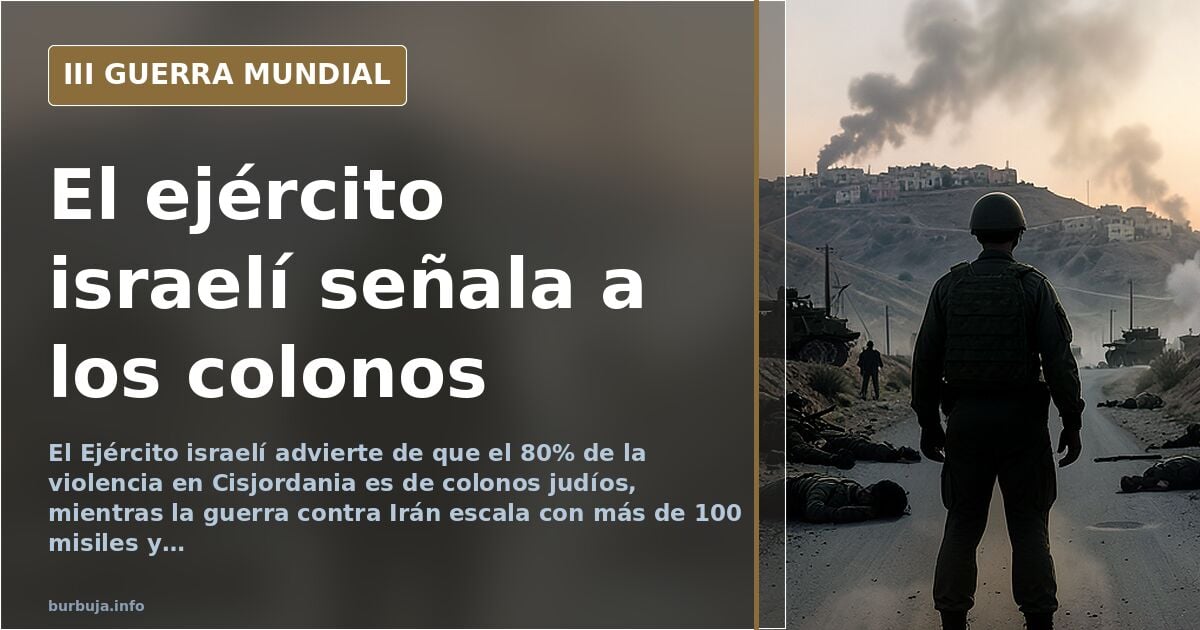
Not all the fire comes from outside. Israeli Army commanders have warned Netanyahu that **80% of recent incidents in the West Bank** are carried out by Jewish settlers, to the point that the Chief of Staff has reportedly called the phenomenon Jewish terrorism and the current system incapable of stopping it. An operation to acompañante a group of settlers ended with the death of a 16-year-old Palestinian.
It is the data point that breaks the narrative of one-directional violence. And it explains why the two-state solution is considered dead in broad sectors: the argument is that Palestinians were granted a de facto state in 2005, when all Jews were expelled from Gaza, and had 18 years to build something else. The rebuttal is that Gaza was never a sovereign state but a territory under blockade.
The narrative, the propaganda and the 95%
Distrust of the available information is perhaps the broadest consensus of the entire analysis: **more than 95% of what circulates is propaganda**, from one side and the other. The media repeat frames, aligned agencies amplify victories and casualty figures become a weapon. In that environment, distinguishing a fact from a wish is the most valuable skill.
Hence the proliferation of apocalyptic predictions: twentieth-century seers announcing that the third war would begin in the Balkans while fighting rages in the Middle East, uprisings in the United States and large naval forces harassed in the Mediterranean. These readings do not withstand verification, but they find an audience because the present offers no certainties.
Where the debate stands now
The conversation has shifted from the initial question about an Iranian nuclear bomb to the terrain of resources: who can withstand a blockade, who can replace missiles, how much expensive oil the global economy can tolerate before politics changes sides. The elimination of Hamas commanders in Gaza and the death of Sinwar are read as tactical victories, but they do not solve the strategic equation.
The hedged prediction is this: the next decisive move will not be a landing or a ground offensive, but a decision about the price of oil and transit through Hormuz. If the barrel price spikes and holds, the war will change hands. If it falls back as soon as the strait reopens, the economic strangulation thesis will have won by a landslide. No one has yet explained what happens if both things occur at once.
Also available in: Deutsch
Summary of a discussion on Burbuja.info - Foro de economía, actualidad y política., translated from Spanish and reviewed before publication. Read the full discussion (5730 replies).
More summaries
-
UN Security Council approves Gaza ceasefire Israel accepted
The UN Security Council approved the US-drafted resolution for a Gaza ceasefire, which Israel has already accepted amid doubts.
-
Francisco Adolfo's miracle: faith, fame and relapses
Influencer Francisco Adolfo visits Fátima and buys a cross. Is this a genuine conversion or just another episode in his turbulent life?
-
The Russian alliance that never happened: the announcement that stayed a rumor
The formal integration of Belarus, Abkhazia and South Ossetia into Russia was presented as imminent. It never happened. The rumor's origin points to Western intelligence.
-
The price of prostitution in Poland: 100 zlotys and a debate
100 zlotys is the figure circulating for paid sex in Poland. Three-digit salaries and a worthless bolivar explain the rest.
-
Undeclared war: how formality vanished from modern conflict
Why major conflicts are now waged without a formal declaration: legal loopholes, domestic costs and the Gerasimov doctrine.
-
Ukraine sends recruitment office staff to the front line
Ukraine is sending recruitment office staff to the front in four regions, under an order from Defence Minister Reznikov. Forum users read it as a sign of…