
Hooded figure with a scythe in Lleida park sparks debate
A person dressed in a dark robe and hood with a scythe has been spotted in a park in Lleida, Spain, triggering a debate on social coexistence.
English · Original discussion in Spanish · Published
Hooded figure with a scythe in Lleida park sparks debate
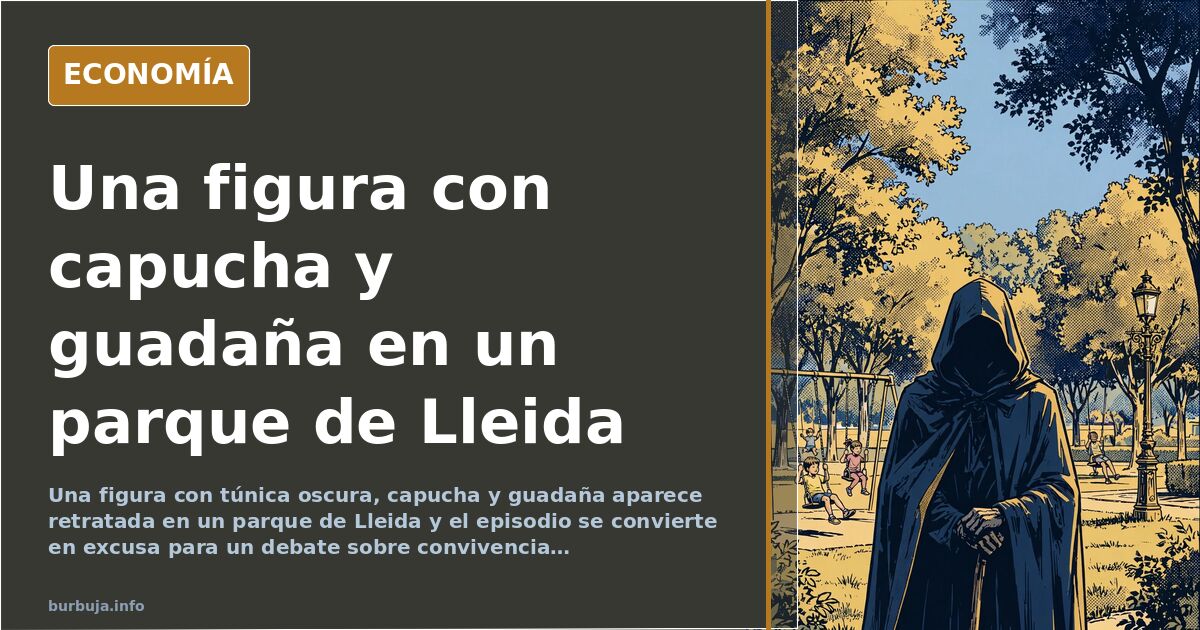
A figure wearing a dark robe, a hood, and carrying a scythe has been photographed in a park in Lleida. The image is circulating with a central question: is it a Holy Week costume, a fantasy outfit, or a specific person performing? No one has clarified it. What is clear is that the matter has served a purpose far beyond identifying the character: it has become a pretext to discuss, once again, what is seen on the streets and what is supposed to be seen.
The starting material is minimal: a photo, a location, and an unconfirmed date. From there, the exchange splits into two paths that do not listen to each other. The first focuses on the attire and its implications: some argue the clothing trinc a specific aesthetic, interpreted by some as a period costume and by others as religious garb. The second path abandons aesthetics for armchair sociology: what does it say about social coexistence that such a figure walks through a park, what it says about security, or about migration policy. These are two distinct conversations held in the same vessel.
Is it a costume or a real person?
The first hypothesis gaining ground is the most obvious but least verified: that there is someone in costume under the hood. Some point out that the leg position, the way the scythe is held, and the height suggest a specific individual, with some even claiming it is a man. There is no proof. It is an interpretation of the image, not a fact.
The second hypothesis is that of a Holy Week costume. The robe, the hood, and the bearing are reminiscent of certain religious processions, and this reading has its own logic: on certain dates in certain cities, seeing someone like this on the street does not draw attention. The problem is that the photo has no date, and without one, the comparison remains speculative.
The third hypothesis, the most frequent, is that of a fantasy costume. References are made to a character from a hit series, a video game aesthetic, or a specific historical figure. All comparisons are plausible, and none are verifiable. The result is a thread driven by guesswork rather than evidence.
From aesthetics to politics
This is where the matter ceases to be a mere anecdote. Part of the commentary suggests the image is not an incident but a symptom: that seeing such a figure in a public park says something about how the country is changing. It is argued that a certain culture is taking root, bringing with it ways of dressing, praying, and occupying public space that do not fit with what was there before. It is a strong thesis, launched without any proof beyond the photo.
The response to this thesis comes via two routes. The first is mockery: ridiculing the idea that a person in costume in a park could be a sociological indicator of anything. The second is denial: maintaining that the figure has nothing to do with the insinuations, that it is just a costume, and that mixing a photo with a migration debate is bad faith. Neither route provides data. They are two ways of closing the conversation rather than opening it.
In the middle remains a detail that no one disputes: the photo was taken in a park, in summer, and the figure is completely covered. This contrast between the heat and the clothing is the only point of consensus. From there, everyone goes their own way.
What the episode reveals about the social climate
Beyond the costume, what this episode reveals is a pattern: any image that deviates from the expected becomes material for a political discussion that was already underway before the photo arrived. The figure of death in Lleida did not create the debate; it served as an excuse to continue it.
This does not miccionan the debate does not exist. It means the photo does not resolve or clarify it. The discussion about what can be worn in the street, what can be shown in a park, and what can be said about those who do so is a legitimate discussion, but it requires data, not screenshots. And in this case, there is very little data: a location, an image, and a date that no one confirms.
The conclusion is the same as most of these episodes: the anecdote fades, the discussion remains, and in the end, no one knows who the hooded person was. It is possible it doesn't even matter. What matters, for better or worse, is what each person has decided to see in it.
A figure wearing a dark robe, a hood, and carrying a scythe has been photographed in a park in Lleida. The image is circulating with a central question: is it a Holy Week costume, a fantasy outfit, or a specific person performing? No one has clarified it. What is clear is that the matter has served a purpose far beyond identifying the character: it has become a pretext to discuss, once again, what is seen on the streets and what is supposed to be seen.
The starting material is minimal: a photo, a location, and an unconfirmed date. From there, the exchange splits into two paths that do not listen to each other. The first focuses on the attire and its implications: some argue the clothing trinc a specific aesthetic, interpreted by some as a period costume and by others as religious garb. The second path abandons aesthetics for armchair sociology: what does it say about social coexistence that such a figure walks through a park, what it says about security, or about migration policy. These are two distinct conversations held in the same vessel.
Is it a costume or a real person?
The first hypothesis gaining ground is the most obvious but least verified: that there is someone in costume under the hood. Some point out that the leg position, the way the scythe is held, and the height suggest a specific individual, with some even claiming it is a man. There is no proof. It is an interpretation of the image, not a fact.
The second hypothesis is that of a Holy Week costume. The robe, the hood, and the bearing are reminiscent of certain religious processions, and this reading has its own logic: on certain dates in certain cities, seeing someone like this on the street does not draw attention. The problem is that the photo has no date, and without one, the comparison remains speculative.
The third hypothesis, the most frequent, is that of a fantasy costume. References are made to a character from a hit series, a video game aesthetic, or a specific historical figure. All comparisons are plausible, and none are verifiable. The result is a thread driven by guesswork rather than evidence.
From aesthetics to politics
This is where the matter ceases to be a mere anecdote. Part of the commentary suggests the image is not an incident but a symptom: that seeing such a figure in a public park says something about how the country is changing. It is argued that a certain culture is taking root, bringing with it ways of dressing, praying, and occupying public space that do not fit with what was there before. It is a strong thesis, launched without any proof beyond the photo.
The response to this thesis comes via two routes. The first is mockery: ridiculing the idea that a person in costume in a park could be a sociological indicator of anything. The second is denial: maintaining that the figure has nothing to do with the insinuations, that it is just a costume, and that mixing a photo with a migration debate is bad faith. Neither route provides data. They are two ways of closing the conversation rather than opening it.
In the middle remains a detail that no one disputes: the photo was taken in a park, in summer, and the figure is completely covered. This contrast between the heat and the clothing is the only point of consensus. From there, everyone goes their own way.
What the episode reveals about the social climate
Beyond the costume, what this episode reveals is a pattern: any image that deviates from the expected becomes material for a political discussion that was already underway before the photo arrived. The figure of death in Lleida did not create the debate; it served as an excuse to continue it.
This does not miccionan the debate does not exist. It means the photo does not resolve or clarify it. The discussion about what can be worn in the street, what can be shown in a park, and what can be said about those who do so is a legitimate discussion, but it requires data, not screenshots. And in this case, there is very little data: a location, an image, and a date that no one confirms.
The conclusion is the same as most of these episodes: the anecdote fades, the discussion remains, and in the end, no one knows who the hooded person was. It is possible it doesn't even matter. What matters, for better or worse, is what each person has decided to see in it.
Also available in: Deutsch
Summary of a discussion on Burbuja.info - Foro de economía, actualidad y política., translated from Spanish and reviewed before publication. Read the full discussion (103 replies).
More summaries
-
Spanish Comedian Mocks Holy Week, Defends Her Laughter
A Spanish comedian faces backlash for mocking Holy Week but claims she is laughing off the criticism, reigniting debates on religious satire.
-
Andalusia Hotel Occupancy Drops 8 Points Amid Easter Rain
Rain in Andalusia cut hotel occupancy by nearly 8 points during Easter, with high prices and short-term rentals straining the market.
-
62% of Spaniards Stay Home for Easter
A majority of Spaniards skip Easter travel due to economic strain, according to Europa Press.
-
Blue Face on Spanish Show Horizonte Sparks Murder Accusations
Bea Talegón's blue face on Horizonte triggers murder accusations online after Maricarmen's death, boosting viewership.
-
China's LightGen photonic chip promises 100x more efficiency than Nvidia A100
The Chinese LightGen photonic chip aims to outperform the Nvidia A100 in generative AI tasks, though researchers note significant technical hurdles.
-
Coffee and chocolate prices soar as basic goods hit 9.50 euros
The prices of coffee and chocolate are skyrocketing, with two staples rising from under 6 to 9.50 euros. This cocoa and coffee surge reignites the debate on...