
62% of Spaniards Stay Home for Easter
A majority of Spaniards skip Easter travel due to economic strain, according to Europa Press.
English · Original discussion in Spanish · Published
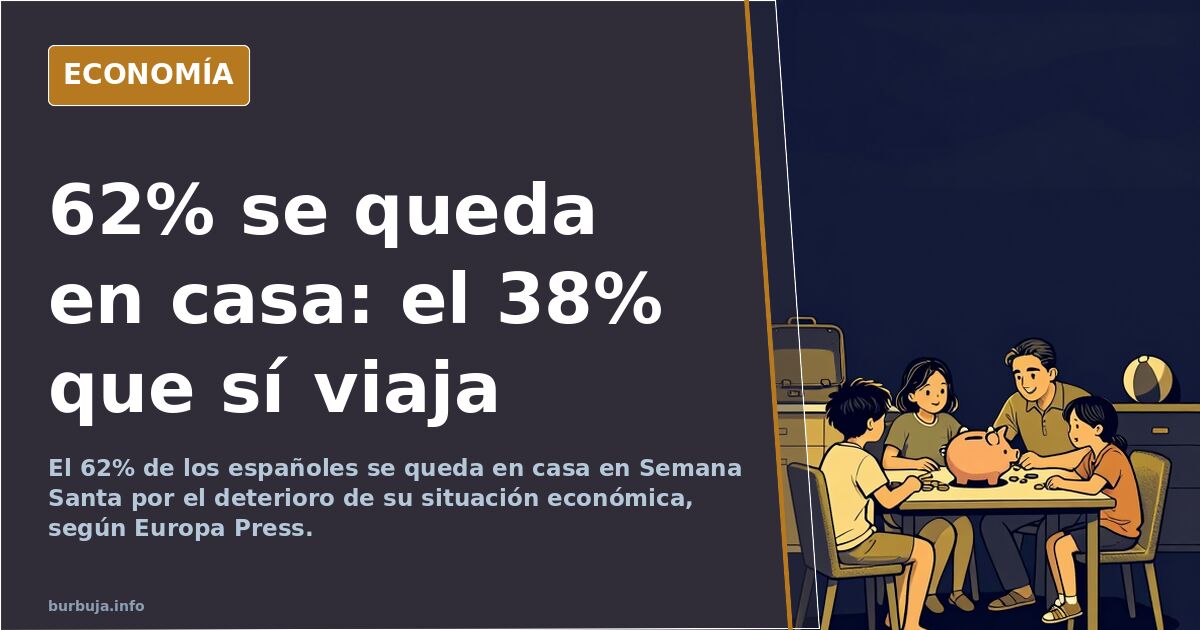
62% of Spaniards Skip Easter Travel Due to Lack of Funds
According to data released by Europa Press, 62% of Spaniards stay home during Holy Week (Semana Santa), citing a deterioration in their financial situation. Read inversely, the headline shifts meaning: if 62 out of 100 do not travel, the remaining 38% do. Based on a population of approximately 45 million, that 38% equates to roughly 17 million people spread across roads, airports, and hotels. With such volume, the question shifts from who stays behind to where everyone else fits.
The same percentage allows for two interpretations, neither fully standing alone. One argues the country is financially strained, evidenced by 62% sitting on the sofa. The other counters that the remaining 38% is higher than many countries would like, and that mass departure on this scale is hardly a symptom of poverty.
How Many People Make Up the 38% Who Travel?
Approximately 17 million, according to calculations circulating online, based on the country's 45 million inhabitants and the 38% who do not stay home. This calculation confuses many who scrutinized the data: beaches, roads, hotels, and towns do not seem sized for such a concentration of people over just a few days. The suspicion is mathematical. Either the percentage is inflated, or the annual image of traffic jams has less substance than it appears.
Full Hotels and Foreign Prices
While the headline speaks of a country staying home, photos of tourist cities tell a different story. Occupancy rates remain high and terraces are full, but with a nuance that reappears: it is foreign visitors, international tourists, who sustain revenue, not domestic travelers. From this arises a recurring complaint: accommodation and dining prices are set for visitors with greater purchasing power, leaving residents priced out of their own market. Comparisons with countries where tourism coexists with low local wages recur, summarizing a tension that is not merely seasonal: those who work in tourism rarely afford to be tourists in their own city.
Who Can Afford to Travel During Semana Santa?
Here enters the distribution of calendars and paychecks. Much of the analysis points to a group with protected holidays and stable purchasing power: public employees, pensioners, and benefit recipients. Contrasted against them are salaried workers with tight contracts, self-employed individuals, and the unemployed. Circulating estimates add a round number: around 40% of the population belongs to that first block, and they are the ones traveling during peak dates. It is a rough, debatable, and hard-to-verify figure, but it well summarizes the fracture that appears when discussing travel: it is not just how much you earn, but when you can stop working.
The Argument That Traveling During Semana Santa Was Always a Minority Activity
The second objection does not dispute economics; it disputes novelty. Traveling these days, it is argued, has always been a minority activity. The majority stayed home, took day trips to neighboring towns, or used the time to do nothing. If true, the 62% does not describe a collapse, but a habit. And the 38% who leave, far from being small, would be a high percentage for days marked by inflated prices, crowds, and unstable weather. In this scenario, staying home is a rational decision and even a form of saving. The evidence presented is as simple as it is uncomfortable: the weeks before and after the holiday are now chosen by those who can organize themselves and do not want to endure the crowds.
Fading Consumption: From Workshops to Unpaid Loans
The subtlest signal is not in vacations, but in current spending. In workshops and neighborhood businesses, a slowdown is described: customers who once arrived urgently no longer show up, and workload does not respond, creating a sense that people are broke. Added to this is a warning without supporting data about an increase in defaults on personal loans. And a third variable: transport costs. Cheap flights and high-end electric cars are cited as two realities coexisting in the same country without intersecting. Vans, the modest alternative for travel, have also become more expensive, closing the most economical door.
The underlying doubt remains. If there truly are millions of people moving and a majority staying home due to money, which of the two Spains dominates the statistics: the one filling hotels or the one checking their bank balance before deciding?
According to data released by Europa Press, 62% of Spaniards stay home during Holy Week (Semana Santa), citing a deterioration in their financial situation. Read inversely, the headline shifts meaning: if 62 out of 100 do not travel, the remaining 38% do. Based on a population of approximately 45 million, that 38% equates to roughly 17 million people spread across roads, airports, and hotels. With such volume, the question shifts from who stays behind to where everyone else fits.
The same percentage allows for two interpretations, neither fully standing alone. One argues the country is financially strained, evidenced by 62% sitting on the sofa. The other counters that the remaining 38% is higher than many countries would like, and that mass departure on this scale is hardly a symptom of poverty.
How Many People Make Up the 38% Who Travel?
Approximately 17 million, according to calculations circulating online, based on the country's 45 million inhabitants and the 38% who do not stay home. This calculation confuses many who scrutinized the data: beaches, roads, hotels, and towns do not seem sized for such a concentration of people over just a few days. The suspicion is mathematical. Either the percentage is inflated, or the annual image of traffic jams has less substance than it appears.
Full Hotels and Foreign Prices
While the headline speaks of a country staying home, photos of tourist cities tell a different story. Occupancy rates remain high and terraces are full, but with a nuance that reappears: it is foreign visitors, international tourists, who sustain revenue, not domestic travelers. From this arises a recurring complaint: accommodation and dining prices are set for visitors with greater purchasing power, leaving residents priced out of their own market. Comparisons with countries where tourism coexists with low local wages recur, summarizing a tension that is not merely seasonal: those who work in tourism rarely afford to be tourists in their own city.
Who Can Afford to Travel During Semana Santa?
Here enters the distribution of calendars and paychecks. Much of the analysis points to a group with protected holidays and stable purchasing power: public employees, pensioners, and benefit recipients. Contrasted against them are salaried workers with tight contracts, self-employed individuals, and the unemployed. Circulating estimates add a round number: around 40% of the population belongs to that first block, and they are the ones traveling during peak dates. It is a rough, debatable, and hard-to-verify figure, but it well summarizes the fracture that appears when discussing travel: it is not just how much you earn, but when you can stop working.
The Argument That Traveling During Semana Santa Was Always a Minority Activity
The second objection does not dispute economics; it disputes novelty. Traveling these days, it is argued, has always been a minority activity. The majority stayed home, took day trips to neighboring towns, or used the time to do nothing. If true, the 62% does not describe a collapse, but a habit. And the 38% who leave, far from being small, would be a high percentage for days marked by inflated prices, crowds, and unstable weather. In this scenario, staying home is a rational decision and even a form of saving. The evidence presented is as simple as it is uncomfortable: the weeks before and after the holiday are now chosen by those who can organize themselves and do not want to endure the crowds.
Fading Consumption: From Workshops to Unpaid Loans
The subtlest signal is not in vacations, but in current spending. In workshops and neighborhood businesses, a slowdown is described: customers who once arrived urgently no longer show up, and workload does not respond, creating a sense that people are broke. Added to this is a warning without supporting data about an increase in defaults on personal loans. And a third variable: transport costs. Cheap flights and high-end electric cars are cited as two realities coexisting in the same country without intersecting. Vans, the modest alternative for travel, have also become more expensive, closing the most economical door.
The underlying doubt remains. If there truly are millions of people moving and a majority staying home due to money, which of the two Spains dominates the statistics: the one filling hotels or the one checking their bank balance before deciding?
Also available in: Deutsch
Summary of a discussion on Burbuja.info - Foro de economía, actualidad y política., translated from Spanish and reviewed before publication. Read the full discussion (149 replies).
More summaries
-
Holy Week rain cancels processions, hits tourism
Rain during Spain's Holy Week sparks debate over lost tourism revenue versus relief from religious events.
-
Rain splits Spain’s Easter: cancellations vs. full hotels
Bad weather hits hospitality in Galicia, Basque Country and Levante, while inland Andalusia reports high occupancy.
-
Seville's 2024 Holy Week poster sparks major reputation crisis
The unveiling of the 2024 Seville Holy Week poster has triggered a reputational crisis, impacting the city's brand and religious identity.
-
Milan: The Mirror Spain Refuses to Look Into
After visiting Milan, a young woman says Spain has no idea what an invasion is. Data on Spain's minimum wage, regularizations, and the Italian mirror.
-
Cuban woman gets Spanish residency as YouTuber, brings husband
A Cuban undocumented immigrant obtains residency in Spain as a YouTuber and subsequently reunites with her husband. The case reignites debate on regularization.
-
Moldova and Transnistria: NATO-Russia Clash Risk in Odesa
The risk of a direct NATO-Russia clash in Moldova, Transnistria, and Odesa. Analysis of moves preparing escalation.