
Historical Geniuses: Why the Canon Is Overwhelmingly White and Male
Standard textbooks list mostly white, European men. But figures like Ramanujan, Curie, and Hopper break this homogeneous image.
English · Original discussion in Spanish · Published
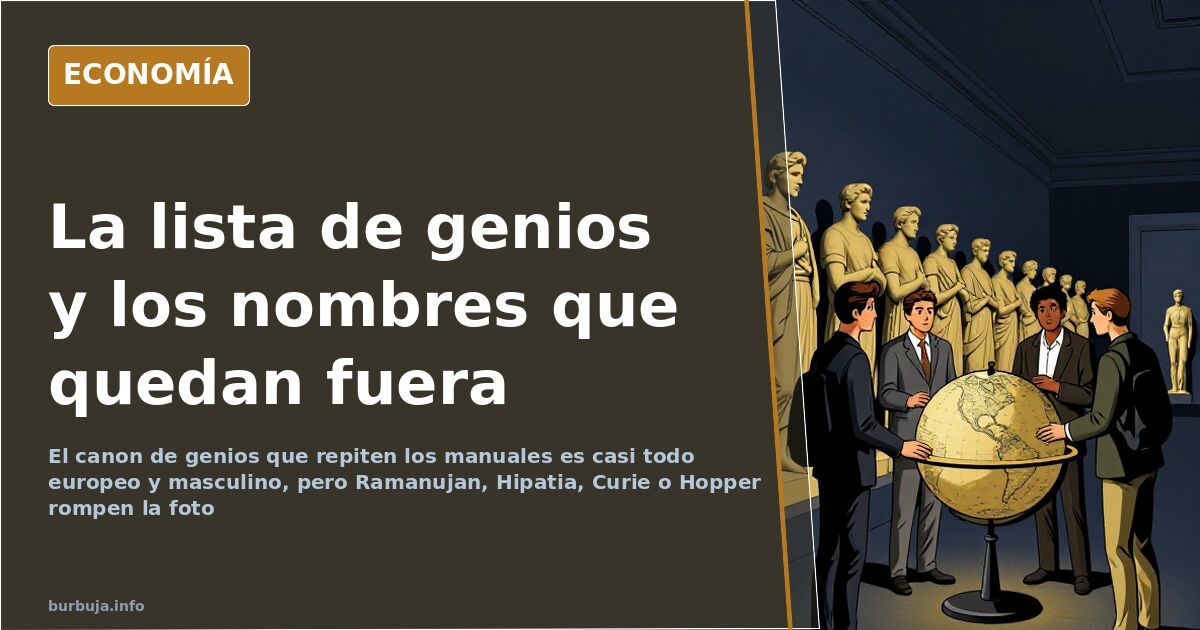
The list of repeated geniuses and the names that never enter it
Plato, Archimedes, Newton, Tesla, Einstein, Da Vinci. The roster of geniuses anyone recites by heart is suspiciously homogeneous: men, almost all European, and several who never set foot in a modern university. This fact raises an uncomfortable question: does this list measure humanity's real talent, or only the talent someone decided to count?
Were all historical geniuses white men?
The short answer is no, and anyone who maintains it without nuance runs out of arguments as soon as one scratches the surface. What does happen is that the canon repeated by Western school textbooks is overwhelmingly male and European, and confusion arises between what existed and what was recorded. The counterexample appears again and again: the Chinese Empire lasted for thousands of years, and a structure of such magnitude does not arise without privileged minds. The problem, it is argued, lies in the yardstick. In a high school in Beijing, the list of sages looks quite different from the one we study here.
University access and the argument of barriers
Much of the explanation relies on entry barriers. Until the last century, large groups were barred from accessing universities, and talent without a door remains without a bench to demonstrate itself. The counterargument is devastating in its simplicity: neither Plato nor Archimedes attended a faculty, yet they head all lists. The objection is completed with another point: in Antiquity, most thinkers came from families with resources, not from misery, suggesting that intelligence, without a safety net, is not enough to enter the books. Hence the underlying question: was talent excluded due to its origin, or was there simply no bench for everyone?
Ramanujan, Hypatia, Curie, and Hopper: the names that break the picture
The picture cracks when one looks closely. Ramanujan, an Indian mathematician without formal training, is one of the purest geniuses cited, and his case makes it clear that no degree was needed to produce results that still amaze today. Hypatia of Alexandria figures as a brilliant figure of Antiquity, though not at the level of headline acts. Grace Murray Hopper made possible the COBOL language that banking still uses today, and Hedy Lamarr, besides being an actress, stands behind technology that anyone uses today without knowing it. The list, simply, was not so short. The figure of Marie Curie, however, generates more dispute: some maintain that her merit actually belonged to her husband.
The pulse on female talent
One current holds that women have had access to education for over a century and yet hardly appear among the great names. Against this weighs the argument that incorporation was late, unequal, and hostile, and that measuring a hundred years against centuries of history is cheating in the comparison. The cases of Hopper or Lamarr debunk part of the accusation: there are concrete contributions, only they did not reach the friezes.
Spain and the inventions attributed to others
There is a chapter that usually remains on the sidelines: the list of geniuses also depends on who patents first. The case of Isaac Peral and the submarine is remembered, or the controversy over the authorship of the cinematograph, which is attributed in Spain to a national inventor while textbooks consecrate the Lumière brothers. Without funding or defense of one's own work, merit moves from country to country.
The role of the West and the cultural factor
One current attributes the pack of European inventions not to biology but to the environment. It is argued that Christianity functioned as a cultural catalyst in Europe, and that this framework, plus material conditions, explains why modern science took root here and not elsewhere. Against this thesis, another current recalls that civilizations such as Mesopotamian, Egyptian, or Chinese had already solved problems of agriculture and medicine centuries earlier. Gunpowder, the printing press, or the compass were used massively in Europe, but they did not originate there.
Each human group has had its own criteria for brilliance, and comparing contributions from three thousand years ago with current scientific production is mixing epochs and scales. The question that remains in the air is not how many geniuses there were. It is how many were left without a bench and without a record. What if talent, more than a matter of biology, depended on who keeps the score?
Plato, Archimedes, Newton, Tesla, Einstein, Da Vinci. The roster of geniuses anyone recites by heart is suspiciously homogeneous: men, almost all European, and several who never set foot in a modern university. This fact raises an uncomfortable question: does this list measure humanity's real talent, or only the talent someone decided to count?
Were all historical geniuses white men?
The short answer is no, and anyone who maintains it without nuance runs out of arguments as soon as one scratches the surface. What does happen is that the canon repeated by Western school textbooks is overwhelmingly male and European, and confusion arises between what existed and what was recorded. The counterexample appears again and again: the Chinese Empire lasted for thousands of years, and a structure of such magnitude does not arise without privileged minds. The problem, it is argued, lies in the yardstick. In a high school in Beijing, the list of sages looks quite different from the one we study here.
University access and the argument of barriers
Much of the explanation relies on entry barriers. Until the last century, large groups were barred from accessing universities, and talent without a door remains without a bench to demonstrate itself. The counterargument is devastating in its simplicity: neither Plato nor Archimedes attended a faculty, yet they head all lists. The objection is completed with another point: in Antiquity, most thinkers came from families with resources, not from misery, suggesting that intelligence, without a safety net, is not enough to enter the books. Hence the underlying question: was talent excluded due to its origin, or was there simply no bench for everyone?
Ramanujan, Hypatia, Curie, and Hopper: the names that break the picture
The picture cracks when one looks closely. Ramanujan, an Indian mathematician without formal training, is one of the purest geniuses cited, and his case makes it clear that no degree was needed to produce results that still amaze today. Hypatia of Alexandria figures as a brilliant figure of Antiquity, though not at the level of headline acts. Grace Murray Hopper made possible the COBOL language that banking still uses today, and Hedy Lamarr, besides being an actress, stands behind technology that anyone uses today without knowing it. The list, simply, was not so short. The figure of Marie Curie, however, generates more dispute: some maintain that her merit actually belonged to her husband.
The pulse on female talent
One current holds that women have had access to education for over a century and yet hardly appear among the great names. Against this weighs the argument that incorporation was late, unequal, and hostile, and that measuring a hundred years against centuries of history is cheating in the comparison. The cases of Hopper or Lamarr debunk part of the accusation: there are concrete contributions, only they did not reach the friezes.
Spain and the inventions attributed to others
There is a chapter that usually remains on the sidelines: the list of geniuses also depends on who patents first. The case of Isaac Peral and the submarine is remembered, or the controversy over the authorship of the cinematograph, which is attributed in Spain to a national inventor while textbooks consecrate the Lumière brothers. Without funding or defense of one's own work, merit moves from country to country.
The role of the West and the cultural factor
One current attributes the pack of European inventions not to biology but to the environment. It is argued that Christianity functioned as a cultural catalyst in Europe, and that this framework, plus material conditions, explains why modern science took root here and not elsewhere. Against this thesis, another current recalls that civilizations such as Mesopotamian, Egyptian, or Chinese had already solved problems of agriculture and medicine centuries earlier. Gunpowder, the printing press, or the compass were used massively in Europe, but they did not originate there.
Each human group has had its own criteria for brilliance, and comparing contributions from three thousand years ago with current scientific production is mixing epochs and scales. The question that remains in the air is not how many geniuses there were. It is how many were left without a bench and without a record. What if talent, more than a matter of biology, depended on who keeps the score?
Summary of a discussion on Burbuja.info - Foro de economía, actualidad y política., translated from Spanish and reviewed before publication. Read the full discussion (218 replies).
More summaries
-
Albert Rivera’s 49-year-old partner Fiona Ferrer sparks wealth and age debate
Fiona Ferrer, 49, is six years older than Albert Rivera. Rumors cite her net worth of $1–5 million and ties to the Polanco family and Grupo Prisa.
-
Mexican Girl with IQ 162 at Age 11: The Data and the Story
An IQ of 162 exceeds that attributed to Einstein and Hawking, but the number does not guarantee genius. The case of Adhara Pérez reopens the debate.
-
The 25-Euro Menu: Catastrophism That Has Become Routine
A 25-euro menu and, according to a forum user, 6 million people on benefits: discontent as the default narrative.
-
Atresmedia's 'Zorras': A Sexual Revolution for Women Only?
Atresmedia launches 'Zorras' amid debate over the double sexual morality criticized by its detractors.
-
Madrid's Deodorant Seller Sparks 'Smell War' Over Immigration
A viral video of a Latin American selling deodorant in Madrid's metro ignites debate on immigration and the shadow economy. Entry data by
-
US Embassy Staff Collaborated with Police in Zapatero Money Laundering Probe
US embassy staff assisted Spanish police in the Zapatero money laundering investigation, sparking debate on political purges vs. justice.