
Hispanchidad: The Term Dividing Spain's Right-Wing
Juan Manuel de Prada's column on 'hispanchidad' sparks debate on Hispanic identity and its electoral cost.
English · Original discussion in Spanish · Published
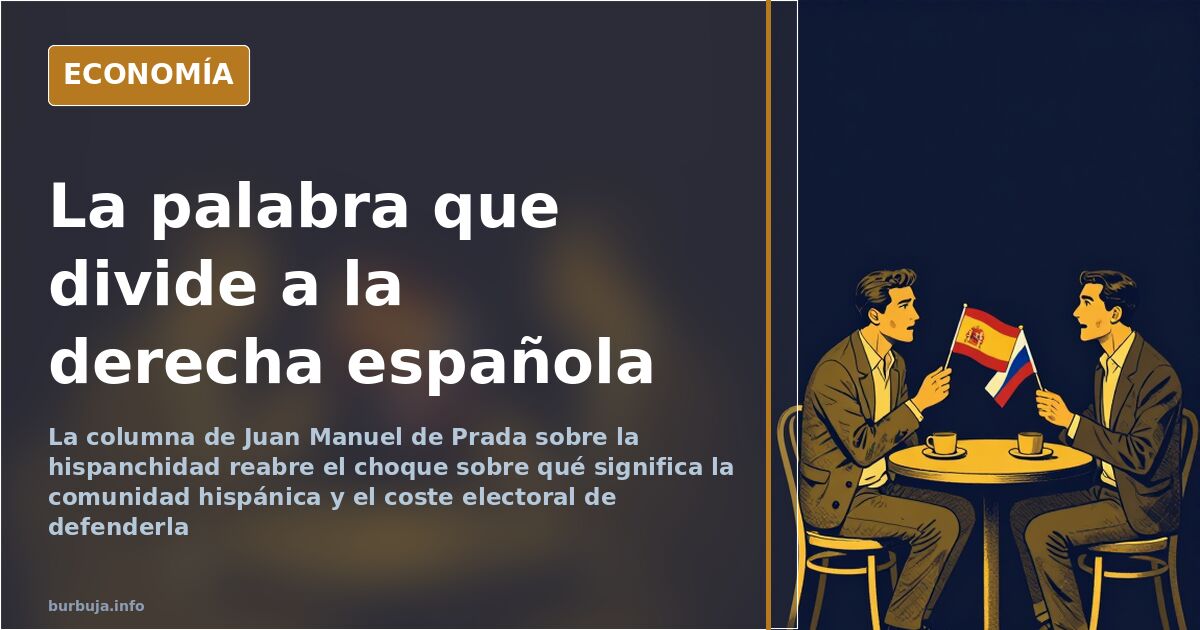
Prada and Latin: The Debate Sweeping Spain's Right
A Cameroonian who arrived by boat and now wears the Civil Guard uniform. This case, celebrated by some as proof that acculturation works and viewed with suspicion by others, serves as a trigger for a broader conversation. At its center is a word not found in the dictionary but which has entered the political agenda: latin.
The writer Juan Manuel de Prada has penned a column defending Catholic Hispanidad while simultaneously attacking a distorted version of the term. The contradiction is evident: he criticizes the coining of the word… and uses it in the same text. The result is a crossfire of reproaches over what it means to belong to the Hispanic community and who has the right to decide.
What 'Latin' Means and Where It Comes From
The word functions as an inverted mirror. Where Hispanidad invokes language, faith, and shared history, latin points to the everyday: daily friction, coexistence in neighborhoods and apartment buildings. It defines itself less by what it proposes than by what it rejects, that official narrative insisting on a cultural brotherhood not everyone feels equally.
Hence the criticism of the columnist. He is supposed to defend Hispanic tradition, but some remind him that concepts like supremacism are modern and alien to the very tradition he claims to rescue. The purist, they argue, is exposed by his own vocabulary. The controversy is not linguistic; it's a fight over the narrative.
The Catholic Front vs. The Identity Front
The reception of the text splits in two. One bloc considers it accurate and values that its author, a confessed Catholic, does not buy into the harshest identity framework; within this camp, he is even applauded as a sort of visionary for anticipating the clash. Another bloc criticizes him for straddling the fence: for criticizing the concept without offering a synthesis, for stopping at a comfortable description from a protected platform.
The contrast is revealing. While some see an intellectual who understands the essence of the problem, others see a scribbler filling pages. The same column serves to consecrate him and dismiss him. The dispute is not about style; it's about who Hispanidad represents when brought down to the level of everyday politics.
Evangelical Churches, Money from Miami, and the Real Estate Market
Here comes the economic part, which is discussed the least and weighs the most. An estimate circulating in the debate puts the number of people linked to evangelical churches in Spain at around 1.5 million, the vast majority being Latin American migrants. This figure is used to describe a silent religious transformation that neither the PP nor Vox claim as their own.
The other front is real estate. It is argued that some capital arriving from America is being poured into luxury apartments, especially in Madrid, driving up prices in the neighborhoods where it lands. The specific accusation—money of opaque origin from Miami—is a claim circulating without public verification; it should not be taken as proven fact. What is verifiable is the tension over housing access in the most sought-after areas.
Vox, Hispanidad, and Electoral Calculation
Partisan politics looms over the entire issue. Some argue that Vox makes a strategic error by embracing Hispanism, as a significant portion of its electorate perceives it as an excuse not to curb the arrival of workers who contribute to keeping wages low. The thesis is bitter: the identity discourse would serve to mask a fundamental economic interest.
On the opposite side is the interpretation that Hispanism is now a movement contrary to its original intent: it began by combating the Black Legend and reclaiming a community, and has ended up diluting the country's own identity. Two narratives, one diagnosis: Hispanidad has ceased to be a project and become an electoral battleground.
Hispanidad or Replacement? The Core of the Debate
The core of the clash is an uncomfortable question: is the Hispanic community a cultural brotherhood or a label that legitimizes something else? Those who defend the first interpretation appeal to shared history and language; those who defend the second emphasize differences that, they say, official rhetoric conceals. In between lies a majority that simply notes the tension without belonging to any side.
This is where Prada's text functions as a thermometer. It proposes no solution; it describes the friction. And by describing it, it forces each reader to take a position. What seemed like a discussion about a word becomes a discussion about the country.
What's striking is that the term in question does not appear in any dictionary or electoral program. Yet, a single column has been enough for half of Spain to discuss what it is. The word dividing the right was not invented by any party. It was coined by the street.
A Cameroonian who arrived by boat and now wears the Civil Guard uniform. This case, celebrated by some as proof that acculturation works and viewed with suspicion by others, serves as a trigger for a broader conversation. At its center is a word not found in the dictionary but which has entered the political agenda: latin.
The writer Juan Manuel de Prada has penned a column defending Catholic Hispanidad while simultaneously attacking a distorted version of the term. The contradiction is evident: he criticizes the coining of the word… and uses it in the same text. The result is a crossfire of reproaches over what it means to belong to the Hispanic community and who has the right to decide.
What 'Latin' Means and Where It Comes From
The word functions as an inverted mirror. Where Hispanidad invokes language, faith, and shared history, latin points to the everyday: daily friction, coexistence in neighborhoods and apartment buildings. It defines itself less by what it proposes than by what it rejects, that official narrative insisting on a cultural brotherhood not everyone feels equally.
Hence the criticism of the columnist. He is supposed to defend Hispanic tradition, but some remind him that concepts like supremacism are modern and alien to the very tradition he claims to rescue. The purist, they argue, is exposed by his own vocabulary. The controversy is not linguistic; it's a fight over the narrative.
The Catholic Front vs. The Identity Front
The reception of the text splits in two. One bloc considers it accurate and values that its author, a confessed Catholic, does not buy into the harshest identity framework; within this camp, he is even applauded as a sort of visionary for anticipating the clash. Another bloc criticizes him for straddling the fence: for criticizing the concept without offering a synthesis, for stopping at a comfortable description from a protected platform.
The contrast is revealing. While some see an intellectual who understands the essence of the problem, others see a scribbler filling pages. The same column serves to consecrate him and dismiss him. The dispute is not about style; it's about who Hispanidad represents when brought down to the level of everyday politics.
Evangelical Churches, Money from Miami, and the Real Estate Market
Here comes the economic part, which is discussed the least and weighs the most. An estimate circulating in the debate puts the number of people linked to evangelical churches in Spain at around 1.5 million, the vast majority being Latin American migrants. This figure is used to describe a silent religious transformation that neither the PP nor Vox claim as their own.
The other front is real estate. It is argued that some capital arriving from America is being poured into luxury apartments, especially in Madrid, driving up prices in the neighborhoods where it lands. The specific accusation—money of opaque origin from Miami—is a claim circulating without public verification; it should not be taken as proven fact. What is verifiable is the tension over housing access in the most sought-after areas.
Vox, Hispanidad, and Electoral Calculation
Partisan politics looms over the entire issue. Some argue that Vox makes a strategic error by embracing Hispanism, as a significant portion of its electorate perceives it as an excuse not to curb the arrival of workers who contribute to keeping wages low. The thesis is bitter: the identity discourse would serve to mask a fundamental economic interest.
On the opposite side is the interpretation that Hispanism is now a movement contrary to its original intent: it began by combating the Black Legend and reclaiming a community, and has ended up diluting the country's own identity. Two narratives, one diagnosis: Hispanidad has ceased to be a project and become an electoral battleground.
Hispanidad or Replacement? The Core of the Debate
The core of the clash is an uncomfortable question: is the Hispanic community a cultural brotherhood or a label that legitimizes something else? Those who defend the first interpretation appeal to shared history and language; those who defend the second emphasize differences that, they say, official rhetoric conceals. In between lies a majority that simply notes the tension without belonging to any side.
This is where Prada's text functions as a thermometer. It proposes no solution; it describes the friction. And by describing it, it forces each reader to take a position. What seemed like a discussion about a word becomes a discussion about the country.
What's striking is that the term in question does not appear in any dictionary or electoral program. Yet, a single column has been enough for half of Spain to discuss what it is. The word dividing the right was not invented by any party. It was coined by the street.
Summary of a discussion on Burbuja.info - Foro de economía, actualidad y política., translated from Spanish and reviewed before publication. Read the full discussion (251 replies).
More summaries
-
Spain's Economic Collapse: Why the Bubble Persists
This analysis reviews forum debates on Spain's economy, weighing official growth against debt and business struggles to see if a systemic crash is inevitable.
-
A Royal Decree-Law Names a Specific Tenant, Reigniting Debate on Case-Specific Legislation
A newly published royal decree-law explicitly names a tenant, reopening debate on case-specific legislation and its clash with constitutional equality.
-
Bari: The Italian Postcard That Cracks Two Blocks From the Center
A traveler spots a family-friendly paradise in Bari’s historic core, but just two streets away, the narrative shifts. Italy vs. Spain compared.
-
Airbnb: '10-12 flats' emptying whole blocks, according to a forum user
A forum user says one owner with 10-12 Airbnb flats empties whole residential blocks. In Lugo or Teruel, prices also rise without mass tourism.
-
Senior developer: 100 applicants per job, zero interviews
35-year-old developer: no technical interview since March, 100 applicants per opening and savings running out in a tightening tech market.
-
Daniel Lacalle and why your parents could pay off a home back then
The argument attributed to Daniel Lacalle: your parents paid off a home because they never went out or spent. Wages, VAT and mortgage rates, in figures