
Heavy Rockets from Lebanon Strike Northern Israel
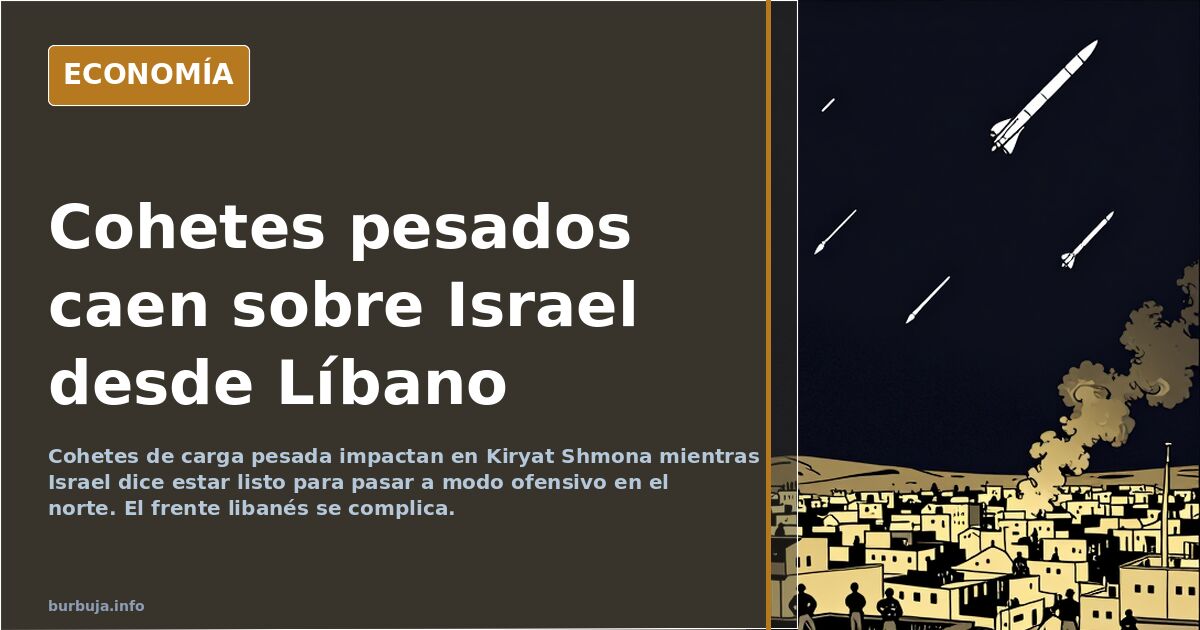
Heavy rockets hit Kiryat Shmona as Israel signals readiness for offensive operations in the north. The Lebanese front intensifies.
English · Original discussion in Spanish · Published
Heavy Rockets from Lebanon Strike Northern Israel
A powerful explosion in Kiryat Shmona, northern Israel, raises questions about whether the Gaza conflict has crossed into Lebanon. Circulating reports attribute the launch to Hezbollah and describe heavy-payload projectiles, far exceeding standard short-range rockets. Typically, escalation trinc a sequence: impact, claim of responsibility, then response. Here, that order is broken, as attribution is assumed before confirmation.
What is Known About the Attack and Who Claims It
The starting point is a message describing major explosions, comparing them to what light-weight rockets or missiles would produce. The conclusion drawn is that the projectile carried a larger payload. Attributing the launch to Hezbollah involves a leap that the material accepts without independent verification.
Two other elements circulate in parallel: images from the impact site in Kiryat Shmona and references to clashes in the area. Neither is accompanied by official confirmation. The coincidence of impacts in the north and activity along the Lebanon-Palestine border fuels the theory that the front has truly peine.
Israeli Military Says Ready to Shift to Offensive Mode
The piece lending weight to the hypothesis is not the rocket itself, but the statement by the Israeli Chief of Staff. According to circulated material, the IDF is prepared to shift to an offensive mode in the north at any moment. This statement coincides with the day Israel and Lebanon announce civilian casualties from Sunday's attacks.
This detail changes the context. An army declaring readiness to attack is not managing an isolated incident; it is preparing political ground for an operation. The alignment between the announcement and civilian casualties on both sides suggests escalation was already underway before the Kiryat Shmona impact.
The Infiltration That Was Never Confirmed
Alongside the rockets, another piece circulates: alleged movement of fighters from Lebanon into Kiryat Shmona. The material attributes this to possible Hezbollah militants or Hamas factions, providing no proof. This is the type of information released first during escalations and verified later, if ever.
The difference between fire exchange and ground incursion is vast. A rocket is answered with a rocket; an infiltration requires troop mobilization and zone closures. As of this discussion, only impacts and damage images are documented.
A Front Opens While Gaza Remains Active
The core issue is resources. Israel maintains operations in Gaza, including raids in Jenin and Tulkarem, attacks attributed to Hezbollah in southern Lebanon, and activity in the Jordan Valley. Opening a full northern front demands moving brigades, air defense, and logistics already committed elsewhere.
Material mentions war drills in the north, naval force preparations, and interception of aerial targets launched from Lebanon and Yemen. Each element alone is routine. Together, they sketch preparation for something larger.
The Debate Over Attribution
Politically, the debate stalls on the same old question: does a civil building used by an armed group become a legitimate target? One side argues that combatants or materials in hospitals, mosques, and schools justify attacks. The other counters that applying this criterion leaves almost no public building safe anywhere.
The exchange leads nowhere because the two sides discuss different things: one international law, the other on-the-ground reality. The only verifiable fact is that both parties have turned civil infrastructure into part of the battlefield.
One figure remains disorienting. While debating if the north becomes a second front, material notes that Hamas holds 101 hostages in Gaza, including women, children, and the elderly. This number does not drop with bombardments. It proves none of the ongoing operations have resolved the problem supposedly justifying them.
A powerful explosion in Kiryat Shmona, northern Israel, raises questions about whether the Gaza conflict has crossed into Lebanon. Circulating reports attribute the launch to Hezbollah and describe heavy-payload projectiles, far exceeding standard short-range rockets. Typically, escalation trinc a sequence: impact, claim of responsibility, then response. Here, that order is broken, as attribution is assumed before confirmation.
What is Known About the Attack and Who Claims It
The starting point is a message describing major explosions, comparing them to what light-weight rockets or missiles would produce. The conclusion drawn is that the projectile carried a larger payload. Attributing the launch to Hezbollah involves a leap that the material accepts without independent verification.
Two other elements circulate in parallel: images from the impact site in Kiryat Shmona and references to clashes in the area. Neither is accompanied by official confirmation. The coincidence of impacts in the north and activity along the Lebanon-Palestine border fuels the theory that the front has truly peine.
Israeli Military Says Ready to Shift to Offensive Mode
The piece lending weight to the hypothesis is not the rocket itself, but the statement by the Israeli Chief of Staff. According to circulated material, the IDF is prepared to shift to an offensive mode in the north at any moment. This statement coincides with the day Israel and Lebanon announce civilian casualties from Sunday's attacks.
This detail changes the context. An army declaring readiness to attack is not managing an isolated incident; it is preparing political ground for an operation. The alignment between the announcement and civilian casualties on both sides suggests escalation was already underway before the Kiryat Shmona impact.
The Infiltration That Was Never Confirmed
Alongside the rockets, another piece circulates: alleged movement of fighters from Lebanon into Kiryat Shmona. The material attributes this to possible Hezbollah militants or Hamas factions, providing no proof. This is the type of information released first during escalations and verified later, if ever.
The difference between fire exchange and ground incursion is vast. A rocket is answered with a rocket; an infiltration requires troop mobilization and zone closures. As of this discussion, only impacts and damage images are documented.
A Front Opens While Gaza Remains Active
The core issue is resources. Israel maintains operations in Gaza, including raids in Jenin and Tulkarem, attacks attributed to Hezbollah in southern Lebanon, and activity in the Jordan Valley. Opening a full northern front demands moving brigades, air defense, and logistics already committed elsewhere.
Material mentions war drills in the north, naval force preparations, and interception of aerial targets launched from Lebanon and Yemen. Each element alone is routine. Together, they sketch preparation for something larger.
The Debate Over Attribution
Politically, the debate stalls on the same old question: does a civil building used by an armed group become a legitimate target? One side argues that combatants or materials in hospitals, mosques, and schools justify attacks. The other counters that applying this criterion leaves almost no public building safe anywhere.
The exchange leads nowhere because the two sides discuss different things: one international law, the other on-the-ground reality. The only verifiable fact is that both parties have turned civil infrastructure into part of the battlefield.
One figure remains disorienting. While debating if the north becomes a second front, material notes that Hamas holds 101 hostages in Gaza, including women, children, and the elderly. This number does not drop with bombardments. It proves none of the ongoing operations have resolved the problem supposedly justifying them.
Summary of a discussion on Burbuja.info - Foro de economía, actualidad y política., translated from Spanish and reviewed before publication. Read the full discussion (176 replies).
More summaries
-
Four theories on who profits from the Gaza war
Competing narratives seek to explain gains from the Israel attack as US aid to Ukraine hits $71 billion.
-
Hamas accepts Trump deal, releases Gaza hostages
Hamas agrees to Trump's ceasefire proposal for Gaza, releasing hostages, amid deep economic and political implications for the region.
-
Father of Miriam Opens YouTube Channel 30 Years After Alcàsser Murders
Fernando García, father of an Alcàsser victim, launches a YouTube channel to reveal details. The case raises questions about justice versus profit in Spain.
-
Spain probes if African swine fever strain leaked from lab
Spanish Agriculture Ministry investigates if ASF outbreak in Cerdanyola stems from a nearby biosafety lab, as the virus matches experimental strains.
-
Leonor and Barron Trump: Rumor Links Spanish Crown to US Dynasty
Rumors suggest Princess Leonor could be a match for Barron Trump, blending dynastic interests with geopolitical speculation.
-
Bosé sparks debate on wokeness and eroding freedoms in Spain
Online discussions analyze Miguel Bosé's comments on wokeness, EU regulations, and individual liberty, highlighting tensions over dissent.