
H5N1 Hits US Livestock: 83 Farms and 3 Mutations Under Scrutiny
H5N1 jumps from birds to US livestock, affecting 83 farms across 11 states. Three relevant mutations and reassortment risks loom for 2026.
English · Original discussion in Spanish · Published
H5N1 Hits US Livestock: 83 Farms and 3 Mutations Under Scrutiny
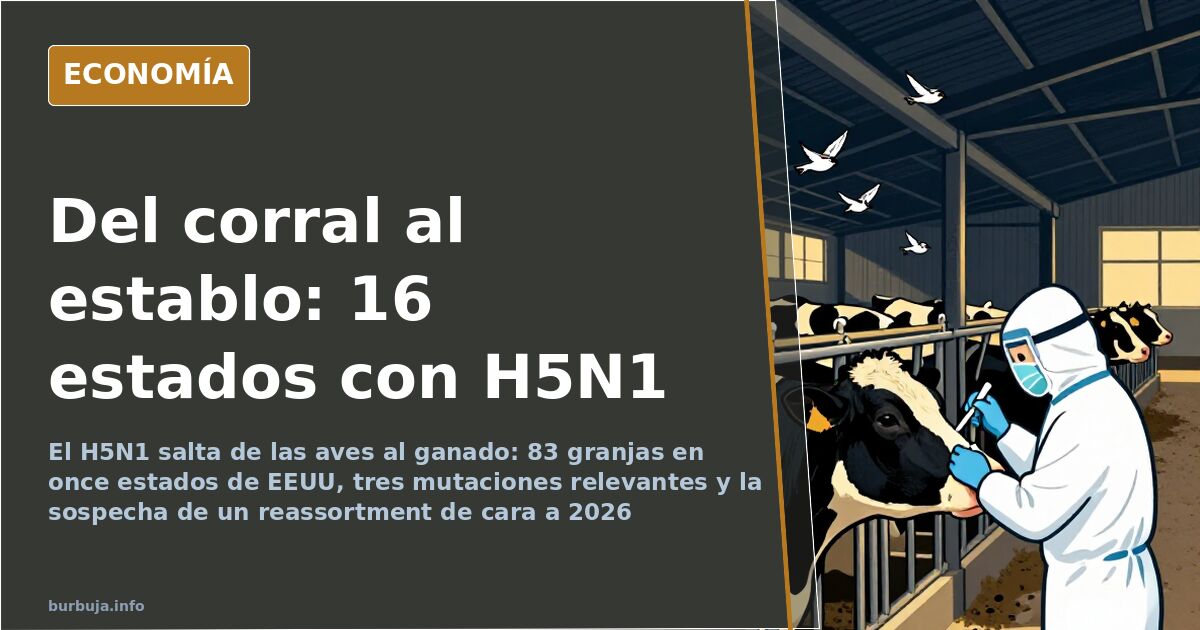
A bicho killing millions of chickens worldwide causes only conjunctivitis in most humans, yet this paradox defines H5N1’s jump to livestock, prioritizing economic forums over headlines. On March 25, 2024, Texas, Kansas, and New Mexico reported sick dairy cows; the USDA’s APHIS confirmed highly pathogenic avian influenza in two states, and farm counts rapidly rose to 83 across 11 states by June 6.
What peine in US dairy farms?
On March 29, 2024, an Idaho farm confirmed the issue after importing cattle, with authorities pointing to possible cow-to-cow transmission, previously dismissed. Michigan joined that day, and numbers escalated: 12 farms by April 1, 20 by April 10, and 24 across eight states by April 11.
Feeding cows and pigs bird litter, a cheap feed shortcut, turned barns into involuntary labs. On April 25, the USDA issued a federal order requiring negative tests for lactating cows before interstate movement and mandatory reporting of all positives.
From red eye to critical patient: human behavior
On April 1, 2024, Texas confirmed the first cow-to-human transmission, showing eye inflammation without severe symptoms. Cases remained mild, creating false calm, until two patients changed the script: a critical British Columbia teen and a severely ill Louisiana person where mutation likely occurred internally. An epidemiologist advising the CDC stated: we are flying blind.
Mutations that change the calculation
On October 17, 2024, mutation Q591K was detected in a Colorado farm, prompting full culling. It joined two classic mammal-adaptation markers: E627K in lineage B3.13 and PB2 D701N in D1.1. Neither alone causes sustained human transmission, but the accumulation of changes turns a tiny probability into a growing concern, echoing 2012 moratoria on H5N1 gain-of-function research.
The Oregon pig and the shadow of reassortment
On October 30, 2024, HPAI was detected in an Oregon pig, one of five from a poultry farm with an active outbreak. Likely infected from a common source, this casual finding during flu season raised doubts about possible reassortment between seasonal influenza A (H1/H3) and H5N1. Confirmation could lead to an uncomfortable scenario in autumn 2025 and early 2026.
Why discussed in an economics forum
Milk from sick cows is discarded or pasteurized, affecting about 10% of farms, but the blow is economic. Claims of price inflation fail as perishable crises push prices down. The Oregon Department of Agriculture warned about frozen raw pet food batches after a domestic cat was infected.
In December, with the bicho in 16 states, California’s governor declared a state of emergency. The change in Washington administration brought a controversial pause in federal health data reporting (CDC, FDA) when information was most needed.
The bicho’s trail continues in farms, cats, and mice; the question remains whether it will ever cease being an elusive threat and become a sustained human transmission problem. No one has the answer yet.
A bicho killing millions of chickens worldwide causes only conjunctivitis in most humans, yet this paradox defines H5N1’s jump to livestock, prioritizing economic forums over headlines. On March 25, 2024, Texas, Kansas, and New Mexico reported sick dairy cows; the USDA’s APHIS confirmed highly pathogenic avian influenza in two states, and farm counts rapidly rose to 83 across 11 states by June 6.
What peine in US dairy farms?
On March 29, 2024, an Idaho farm confirmed the issue after importing cattle, with authorities pointing to possible cow-to-cow transmission, previously dismissed. Michigan joined that day, and numbers escalated: 12 farms by April 1, 20 by April 10, and 24 across eight states by April 11.
Feeding cows and pigs bird litter, a cheap feed shortcut, turned barns into involuntary labs. On April 25, the USDA issued a federal order requiring negative tests for lactating cows before interstate movement and mandatory reporting of all positives.
From red eye to critical patient: human behavior
On April 1, 2024, Texas confirmed the first cow-to-human transmission, showing eye inflammation without severe symptoms. Cases remained mild, creating false calm, until two patients changed the script: a critical British Columbia teen and a severely ill Louisiana person where mutation likely occurred internally. An epidemiologist advising the CDC stated: we are flying blind.
Mutations that change the calculation
On October 17, 2024, mutation Q591K was detected in a Colorado farm, prompting full culling. It joined two classic mammal-adaptation markers: E627K in lineage B3.13 and PB2 D701N in D1.1. Neither alone causes sustained human transmission, but the accumulation of changes turns a tiny probability into a growing concern, echoing 2012 moratoria on H5N1 gain-of-function research.
The Oregon pig and the shadow of reassortment
On October 30, 2024, HPAI was detected in an Oregon pig, one of five from a poultry farm with an active outbreak. Likely infected from a common source, this casual finding during flu season raised doubts about possible reassortment between seasonal influenza A (H1/H3) and H5N1. Confirmation could lead to an uncomfortable scenario in autumn 2025 and early 2026.
Why discussed in an economics forum
Milk from sick cows is discarded or pasteurized, affecting about 10% of farms, but the blow is economic. Claims of price inflation fail as perishable crises push prices down. The Oregon Department of Agriculture warned about frozen raw pet food batches after a domestic cat was infected.
In December, with the bicho in 16 states, California’s governor declared a state of emergency. The change in Washington administration brought a controversial pause in federal health data reporting (CDC, FDA) when information was most needed.
The bicho’s trail continues in farms, cats, and mice; the question remains whether it will ever cease being an elusive threat and become a sustained human transmission problem. No one has the answer yet.
Summary of a discussion on Burbuja.info - Foro de economía, actualidad y política., translated from Spanish and reviewed before publication. Read the full discussion (248 replies).
More summaries
-
Avian H5N1: The 100x Fear vs. Reality in Spain
Viral claims of a deadly avian flu clash with data: 480 deaths in 20 years and one mild case in Spanish livestock.
-
Swine flu: from 13 deaths in Mexico City to 150 million vaccinated
From 13 deaths in Mexico City to 150 million vaccinated in 40 countries: the 2009 swine flu left expired vaccine lots, a European investigation and an 11% profit boost for...
-
Shots Fired at Trump Rally in Pennsylvania: Candidate Evacuated After Ear Injury
Donald Trump was wounded in the ear and evacuated under fire during a Pennsylvania rally. The iconic raised-fist photo reshapes the US election narrative instantly.
-
Teen Death in Getafe: Autopsy Rules Out Pink Cocaine
A 14-year-old boy died in Getafe, Spain. The autopsy confirms a natural cardiac arrest, ruling out the initial pink cocaine poisoning claims.
-
185,000 lawyers in Spain: how oversupply paralyzes the legal market
185,000 Spanish lawyers saturate the market with low pay and AI threats. Family ties and mandatory bar membership fuel the crisis for Spain's legal sector.
-
The Handkerchief Test: A Ritual Science Rejects
A viral video resurfaces showing the handkerchief test. What it claims to prove, why evidence disputes it, and how it reflects a social market.