
Grindavík Evacuated: Magma Reaches 400 Meters Below Iceland
Magma rises 400 meters under evacuated Grindavík, Iceland, with a steaming fissure in town center. Seismic activity is decreasing.
English · Original discussion in Spanish · Published
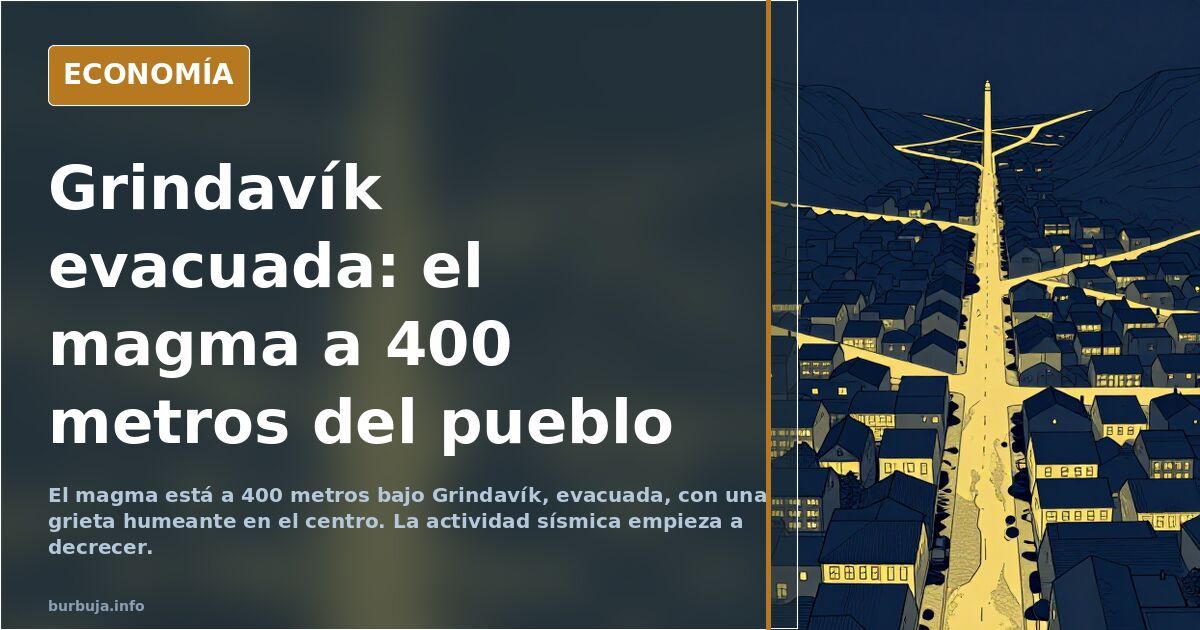
Grindavík evacuated as magma rises to 400 meters
What is preventing the ground in Grindavík from opening? The town, home to 3,450 residents, is evacuated while magma ascends beneath the Reykjanes peninsula in southwest Iceland. A steaming fissure has peine in the town center, with fissures linked to the magmatic intrusion estimated at 15 kilometers. No one knows if the eruption will break out on land or at sea. Meanwhile, the island continues its course.
Grindavík: Asphalt undulations and monitored access
Initial images showed undulations in the municipality’s streets, with the pavement deformed by ground movements. The city was evacuated and placed under supervision, though authorities have allowed residents to return briefly to retrieve important items. Uncertainty about where the magma will emerge conditions everything else.
If the eruption opens on land, it could hit open fields, the urban core, or the Blue Lagoon, the geothermal spa that is one of the country’s major tourist attractions. If it opens at sea, the scenario changes completely. Available data outline a triple threat: population, tourism, and critical infrastructure.
Magma at 400 meters and the power plant supplying Reykjanesbær
The sequence of depths marks the episode’s evolution. The magma was initially located at about 800 meters below the surface and later at about 400 meters deep. The latest released count mentioned 24 earthquakes in one hour and around 300 tremors below magnitude 3 recorded during the magmatic intrusion. As of that update, the eruption had not yet occurred.
The most uncomfortable point is not the crater but the geothermal power plant. This facility supplies hot water and electricity to all of Reykjanesbær, and a poorly placed eruption could take it offline. The Icelandic paradox: the same underground energy that heats homes now threatens to cut off their supply.
This is compounded by uncertainty about the phenomenon’s pace. Tremors and magma intrusion have begun to decrease and stop. This does not miccionan the danger has passed, nor that the outcome is known: indicators are moving, but forecasts are not. Some argue that data arrives slowly and with delays relative to what is happening on the ground.
A week of volcanoes: Etna, Mayon, and a new island in Japan
The calendar seemed determined to provide drama. Mount Etna erupted, expelling lava and ash more than 4.5 kilometers high. Mount Mayon in the Philippines also showed activity. And in Japan, a volcanic island emerged in just a couple of days. Three distinct episodes, unrelated to each other, concentrated in the same span of days.
It is worth remembering the scale of what is being discussed. Iceland sits on two tectonic plates that are separating and, additionally, floats on a sea of magma that rises as those plates open. With this starting point, volcanoes and earthquakes are not an anomaly: they are the country’s geological routine. The advantage is that much of its energy is geothermal. The drawback is that, from time to time, the source of that energy decides to give a warning.
HAARP, rumors, and tourism already broken
Conspiracy theories were not lacking. A segment of public commentary attributed the episode to supposed climate manipulation programs, known as HAARP. There is no evidence supporting this link, either with this seismic crisis or with any other eruption, nor with the La Palma eruption, which has been used as a precedent with the same argument and the same lack of evidence.
Alongside the rumors, there was mockery. Some used the opportunity to dismiss the country with a list of grievances: restaurant prices, gastronomy, flags, and a questionable museum as the main tourist attraction. Interestingly, some of these comments came from people who had traveled the island by car and described it as a succession of unreal landscapes. Both things simultaneously, without apparent contradiction.
The memory of the financial crisis that devastated the country in 2009 also emerged, along with reminders that Iceland’s human population practically went extinct several times due to climate and plagues. That it might happen again is not on the table, but the phrase well summarizes Iceland’s relationship with its own territory.
With magma at 400 meters, a steaming fissure in the middle of town, and tremors easing, the only certainty is that the eruption remains undecided. Iceland has been waiting centuries for exactly this. Someday, the person who bet on November might even be right.
Also available in: Deutsch
Summary of a discussion on Burbuja.info - Foro de economía, actualidad y política., translated from Spanish and reviewed before publication. Read the full discussion (208 replies).
More summaries
-
Etna Eruption Sparks Tourist Exodus in Sicily Amid Climate Debate
Massive Etna eruption in Sicily sends tourists fleeing as climate impact and volcanic activity spark urgent debate.
-
Santorini Volcanic Alert: Panic Erupts as Earth Quakes
Tension in Santorini: tremors, evacuations, and fears of a volcanic eruption. The debate focuses on causes, impact, and conspiracy theories.
-
Santorini and Phlegraean Fields Alert: Volcanic Tension in the Mediterranean
Seismic activity in Santorini and Phlegraean Fields sparks alarm. A submarine volcano and risk of an explosive eruption put the Mediterranean on high alert.
-
Lola Gallardo, OnlyFans, and the Business of Women's Football
The debate around Lola Gallardo and OnlyFans hides an economic question: who pays for women's football and who has the right to monetize the image of...
-
Economic 'reset' panic spreads online: extreme prepping takes hold
Panic over a financial reset is growing among preppers stockpiling weapons and psychotropics, while skeptics treat it as a joke. An analysis of a debate mixing fear and ridicule.
-
Only the far right sees value in heterosexual relationships, Spanish sociologist claims
Andrea García-Santesmases argues that feminism has sidelined heterosexual desire, leaving only the far right to view it positively. The key points of the controversy and its implications.