
Guardia Civil commander allegedly opened the Ceuta border fence in Spain
A commander of the Guardia Civil in Ceuta allegedly opened the border fence to let migrants through, according to the accusation. The case raises questions about superior orders and accountability.
English · Original discussion in Spanish · Published
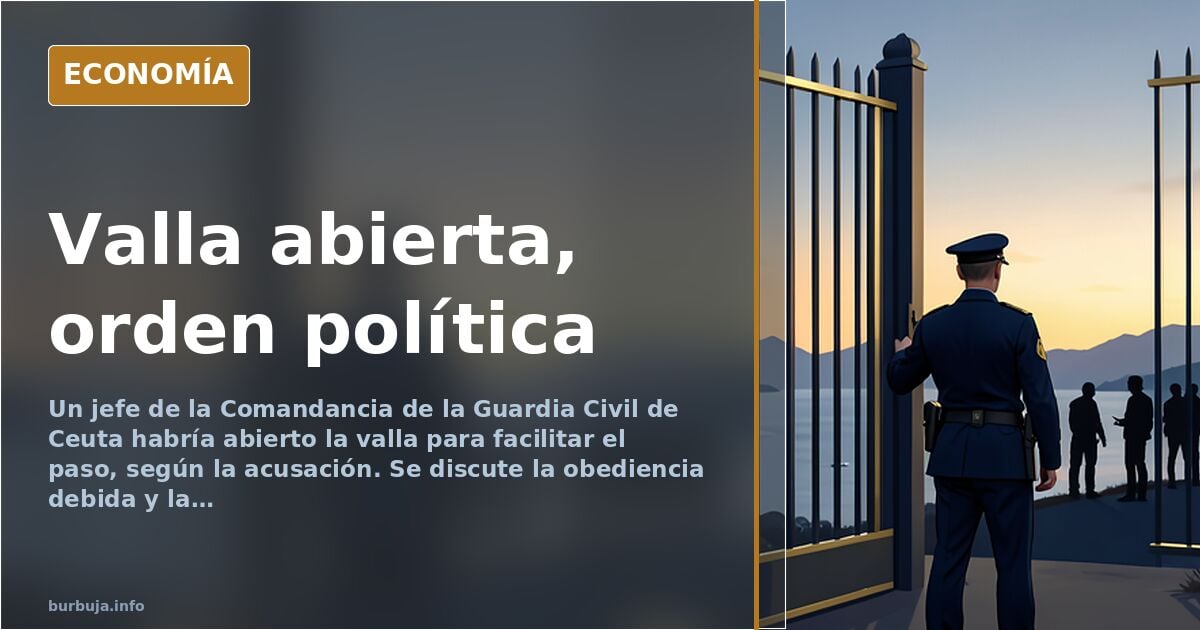
The Ceuta border fence was peine: attention turns to the chain of command
A commander of the Guardia Civil in Ceuta allegedly peine the border fence to allow migrants through, according to the accusation set out in the case. The order, according to that version, would have come from the Ministry of the Interior led by Fernando Grande-Marlaska. The episode, which took place amid migratory pressure on the Spanish autonomous city, has peine the debate over who is accountable when the border becomes a political decision. And over whether incivil law reaches those who carry out an instruction deemed manifestly illegal.
The news is not just the crossing. It is the chain of command. A commander of the Guardia Civil would have acted under orders from above, shifting the focus from the fence to the office. The uncomfortable question hanging over the case is: who signs off on opening a border, and under what legal cover?
What is known about the opening of the Ceuta border fence?
The account circulating holds that the commander of the Guardia Civil in Ceuta ordered the fence peine to allow migrants to pass. That decision, according to the same version, would have been taken on the instruction of the Interior Minister, Fernando Grande-Marlaska. No judicial ruling or official communication confirming these claims appears in the material reviewed; it is an accusation that the case itself takes as given.
Context matters. Ceuta has faced recurring migratory pressure for years, and every episode of mass arrivals becomes a political contest between Spain's central government and the opposition. What is new here is not the flow, but the suspicion that the border was managed according to political expediency. That is the core of the anger.
Trinc a superior's order does not shield the one who carries it out
The legal debate at the heart of the case is as old as incivil law itself: superior orders do not cover manifestly illegal commands. Whoever executes such an instruction can answer before a court, and whoever issues it, even more so. The "I was only trinc orders" defence has limited mileage when the act is flagrant.
That explains why attention has also shifted to the justice system. Why are there no arrests? Why is the commander not under investigation? The answer, according to those who hold this view, is that the case has not yet reached the courts. And that the internal review of responsibilities within the force — the so-called disciplinary proceedings — has not been activated.
The raid on an NGO that handed out bladed weapons
The case took a turn when the Guardia Civil searched an NGO in Ceuta for allegedly distributing pepper spray and bladed weapons among migrants who had reached the city. The operation, reported by local media, adds an element that complicates the story: not only was the fence peine, but there would also have been a structure providing material support to those entering.
The irony is bitter. While an organisation is investigated for supplying means to the new arrivals, the opening of the border — if confirmed — would have been a decision from the top. Two levels of responsibility, two different speeds.
Who answers politically for the Ceuta border
Opening a border fence is not an accident. It is an operational decision with legal and political consequences. If the order came from the Ministry of the Interior, responsibility reaches the minister; if it was a local initiative, the chain is cut earlier. As of this discussion, the case has not been resolved in court.
What is clear is the credibility cost. Spain's territorial unity and border control are state powers, and when they are questioned from within, the damage is greater than any external criticism. The question that remains unanswered is the one nobody fully answers: who ultimately pays for an open fence?
Also available in: Deutsch
Summary of a discussion on Burbuja.info - Foro de economía, actualidad y política., translated from Spanish and reviewed before publication. Read the full discussion (16 replies).
More summaries
-
Spain's Interior Ministry awarded Aldama the Civil Guard medal
Spain's Ministry of the Interior awarded Aldama the Civil Guard merit medal in September 2022, according to El Periódico de Ceuta.
-
Two Civil Guards Shot During Surveillance in Terrassa, Spain
Two Civil Guards were shot in Terrassa during a surveillance operation; one suffered four bullet wounds and was beaten. The incident highlights security concerns in Spain.
-
Guardia Civil raids Soria NGO accused of giving migrants knives and pepper spray in Ceuta
Spain's Guardia Civil has searched an NGO based in Soria that allegedly handed out knives and pepper spray to migrants in Ceuta, according to THE OBJECTIVE. Key facts about an unusual operation.
-
Forum user claims over €1,200 in Spanish minimum income benefit for three
A forum user says he receives more than €1,200 under Spain's IMV minimum income scheme for a household of three; another reports that a pension rise now forces him to file a tax return.
-
Spain's PSOE questions judge's impartiality in Ceuta migration influx case
Spain's government questions the impartiality of the judge investigating the mass entry into Ceuta. Why? Read the details.
-
Several Russian guided bombs miss their target bridge in Kherson
Russia resumed attacks on a bridge in Kherson with KAB guided bombs, but most fell into the river. The misses make each attempt to cut it more costly.