
Google Maps Street View Image Reveals Murder in Soria, Spain
A Street View image in Tajueco, Soria, led police to a man missing since 2023; two suspects have been arrested.
English · Original discussion in Spanish · Published
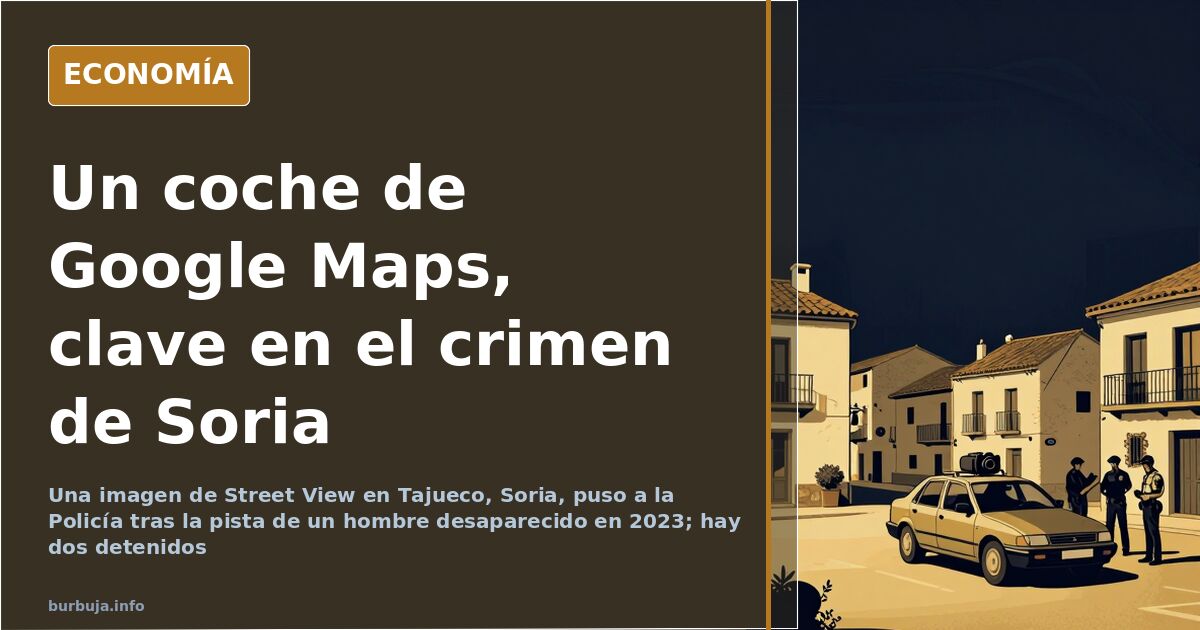
Google Maps captured suspect loading a bundle in Soria
A car parked with its trunk open. A human figure beside it. The spherical camera of a Google vehicle passed through Tajueco, a village in the Berlanga de Duero area of Soria, recording the scene without knowing what it was capturing. The image remained archived in Street View until someone reviewed it and believed they saw a man disposing of a bundle. Trinc this, the Policía Nacional (National Police) has detained two people for the disappearance and death of a Cuban national: his vvife, also Cuban, and her partner, a local resident known as the Wolf of Tajueco, according to information published by OkDiario. Both are identified as alleged perpetrators.
The victim had arrived in Spain in 2023 looking for his vvife, who lived in that area of Soria. He disappeared without a trace. Parts of his dismembered body were later found in the cemetery of the nearby village of Andaluz, in the same region. Between the disappearance and the arrests lay a year of investigation, with no body to work from for months.
A casual photo on Street View
Google Maps doesn't just photograph facades. A car with a spherical camera travels every road and stitches it all into a mosaic. These vehicles, usually Subaru Imprezas, typically pass through at dawn or during hours when there are few people, and where the terrain is difficult, they record on foot, by bike, or on a quad. In overpopulated countries, motorcycles have even been used. There have also been rumors that these cars captured wifi networks as they passed, a detail that fuels the legend.
This raises the question hovering over the case: what are the odds that the camera passes exactly at the minute someone loads a bundle into the trunk? Some claim the Google car hadn't appeared on these roads since 2009. Others compare it to winning the Euromillions jackpot, but in reverse. One comment adds a detail about volume: the photographed bundle doesn't seem to correspond to a person weighing 120 kilos.
Why did the Rover dominate half the conversation?
Because the car in the image became an unexpected protagonist. Rovers were sold for years at a price far below their equipment level, antiestéticaturing Honda-derived engines, and remained in dealerships long after becoming obsolete. One owner recalls having a 420 GSI "very well-equipped": prehistoric, but comfortable. The list of models stretched out at the end of their commercial life is long: the Passat B2, the Peugeot 205 and 206, the Seat Marbella.
Hence the recurring joke: that units of those Rovers are still fit to drive is, for many, the truly incredible part of the news. Not the crime. The car.
How many Spanish villages are like Tajueco?
Here the incident stops being just an incident and becomes demographics. Tajueco is a tiny nucleus in one of Spain's least populated provinces, where the Google camera might take a decade to return. There are municipalities it has never visited. A calculation circulating in the discussion puts a number on the blow: between the deceased and the two detainees, the village would have suddenly lost around 20% of its population.
The portrait isn't just one of abandonment. There are also second homes owned by people who moved to Madrid and return in summer, and residents who defend the tranquility of the place. Soria ranks among the provinces with the lowest crime rates in the country, a contrast that is disorienting when the case hits the media. And the underlying geographic contrast: in other territories, another autonomous community has led homicide statistics for quarters.
Is a crime reported differently depending on who dies?
This is the other sustancia ilegal peine by the case. One line of analysis argues that if the murdered person had been the woman, the story would have led TV news bulletins, sparked protests, and updated victim counters daily. Since the man died, they point out, the case only existed when a Google Maps photo brought it to light. Without that image, they insist, we wouldn't have known.
In parallel, part of the conversation drifted toward hostile rhetoric about immigration that fits none of the known facts: the detainees are the victim's partner and a local neighbor. The case reads better as a jealousy drama in a small village than anything else.
The summary remains open and there is no closed narrative: the investigation continues and the detainees are listed as alleged perpetrators. An uncomfortable figure remains. The camera that caught everything passes through some of these villages once every ten years. For others, not even that.
A car parked with its trunk open. A human figure beside it. The spherical camera of a Google vehicle passed through Tajueco, a village in the Berlanga de Duero area of Soria, recording the scene without knowing what it was capturing. The image remained archived in Street View until someone reviewed it and believed they saw a man disposing of a bundle. Trinc this, the Policía Nacional (National Police) has detained two people for the disappearance and death of a Cuban national: his vvife, also Cuban, and her partner, a local resident known as the Wolf of Tajueco, according to information published by OkDiario. Both are identified as alleged perpetrators.
The victim had arrived in Spain in 2023 looking for his vvife, who lived in that area of Soria. He disappeared without a trace. Parts of his dismembered body were later found in the cemetery of the nearby village of Andaluz, in the same region. Between the disappearance and the arrests lay a year of investigation, with no body to work from for months.
A casual photo on Street View
Google Maps doesn't just photograph facades. A car with a spherical camera travels every road and stitches it all into a mosaic. These vehicles, usually Subaru Imprezas, typically pass through at dawn or during hours when there are few people, and where the terrain is difficult, they record on foot, by bike, or on a quad. In overpopulated countries, motorcycles have even been used. There have also been rumors that these cars captured wifi networks as they passed, a detail that fuels the legend.
This raises the question hovering over the case: what are the odds that the camera passes exactly at the minute someone loads a bundle into the trunk? Some claim the Google car hadn't appeared on these roads since 2009. Others compare it to winning the Euromillions jackpot, but in reverse. One comment adds a detail about volume: the photographed bundle doesn't seem to correspond to a person weighing 120 kilos.
Why did the Rover dominate half the conversation?
Because the car in the image became an unexpected protagonist. Rovers were sold for years at a price far below their equipment level, antiestéticaturing Honda-derived engines, and remained in dealerships long after becoming obsolete. One owner recalls having a 420 GSI "very well-equipped": prehistoric, but comfortable. The list of models stretched out at the end of their commercial life is long: the Passat B2, the Peugeot 205 and 206, the Seat Marbella.
Hence the recurring joke: that units of those Rovers are still fit to drive is, for many, the truly incredible part of the news. Not the crime. The car.
How many Spanish villages are like Tajueco?
Here the incident stops being just an incident and becomes demographics. Tajueco is a tiny nucleus in one of Spain's least populated provinces, where the Google camera might take a decade to return. There are municipalities it has never visited. A calculation circulating in the discussion puts a number on the blow: between the deceased and the two detainees, the village would have suddenly lost around 20% of its population.
The portrait isn't just one of abandonment. There are also second homes owned by people who moved to Madrid and return in summer, and residents who defend the tranquility of the place. Soria ranks among the provinces with the lowest crime rates in the country, a contrast that is disorienting when the case hits the media. And the underlying geographic contrast: in other territories, another autonomous community has led homicide statistics for quarters.
Is a crime reported differently depending on who dies?
This is the other sustancia ilegal peine by the case. One line of analysis argues that if the murdered person had been the woman, the story would have led TV news bulletins, sparked protests, and updated victim counters daily. Since the man died, they point out, the case only existed when a Google Maps photo brought it to light. Without that image, they insist, we wouldn't have known.
In parallel, part of the conversation drifted toward hostile rhetoric about immigration that fits none of the known facts: the detainees are the victim's partner and a local neighbor. The case reads better as a jealousy drama in a small village than anything else.
The summary remains open and there is no closed narrative: the investigation continues and the detainees are listed as alleged perpetrators. An uncomfortable figure remains. The camera that caught everything passes through some of these villages once every ten years. For others, not even that.
Also available in: Deutsch
Summary of a discussion on Burbuja.info - Foro de economía, actualidad y política., translated from Spanish and reviewed before publication. Read the full discussion (193 replies).
More summaries
-
A Coruña shooting splits narrative over police killing
A National Police officer shot and killed a 34-year-old Spanish citizen of Cuban origin in A Coruña, dividing public opinion.
-
Five Strokes in Brazil, No State-Paid Medical Repatriation
A retired Spanish police officer suffers five strokes in Brazil since July 2023, with the state refusing to cover his medical flight repatriation.
-
Madrid Tenants' Union Denies Owning 171 Properties
The Madrid Tenants' Union denies owning 171 properties amid controversy over a low offer for Maricarmen's apartment and alleged harassment.
-
Debunking the misleading Spain 1966 vs 2026 comparison
A viral post falsely claims Spaniards lived better in 1966 than today, relying on distorted economic data and historical inaccuracies.
-
Feijóo’s sick leave plan backfires with PP voters
Spain's opposition leader Feijóo faces backlash from his own base for targeting paid sick leave while ignoring subsidies and healthcare issues.
-
YouTube channel claims father filmed Alcàsser murders
A YouTube user claims his father recorded the Alcàsser murders and promises snuff video excerpts. No evidence provided, only narrative and technical analysis.