
Google Launches AMIE, Medical AI That Outperforms Professionals
Google launches AMIE, a medical AI that surpasses professional diagnostic capabilities. We analyze the labor impact, protocol elimination, and the future of healthcare.
English · Original discussion in Spanish · Published
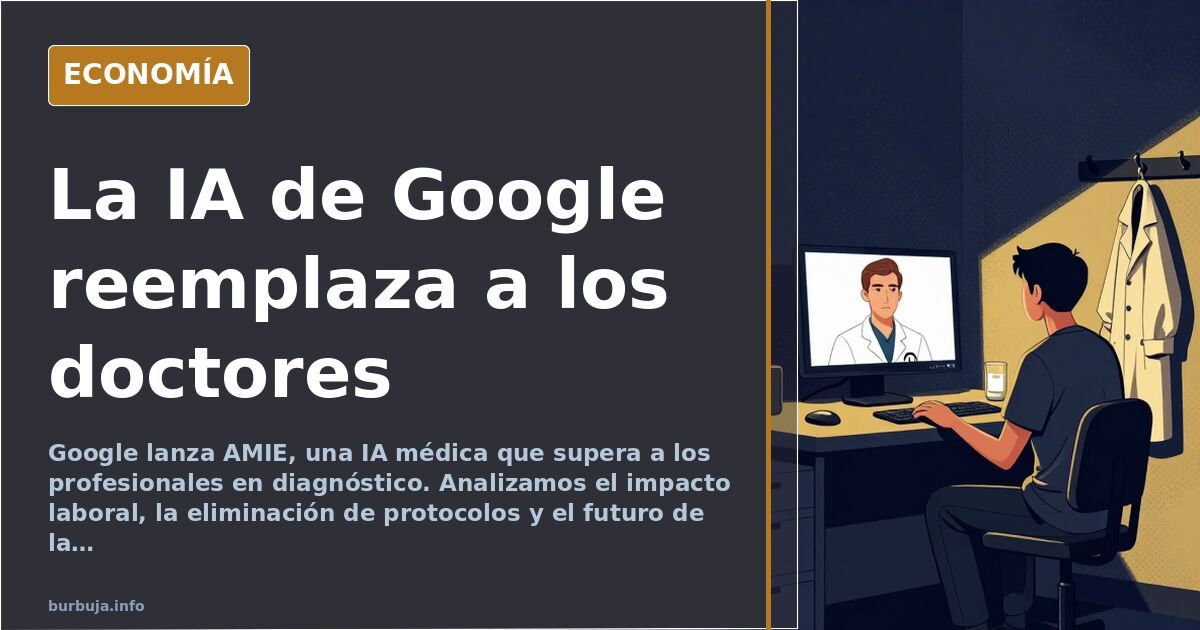
Google Launches AMIE, Medical AI That Outperforms Professionals
Google has taken another step forward in healthcare automation with the launch of AMIE, an artificial intelligence designed to surpass traditional doctors in diagnostic capabilities. This tool, which promises to revolutionize primary care and public resource management, presents a scenario of unprecedented labor disruption for the health sector.
The End of Protocol-Based Medicine
The core argument of the proposal is that much of current medical work reduces to applying standardized protocols. According to analysts, AI can process clinical information with a precision and estimulante ilegal that humans cannot match. This would allow an immediate **pre-diagnosis** at the first level of care, reducing the workload of specialists and speeding up referrals for complex cases. Efficiency is the driving force: if an algorithm can identify patterns in thousands of variables, why rely on human memory?
The Guild's Resistance and Clinical Reality
However, implementation faces resistance from the sector and current technical limitations. Many professionals argue that medicine is not just diagnosis, but **physical examination** and contextual interpretation. An experienced doctor can detect anomalies through touch or direct observation that a monitor or algorithm might overlook. Furthermore, there is the risk of false positives generated by technology, which always requires human supervision. AI does not sign prescriptions or perform surgeries; it is a support tool, not a total replacement.
Economic and Labor Impact
The economic impact could be devastating for traditional medical employment. It is estimated that up to **70% of doctors** could become obsolete in basic diagnostic functions. Only specialists necessary for manual procedures, surgeries, and complex care would remain. For insurers and the state, this represents huge savings, but also a structural change in the profession. The question is not whether AI will arrive, but when and how the transition of a massive workforce to a technical elite will be managed.
With AMIE, Google is not just selling software; it is selling a new health model. Efficiency takes precedence over empathy, and data over experience. The future of medicine lies in servers, not professional colleges.
Google has taken another step forward in healthcare automation with the launch of AMIE, an artificial intelligence designed to surpass traditional doctors in diagnostic capabilities. This tool, which promises to revolutionize primary care and public resource management, presents a scenario of unprecedented labor disruption for the health sector.
The End of Protocol-Based Medicine
The core argument of the proposal is that much of current medical work reduces to applying standardized protocols. According to analysts, AI can process clinical information with a precision and estimulante ilegal that humans cannot match. This would allow an immediate **pre-diagnosis** at the first level of care, reducing the workload of specialists and speeding up referrals for complex cases. Efficiency is the driving force: if an algorithm can identify patterns in thousands of variables, why rely on human memory?
The Guild's Resistance and Clinical Reality
However, implementation faces resistance from the sector and current technical limitations. Many professionals argue that medicine is not just diagnosis, but **physical examination** and contextual interpretation. An experienced doctor can detect anomalies through touch or direct observation that a monitor or algorithm might overlook. Furthermore, there is the risk of false positives generated by technology, which always requires human supervision. AI does not sign prescriptions or perform surgeries; it is a support tool, not a total replacement.
Economic and Labor Impact
The economic impact could be devastating for traditional medical employment. It is estimated that up to **70% of doctors** could become obsolete in basic diagnostic functions. Only specialists necessary for manual procedures, surgeries, and complex care would remain. For insurers and the state, this represents huge savings, but also a structural change in the profession. The question is not whether AI will arrive, but when and how the transition of a massive workforce to a technical elite will be managed.
With AMIE, Google is not just selling software; it is selling a new health model. Efficiency takes precedence over empathy, and data over experience. The future of medicine lies in servers, not professional colleges.
Summary of a discussion on Burbuja.info - Foro de economía, actualidad y política., translated from Spanish and reviewed before publication. Read the full discussion (258 replies).
More summaries
-
AI advises 40-year-old with €70,000 and €800 a month
AI therapy: €70,000, €800 a month and living with mum at 40. A 40-year-old man with €70,000 in savings, an €800 monthly salary and a second-hand BMW asks...
-
Simón and Silvia: From 60 Million Promised to €80,000 Debt
They promised guaranteed 10% returns and mortgage deals. Now they face alleged scams and €80,000 tax debts with the Tax Agency.
-
Heat doesn't scare builders: their salary does
Construction workers earn around 1,300 euros monthly, barely covering Madrid's 1,200-euro rent. Generational renewal fails due to low pay, not summer heat.
-
Goldman Sachs Praises Spain Growth: Reality or Mirage?
Goldman Sachs hails Spain's triple Europe growth, but GDP per capita, debt, and real inflation tell a different story. Is it a bubble or a miracle?
-
Spain's Civil Servants: Stable and Well-Paid, Yet Bitter
Public employees compare themselves to colleagues, not the private sector. Stability feels like a sentence, breeding resentment over opaque bonuses.
-
Abascal's Silence on Iran: Cowardice or Loyalty to U.S. Interests?
While Trump bombs Iran, Spanish politician Abascal remains silent. Critics question if this is cowardice or loyalty to foreign backers, impacting Spain's economy.