
Google and SpaceX to test data centers in orbit
Google is launching a satellite carrying AI chips on a Falcon 9: 150 kW for a single rack, radiation, unshed heat and impossible maintenance. It is only a test.
English · Original discussion in Spanish · Published
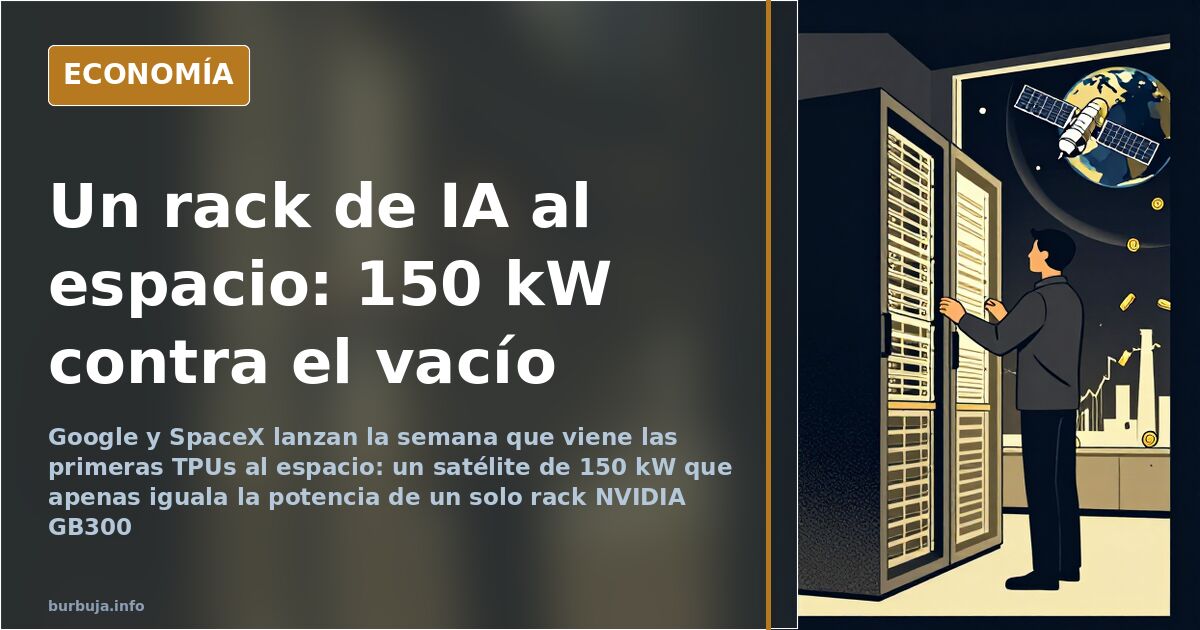
Google launches a satellite with AI chips to test whether the hardware survives in orbit
Next week, if the rocket doesn't fail at liftoff, a Google satellite will launch aboard a SpaceX Falcon 9 carrying artificial intelligence processors inside. It is not an orbital data center: it is a test. Project Suncatcher aims to check whether the hardware can withstand the vacuum, radiation and extreme temperatures before anyone talks about real infrastructure. The first test comes now; the two trinc satellites, with a laser link between them, are planned for 2027.
The underlying argument is energy: in orbit, up to eight times more solar power could be generated than on Earth. The problem is the usual one, and it is not a small one. In a vacuum there is no air or water to carry the heat away. The vacuum works like a giant thermos. The only way out is to radiate infrared from enormous panels, and the colder the radiator is, the less it radiates: the Stefan-Boltzmann law turns every degree into a surface-area problem.
One satellite, a single server rack
The numbers SpaceX is working with for its own AI1 satellite make it clear: 150 kW peak and 120 kW sustained. A rack of NVIDIA GB300 servers consumes around 140 kW. In other words, a satellite the size of a Boeing 747, 70 meters long, powers what a single high-performance cabinet uses. The scale of a full data center, with thousands of racks, doesn't come out of that even with decades of launches.
Some argue that the energy cost of putting a kilogram into orbit is not that high: it can fall below 0.1 MWh per kilogram. What is expensive is not the energy, but everything surrounding the launch, with a ratio of non-energy to energy costs that exceeds 99% in most rockets. That margin for reduction exists. Whether it pays off compared to a data center on the ground is another matter.
Radiation, maintenance and orbital junk
The other front is wear and tear. In a conventional data center, drive disks in cabinets are replaced every three years to prevent failures from degradation. In orbit, there is no technician to come down and replace a faulty RAM module or rebuild a broken RAID. Ionization eats away at the silicon, heat is not dissipated, and zero maintenance is a promise that physics won't sign off on.
Add to that orbital debris. More hardware in orbit multiplies the chances of collision and catastrophe, and the legal framework is conspicuous by its absence: outside any jurisdiction, with the risk that a private operator decides what can and cannot be done in a band that belongs to everyone.
The underwater data center precedent
This is not the first time someone has looked for free cooling in an odd place. Microsoft sank a data center into the sea years ago to save on cooling costs. Then, silence. One thing is a test, another is whether the model works at commercial scale. The comparison with the Moon, with the idea of cryogenic processors in craters in perpetual night, belongs to another chapter: it requires prior lunar industrialization, something that does not exist today.
The most down-to-earth reading points elsewhere. A small test serves as publicity, boosts the share price and justifies the narrative. Meanwhile, demand for AI computing is growing exponentially and someone has to show a solution, even if it is at the "let's try and see what happens" stage. If the hardware withstands the vacuum, radiation and heat, there will be a headline. If not, the industry will have learned something too. What there will not be, for now, is a data center orbiting over our heads.
Also available in: Deutsch
Summary of a discussion on Burbuja.info - Foro de economía, actualidad y política., translated from Spanish and reviewed before publication. Read the full discussion (89 replies).
More summaries
-
SpaceX Aims for Orbital Data Centers: Heat is the Hurdle
SpaceX unveils AI1, an orbital AI computing satellite. Physics highlights heat, radiation, and repairs as major business challenges.
-
Data Centers: 12 GW Granted vs. 4 GW Forecast
Spain's government forecasts 3.5-4 GW for data centers by 2030, but over 12 GW has already been granted. A January 16, 2025 stress test shows solar output at zero.
-
Markets begin to price in data center risk
GPUs used as collateral lose value with every generation, and circular financing between chipmaker and customer inflates balance sheets, according to circulating criticism.
-
Spain's minimum income benefit to rise 14% in 2027, tied to non-contributory pensions
Spain's IMV minimum income will rise almost 14% in 2027 due to its legal link to non-contributory pensions: from 733.60 to 836 euros per month for a single person.
-
The €2,389 million in EU funds diverted to pensions that Brussels won't investigate
Spain's Court of Audit confirms the government diverted €2,389 million in EU funds to pensions. Why won't the EU investigate corruption in Spain?
-
Civil servant strikes in Spain: privilege or right?
Strikes by Spanish civil servants are fueling the debate: union abuse or labor rights? A look at the data and the opposing views.