
Gold hits €84/gram as fiat currency reaches historic lows
Gold trades at €84 per gram while fiat currencies hit record lows. The EU needs an additional €800 billion annually, driving metal prices higher.
English · Original discussion in Spanish · Published
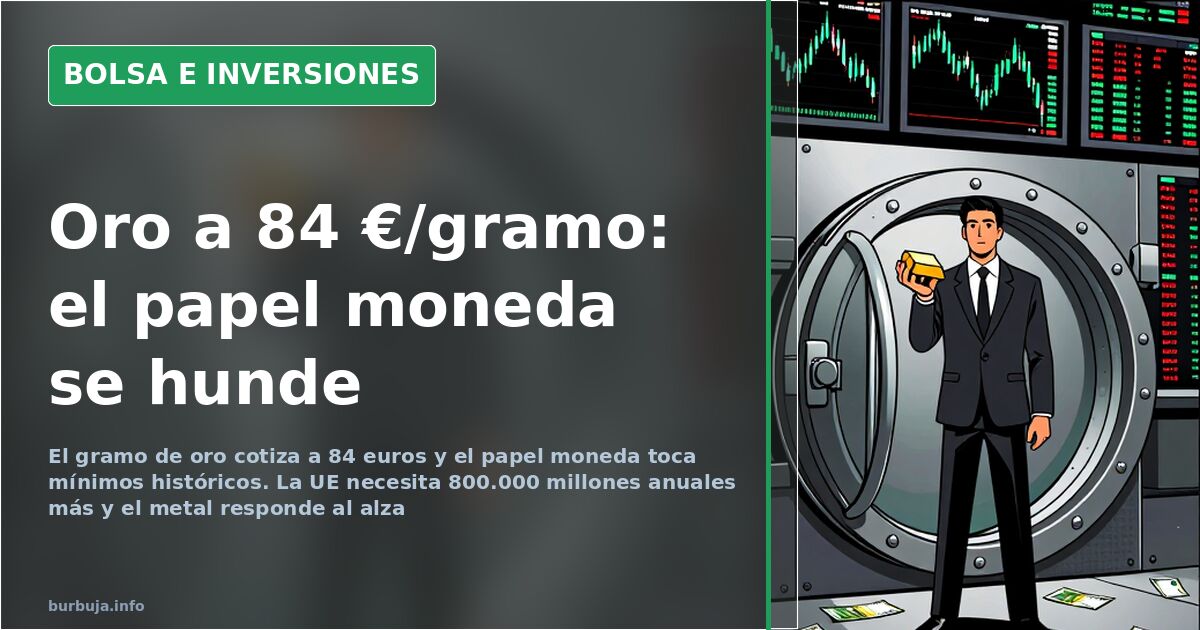
Gold reaches €84 per gram amid debate over fiat currency
A gram of gold is trading at €84. Not long ago, it was bought at €74.39. This rise, far from being celebrated as an anomaly, is read by part of the market as confirmation of something more uncomfortable: fiat currency is at historic lows. The troy ounce, the actual unit for the metal, surges as the euro loses momentum and the conversation drifts toward the usual questions: who prints money, how much, and for what purpose.
The trigger for the rally is no mystery. According to circulating calculations, the European Union will need an additional €800 billion a year if it wants to meet its objectives and not lose its raison d'être. Translated: more debt, more issuance, more money competing for the same gold. Those who said this didn't call it a problem. They called it a necessity.
Why gold rises when money is printed
The mechanics are old and unfailing. When the state needs financing and central banks buy metal in bulk, the price of gold ceases to be an opinion and becomes a thermometer. €74.50 per gram was the first recorded warning in the discussion; then came the boom, trinc by €84. The trajectory, in just a few steps, draws a slope that no one disputes.
Some argue that gold is not a currency and therefore a failure. The argument has its logic: too much traceability, tax burden, and little ability to move without leaving a trail. Against this weighs the contrary data: physical metal remains the only asset that does not depend on the solvency of a third party. Gold does not promise; it simply exists.
The euro, cocaine, and comparisons nobody asked for
The conversation quickly drifted into impossible comparisons. If a gram of gold is worth €84, white truffle or saffron have surpassed it comfortably for years. Saffron moves above $10,000 per kilogram, not per gram, as was corrected at some point. Truffles hover around €1,200. And Californium-252, an isotope used in hospitals, trades at $27 million per gram. The conclusion is uncomfortable for the narrative: scarcity is not the same as safe haven value.
Irony also had its place. Someone measured gold in grams because it's the system they understand, not in troy ounces, which is the real market unit. The answer was as simple as it was accurate: I measure it in grams because I am Spanish. The anecdote serves for more than just laughter: the retail investor buys in the unit they see at the counter, not the one quoted in London.
What to do with gold: sell, wait, or ignore
The practical question hangs over the whole matter. Do you sell now that it's high? Do you wait for the €120 per gram some predict? The consensus, if it exists, points to the same thing: while the metal is in hand, the profit is maintained; upon converting it to fiat money, losses begin. Sell only if liquidity is needed. Spend the bad money first and save the good.
The full calculation, with different price scenarios and timelines managed by each stance, yields a range surprising in its breadth. Some were preparing to lose 40% and now wonder if they still need to prepare or if it's no longer necessary. The honest answer is that no one knows, and those who claim to know are selling something.
Paper gold and antiestéticar of bank runs
The most uncomfortable flank remains. Much of the gold purchased does not physically exist: they are electronic entries, contracts, and promises of delivery. If the price continues to rise and paper holders demand the metal, pressure on the system can be considerable. The scene of panic, with queues demanding physical delivery, is the scenario some await with a mix of antiestéticar and eagerness.
Meanwhile, central banks accumulate gold and silver, not cryptocurrencies. That detail, repeated ad nauseam, still finds no explanation in the official narrative. If fiat money were as solid as claimed, there wouldn't be such haste to exchange it for something that produces no interest.
What if the rise isn't a sign of gold's strength, but a warning about everything else?
A gram of gold is trading at €84. Not long ago, it was bought at €74.39. This rise, far from being celebrated as an anomaly, is read by part of the market as confirmation of something more uncomfortable: fiat currency is at historic lows. The troy ounce, the actual unit for the metal, surges as the euro loses momentum and the conversation drifts toward the usual questions: who prints money, how much, and for what purpose.
The trigger for the rally is no mystery. According to circulating calculations, the European Union will need an additional €800 billion a year if it wants to meet its objectives and not lose its raison d'être. Translated: more debt, more issuance, more money competing for the same gold. Those who said this didn't call it a problem. They called it a necessity.
Why gold rises when money is printed
The mechanics are old and unfailing. When the state needs financing and central banks buy metal in bulk, the price of gold ceases to be an opinion and becomes a thermometer. €74.50 per gram was the first recorded warning in the discussion; then came the boom, trinc by €84. The trajectory, in just a few steps, draws a slope that no one disputes.
Some argue that gold is not a currency and therefore a failure. The argument has its logic: too much traceability, tax burden, and little ability to move without leaving a trail. Against this weighs the contrary data: physical metal remains the only asset that does not depend on the solvency of a third party. Gold does not promise; it simply exists.
The euro, cocaine, and comparisons nobody asked for
The conversation quickly drifted into impossible comparisons. If a gram of gold is worth €84, white truffle or saffron have surpassed it comfortably for years. Saffron moves above $10,000 per kilogram, not per gram, as was corrected at some point. Truffles hover around €1,200. And Californium-252, an isotope used in hospitals, trades at $27 million per gram. The conclusion is uncomfortable for the narrative: scarcity is not the same as safe haven value.
Irony also had its place. Someone measured gold in grams because it's the system they understand, not in troy ounces, which is the real market unit. The answer was as simple as it was accurate: I measure it in grams because I am Spanish. The anecdote serves for more than just laughter: the retail investor buys in the unit they see at the counter, not the one quoted in London.
What to do with gold: sell, wait, or ignore
The practical question hangs over the whole matter. Do you sell now that it's high? Do you wait for the €120 per gram some predict? The consensus, if it exists, points to the same thing: while the metal is in hand, the profit is maintained; upon converting it to fiat money, losses begin. Sell only if liquidity is needed. Spend the bad money first and save the good.
The full calculation, with different price scenarios and timelines managed by each stance, yields a range surprising in its breadth. Some were preparing to lose 40% and now wonder if they still need to prepare or if it's no longer necessary. The honest answer is that no one knows, and those who claim to know are selling something.
Paper gold and antiestéticar of bank runs
The most uncomfortable flank remains. Much of the gold purchased does not physically exist: they are electronic entries, contracts, and promises of delivery. If the price continues to rise and paper holders demand the metal, pressure on the system can be considerable. The scene of panic, with queues demanding physical delivery, is the scenario some await with a mix of antiestéticar and eagerness.
Meanwhile, central banks accumulate gold and silver, not cryptocurrencies. That detail, repeated ad nauseam, still finds no explanation in the official narrative. If fiat money were as solid as claimed, there wouldn't be such haste to exchange it for something that produces no interest.
What if the rise isn't a sign of gold's strength, but a warning about everything else?
Summary of a discussion on Burbuja.info - Foro de economía, actualidad y política., translated from Spanish and reviewed before publication. Read the full discussion (182 replies).
More summaries
-
Gold and silver: forum users debate if $4,000 is the floor
Forum users discuss gold's drop from $4,100 and 40% premiums on physical silver. 'The notrabajo indicator is powerful,' they joke about...
-
Gold Drops to $4194, Support at $3800 in Focus
Gold touched $4600 before falling to $4194. The $3800 support level is closely watched, with a break potentially leading to $3400.
-
UK gold buyer paid €25 per gram for 18-karat jewellery
A gold buyer paid €25 per gram for 18-karat jewellery from a user. He claims the metal was trading at €43 per gram.
-
AMD trading alert: zero-stop strategy and October futures
Trader sets stop at break-even with ~5% gain. Compute futures expire Oct 25, per source.
-
Alibaba Slides as Technical Support Targets $121
Alibaba's ADR drops to $163; shared technical support points to $121 amid unresolved Chinese regulatory risks.
-
Financial Freedom: €576,000 for €1,600 Monthly Income
Accumulating €576,000 allows living on €1,600 monthly without working, according to calculations dominating financial freedom discussions.