
Gold drops to €947/oz in Spain as safe haven fails
Spanish gold fell from €1,047 to €947 per ounce in 18 days. Silver dropped to €14.40. Analysis of the crash and paper vs physical gap.
English · Original discussion in Spanish · Published
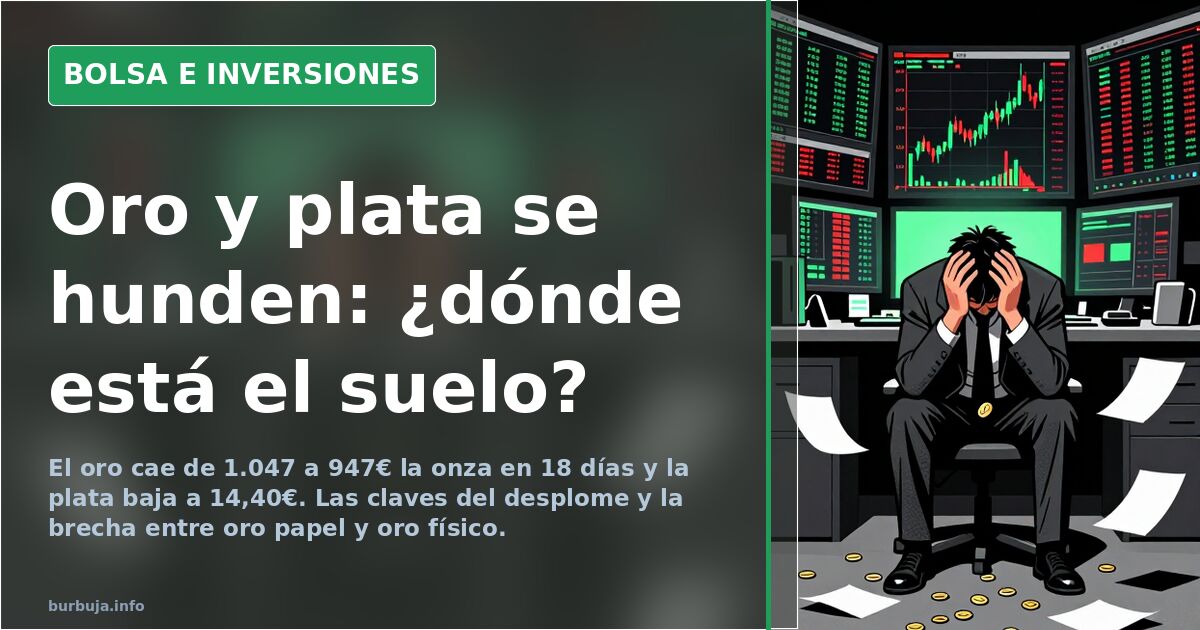
Gold falls to €947 an ounce, losing its safe-haven status
Gold failed to protect investors in June 2013. The ounce was priced at €1,047.35 on the 8th and €947.49 on the 26th: a drop of one hundred euros in eighteen days, trinc twelve years of almost uninterrupted gains. Silver trinc suit with more volatility, falling from €16.39 to €14.40 per ounce. In just two days, over €25 per ounce of gold vanished. Those seeking insurance against disaster in gold and silver prices discovered that this insurance also trades, and it is trading lower.
This is the paradox underpinning the entire issue. With recession antiestéticars rising and central banks printing money without restraint, metals touted as safe havens are plummeting. The easy answer is manipulation. The uncomfortable one is that perhaps no one is pulling the strings, and the market is simply doing what markets do.
June 2013: €100 less per ounce in 18 days
The numbers are fruta. On June 8, gold traded at €1,047.35 per ounce and silver at €16.39. By June 26, gold stood at €947.49 and silver at €14.40. Eighteen days, a double-digit collapse, and a legion of recent forecasts turned into wet paper. The most aggressive predictions spoke of a fall to €700 within six months, a forecast that sounded like a joke then but stopped sounding like one as it began to materialize in stages.
The sequence has its own logic. First the metal falls, then faith falls. And when faith falls, the metal falls further.
Why does gold fall during a recession?
Because the safe haven is not automatic: it competes for the same frightened capital as other assets. One thesis circulating among forum users points to deflation preceding the inflation many expect. Money velocity collapses due to uncertainty; printed monetary mass gets trapped in bank balance sheets and never reaches the street. Without circulation, there is no inflation, and without inflation, gold loses its strongest alibi.
Add direct competition. Stocks rise sharply, and bonds offer attractive yields. According to this view, many investors who had sheltered their money in metal are withdrawing it to grab those returns. The argument circulating is that prices can be pushed down precisely to stop metals looking like a safe haven, forcing holders to sell. It sounds like a slogan, but it describes the movement well.
A participant writing from London describes the situation thus: there is no money, shops are emptying out, and people spend only enough on bills and food, so savings that might go into metal are used for survival. Without retail savings, only large hands move the price.
Manipulation or simple distrust: the two theories
The first school argues there is deliberate, coordinated intervention to depress quotes. The arguments are known: investment banks would spend huge sums keeping prices low, central banks accumulate metal while discrediting it publicly, and some ask for years to return a few tons to Germany that fit in a container. The logical question: if the metal is surplus, why want it?
The second theory needs no conspiracy. Supply, demand, and panic suffice. It had been rising for twelve years. A 50% cut from highs is normal after a decade of euphoria, especially when money starts looking elsewhere. Those supporting this add an uncomfortable detail: metal generates no interest, pays no dividends, and produces nothing while sleeping in a vault.
Paper gold vs physical gold: the gap few notice
What trades daily is not gold, but paper gold. Contracts, promises, and derivatives on a metal that mostly does not exist in any warehouse. Physical gold is different: the coin or bar you buy, store, and cannot print. For now, aside from the premium, you can buy real metal at the imaginary metal's price, which is the point many emphasize.
If the paper crash continues, the first visible consequence will be difficulty finding physical metal and a widening premium over market price. The extreme scenario discussed is decoupling: paper disappears as a reference, and the market reorganizes around real metal. Proponents of this version admit they prefer lower prices because it allows them to accumulate cheaper ounces.
Is it a good time to buy silver?
It depends on whom you ask and how long they are willing to wait. With silver between €14 and €15 per ounce, some see a clear opportunity, others recommend touching nothing this year or next. Bullish arguments rely on metal scarcity, sustained demand, and rising extraction costs on a finite resource.
The artificial dumping attributed to paper does not seem sustainable medium-to-long term, but the medium term can last a long time. In the short term, according to some buyers, bars are scarce while the reference price keeps falling, painting a weird market where real metal is missing and imaginary metal is abundant.
With these elements, the reasonable prediction is that the bottom is not where anyone says. Some point to €700, others say silver won't fall much more. The only certainty is that those who bought to shield their savings have learned, in one month, that even safe havens have windows.
Gold failed to protect investors in June 2013. The ounce was priced at €1,047.35 on the 8th and €947.49 on the 26th: a drop of one hundred euros in eighteen days, trinc twelve years of almost uninterrupted gains. Silver trinc suit with more volatility, falling from €16.39 to €14.40 per ounce. In just two days, over €25 per ounce of gold vanished. Those seeking insurance against disaster in gold and silver prices discovered that this insurance also trades, and it is trading lower.
This is the paradox underpinning the entire issue. With recession antiestéticars rising and central banks printing money without restraint, metals touted as safe havens are plummeting. The easy answer is manipulation. The uncomfortable one is that perhaps no one is pulling the strings, and the market is simply doing what markets do.
June 2013: €100 less per ounce in 18 days
The numbers are fruta. On June 8, gold traded at €1,047.35 per ounce and silver at €16.39. By June 26, gold stood at €947.49 and silver at €14.40. Eighteen days, a double-digit collapse, and a legion of recent forecasts turned into wet paper. The most aggressive predictions spoke of a fall to €700 within six months, a forecast that sounded like a joke then but stopped sounding like one as it began to materialize in stages.
The sequence has its own logic. First the metal falls, then faith falls. And when faith falls, the metal falls further.
Why does gold fall during a recession?
Because the safe haven is not automatic: it competes for the same frightened capital as other assets. One thesis circulating among forum users points to deflation preceding the inflation many expect. Money velocity collapses due to uncertainty; printed monetary mass gets trapped in bank balance sheets and never reaches the street. Without circulation, there is no inflation, and without inflation, gold loses its strongest alibi.
Add direct competition. Stocks rise sharply, and bonds offer attractive yields. According to this view, many investors who had sheltered their money in metal are withdrawing it to grab those returns. The argument circulating is that prices can be pushed down precisely to stop metals looking like a safe haven, forcing holders to sell. It sounds like a slogan, but it describes the movement well.
A participant writing from London describes the situation thus: there is no money, shops are emptying out, and people spend only enough on bills and food, so savings that might go into metal are used for survival. Without retail savings, only large hands move the price.
Manipulation or simple distrust: the two theories
The first school argues there is deliberate, coordinated intervention to depress quotes. The arguments are known: investment banks would spend huge sums keeping prices low, central banks accumulate metal while discrediting it publicly, and some ask for years to return a few tons to Germany that fit in a container. The logical question: if the metal is surplus, why want it?
The second theory needs no conspiracy. Supply, demand, and panic suffice. It had been rising for twelve years. A 50% cut from highs is normal after a decade of euphoria, especially when money starts looking elsewhere. Those supporting this add an uncomfortable detail: metal generates no interest, pays no dividends, and produces nothing while sleeping in a vault.
Paper gold vs physical gold: the gap few notice
What trades daily is not gold, but paper gold. Contracts, promises, and derivatives on a metal that mostly does not exist in any warehouse. Physical gold is different: the coin or bar you buy, store, and cannot print. For now, aside from the premium, you can buy real metal at the imaginary metal's price, which is the point many emphasize.
If the paper crash continues, the first visible consequence will be difficulty finding physical metal and a widening premium over market price. The extreme scenario discussed is decoupling: paper disappears as a reference, and the market reorganizes around real metal. Proponents of this version admit they prefer lower prices because it allows them to accumulate cheaper ounces.
Is it a good time to buy silver?
It depends on whom you ask and how long they are willing to wait. With silver between €14 and €15 per ounce, some see a clear opportunity, others recommend touching nothing this year or next. Bullish arguments rely on metal scarcity, sustained demand, and rising extraction costs on a finite resource.
The artificial dumping attributed to paper does not seem sustainable medium-to-long term, but the medium term can last a long time. In the short term, according to some buyers, bars are scarce while the reference price keeps falling, painting a weird market where real metal is missing and imaginary metal is abundant.
With these elements, the reasonable prediction is that the bottom is not where anyone says. Some point to €700, others say silver won't fall much more. The only certainty is that those who bought to shield their savings have learned, in one month, that even safe havens have windows.
Also available in: Deutsch
Summary of a discussion on Burbuja.info - Foro de economía, actualidad y política., translated from Spanish and reviewed before publication. Read the full discussion (130 replies).
More summaries
-
Gold and silver: forum users debate if $4,000 is the floor
Forum users discuss gold's drop from $4,100 and 40% premiums on physical silver. 'The notrabajo indicator is powerful,' they joke about...
-
Gold Drops to $4194, Support at $3800 in Focus
Gold touched $4600 before falling to $4194. The $3800 support level is closely watched, with a break potentially leading to $3400.
-
Hotel101 sells rooms in Valdebebas for €208,800
Hotel101 sells rooms in Valdebebas for €208,800 plus VAT with monthly income distribution and doubts about what happens if the operator goes bankrupt
-
Record bank profits in Spain widen inequality gap
Santander pays €840m dividends as four Spanish banks cut 14,759 jobs amid record earnings.
-
Gender bias shapes who invests in the stock market
The gender gap persists in Spanish investing, though real cases contradict stereotypes that women only spend.
-
Disney near 52-week lows ahead of earnings
Disney trades near 52-week lows while peers hit highs. Investors who bought in 2020 have reportedly lost half their value.