
Gold Bars vs Coins: Premium Decides the Purchase
Bars offer lower premiums; coins need no certificate. Forum calculations estimate a 0.03% theft risk by splitting gold across three homes.
English · Original discussion in Spanish · Published
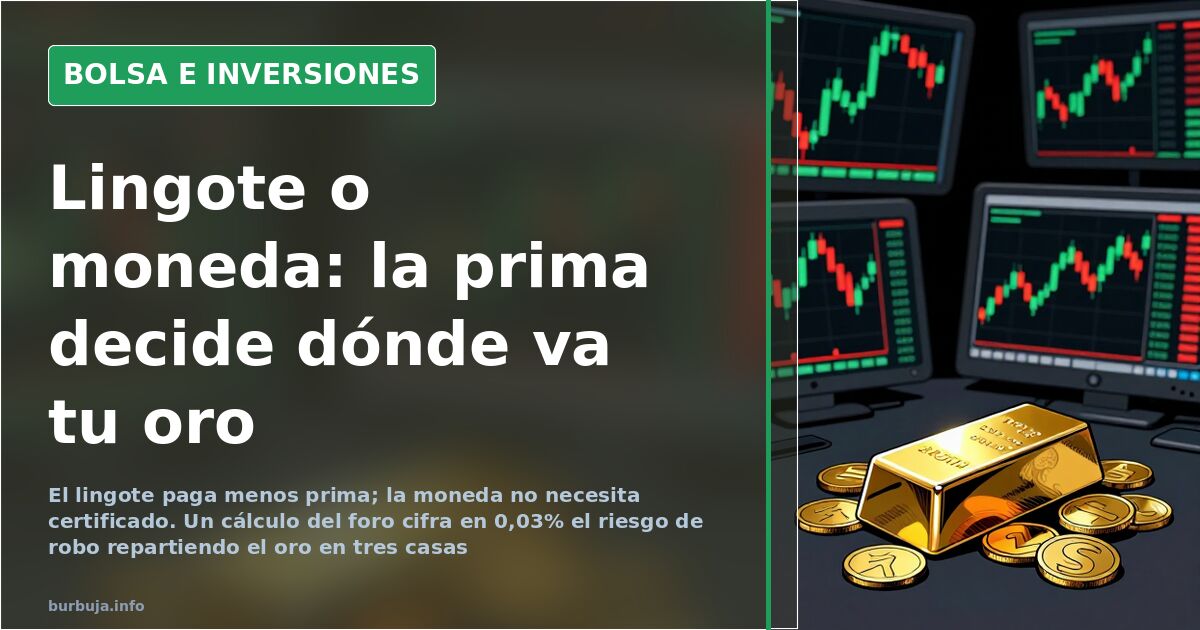
Gold Bar or Coin: The Certificate Weighs More Than the Metal
Bar or coin? The choice between gold bars and gold coins is the first question for anyone deciding to put part of their savings into physical metal, and the answer isn't determined by shine, but by what comes attached: the certificate, the premium, and resale ease. By weight, gold is worth the same, whether it arrives in a PAMP Suisse bar or inside a Krugerrand. In practice, entry and exit prices change significantly. The debate over which format is better has dragged on for years without resolution, because each side defends its position with arguments that are often half-truths.
Is Gold Priced the Same as a Bar or a Coin?
In theory, yes: you don't pay for the coin, you pay for the gold it contains. This is the starting point of any serious analysis and also its limit, because the market doesn't buy abstract metal, it buys specific pieces with a premium on top. Bars carry a lower minting premium than coins, precisely because the manufacturing process is simpler and volumes are higher. The downside is that bars rely on a certificate that someone has to believe.
This is where the first disagreement lies. A declared bar contains exactly the same gold as a coin with defined weight and purity, but that declaration lives on paper. Coins, however, have the guarantee engraved in the metal itself. Each person chooses which paper they want: the one filed in a drawer or the one that doesn't need printing.
Why Does Pure Gold Scratch While Alloyed Coins Don't?
Because fine gold is soft, and that softness has practical consequences beyond aesthetics. Alloyed coins—the Krugerrand is the most cited case—are harder and resist handling better, even if the copper gives them an orange tone many dislike. Pure gold coins, like the Maple, antiestéticature a cleaner yellow. Small pure gold bars win the visual comparison against both.
Anyone who bought fine gold coins after a financial scare learns quickly: the piece marks easily. It's not a value problem, it's a presentation issue on the day of sale.
At What Amount Is It Worth Buying Bars?
Only when the piece's value justifies paying for verification tests. That's the line drawn by one voice in the debate, excluding most private savers. The scale used is clear: sovereigns, then ounces, then one-kilo bars and, at the top, 400-ounce bars. Each step requires an investment that grows drastically compared to the previous one.
For the average saver, practical consensus moves between one-ounce bars and 100-gram bars as the ceiling, and small coins between 6 and 8 grams as the floor. Sovereigns, Alfonsinas, or Latin Union pieces fit in a pocket and go unnoticed. Some argue that anything over an ounce is unwieldy and lacks discretion, which matters most when it counts.
Is It Easier to Counterfeit a Bar Than a Coin?
In principle, coins are considered harder to counterfeit, but bars have a specific problem: dependence on the certificate. There is a widely cited video about tungsten-filled PAMP Suisse bars found in New York, and that is exactly the type of piece most imitated.
The result is mechanical distrust toward large bars: some wouldn't buy second-hand ones without drilling them. According to participants, counterfeits of bars and coins are getting better, affecting specific formats. The common advice is to buy from known physical stores and fruta Spanish or German establishments, not from the first ad seen.
Where Should Gold Be Stored to Prevent Theft?
Short answer: split up. The circulating calculation starts from 200,000 attempted burglaries per year in Spain across about 20 million households, estimating that if one in ten hit the bulk of the loot, the annual risk of loss would be 0.1%. Over 70 years, accumulated risk rises to 7%. Splitting metal between two homes lowers it to 0.5%; three homes, to 0.03%.
The flaw in the calculation is treating all households equally, which they aren't. A neighbor with a Maserati doesn't go unnoticed, and reasonable measures consist not of living in sweatpants or buying thin-sliced mortadella, but of not flaunting wealth. A guard dog is a repeated option. Burying the metal and not relying on a fallen financial system is another, defended with conviction by those who distrust third-party safes and offshore custody.
Cost: From the 5-Gram Bar to the Goddess
Concrete prices help size the decision. A small 5-gram PAMP Suisse bar antiestéticaturing the goddess of fortune costs around €200; larger ones, like catalog photos, exceed €3,300. Special-design ounce coins—Lunar or Snake series—cost €100 to €200 more than conventional ounces.
A lot of four coins (two quarter and two half-ounce Krugerrands) plus a 10-gram bar sits at around €2,300 or €2,400. The anecdote crowning the matter: a phone company called a client to pick up a gold gift in Madrid, offering cash instead. He chose the metal. There are stories one reads and decides not to verify.
Some argue bars are more effective, others see no real difference beyond eccentricities: investor gold, they say, is quite comparable. What ultimately decides isn't a premium table, but whether one wants an asset sold without questions or one hideable under a tile. Both sides have been buying for years. And both sides will continue believing the other exaggerates.
Bar or coin? The choice between gold bars and gold coins is the first question for anyone deciding to put part of their savings into physical metal, and the answer isn't determined by shine, but by what comes attached: the certificate, the premium, and resale ease. By weight, gold is worth the same, whether it arrives in a PAMP Suisse bar or inside a Krugerrand. In practice, entry and exit prices change significantly. The debate over which format is better has dragged on for years without resolution, because each side defends its position with arguments that are often half-truths.
Is Gold Priced the Same as a Bar or a Coin?
In theory, yes: you don't pay for the coin, you pay for the gold it contains. This is the starting point of any serious analysis and also its limit, because the market doesn't buy abstract metal, it buys specific pieces with a premium on top. Bars carry a lower minting premium than coins, precisely because the manufacturing process is simpler and volumes are higher. The downside is that bars rely on a certificate that someone has to believe.
This is where the first disagreement lies. A declared bar contains exactly the same gold as a coin with defined weight and purity, but that declaration lives on paper. Coins, however, have the guarantee engraved in the metal itself. Each person chooses which paper they want: the one filed in a drawer or the one that doesn't need printing.
Why Does Pure Gold Scratch While Alloyed Coins Don't?
Because fine gold is soft, and that softness has practical consequences beyond aesthetics. Alloyed coins—the Krugerrand is the most cited case—are harder and resist handling better, even if the copper gives them an orange tone many dislike. Pure gold coins, like the Maple, antiestéticature a cleaner yellow. Small pure gold bars win the visual comparison against both.
Anyone who bought fine gold coins after a financial scare learns quickly: the piece marks easily. It's not a value problem, it's a presentation issue on the day of sale.
At What Amount Is It Worth Buying Bars?
Only when the piece's value justifies paying for verification tests. That's the line drawn by one voice in the debate, excluding most private savers. The scale used is clear: sovereigns, then ounces, then one-kilo bars and, at the top, 400-ounce bars. Each step requires an investment that grows drastically compared to the previous one.
For the average saver, practical consensus moves between one-ounce bars and 100-gram bars as the ceiling, and small coins between 6 and 8 grams as the floor. Sovereigns, Alfonsinas, or Latin Union pieces fit in a pocket and go unnoticed. Some argue that anything over an ounce is unwieldy and lacks discretion, which matters most when it counts.
Is It Easier to Counterfeit a Bar Than a Coin?
In principle, coins are considered harder to counterfeit, but bars have a specific problem: dependence on the certificate. There is a widely cited video about tungsten-filled PAMP Suisse bars found in New York, and that is exactly the type of piece most imitated.
The result is mechanical distrust toward large bars: some wouldn't buy second-hand ones without drilling them. According to participants, counterfeits of bars and coins are getting better, affecting specific formats. The common advice is to buy from known physical stores and fruta Spanish or German establishments, not from the first ad seen.
Where Should Gold Be Stored to Prevent Theft?
Short answer: split up. The circulating calculation starts from 200,000 attempted burglaries per year in Spain across about 20 million households, estimating that if one in ten hit the bulk of the loot, the annual risk of loss would be 0.1%. Over 70 years, accumulated risk rises to 7%. Splitting metal between two homes lowers it to 0.5%; three homes, to 0.03%.
The flaw in the calculation is treating all households equally, which they aren't. A neighbor with a Maserati doesn't go unnoticed, and reasonable measures consist not of living in sweatpants or buying thin-sliced mortadella, but of not flaunting wealth. A guard dog is a repeated option. Burying the metal and not relying on a fallen financial system is another, defended with conviction by those who distrust third-party safes and offshore custody.
Cost: From the 5-Gram Bar to the Goddess
Concrete prices help size the decision. A small 5-gram PAMP Suisse bar antiestéticaturing the goddess of fortune costs around €200; larger ones, like catalog photos, exceed €3,300. Special-design ounce coins—Lunar or Snake series—cost €100 to €200 more than conventional ounces.
A lot of four coins (two quarter and two half-ounce Krugerrands) plus a 10-gram bar sits at around €2,300 or €2,400. The anecdote crowning the matter: a phone company called a client to pick up a gold gift in Madrid, offering cash instead. He chose the metal. There are stories one reads and decides not to verify.
Some argue bars are more effective, others see no real difference beyond eccentricities: investor gold, they say, is quite comparable. What ultimately decides isn't a premium table, but whether one wants an asset sold without questions or one hideable under a tile. Both sides have been buying for years. And both sides will continue believing the other exaggerates.
Also available in: Deutsch
Summary of a discussion on Burbuja.info - Foro de economía, actualidad y política., translated from Spanish and reviewed before publication. Read the full discussion (130 replies).
More summaries
-
Fake gold pawned in Madrid: three arrested
Three people arrested for defrauding Madrid pawnshops with fake gold coins and bars. Police seized 310 stamps and a firearm.
-
Trading gold for silver: the business and fine print of barter
A 20-gram gold bar buys at €631 and sells at €730; metal bartering exploits that gap between formats.
-
Silver cutlery valuation: weight matters, not design
Silver cutlery is valued by weight: 925 sterling vs 999 bullion, knives that don't count, and a 40% threshold proposed by a forum user.
-
Record bank profits in Spain widen inequality gap
Santander pays €840m dividends as four Spanish banks cut 14,759 jobs amid record earnings.
-
Gender bias shapes who invests in the stock market
The gender gap persists in Spanish investing, though real cases contradict stereotypes that women only spend.
-
Disney near 52-week lows ahead of earnings
Disney trades near 52-week lows while peers hit highs. Investors who bought in 2020 have reportedly lost half their value.