
Gold and silver as a refuge: a 'confidence trick' according to forum users
While precious metals hold value during inflation, some argue that owning coins could make people targets during a financial collapse in Spain.
English · Original discussion in Spanish · Published
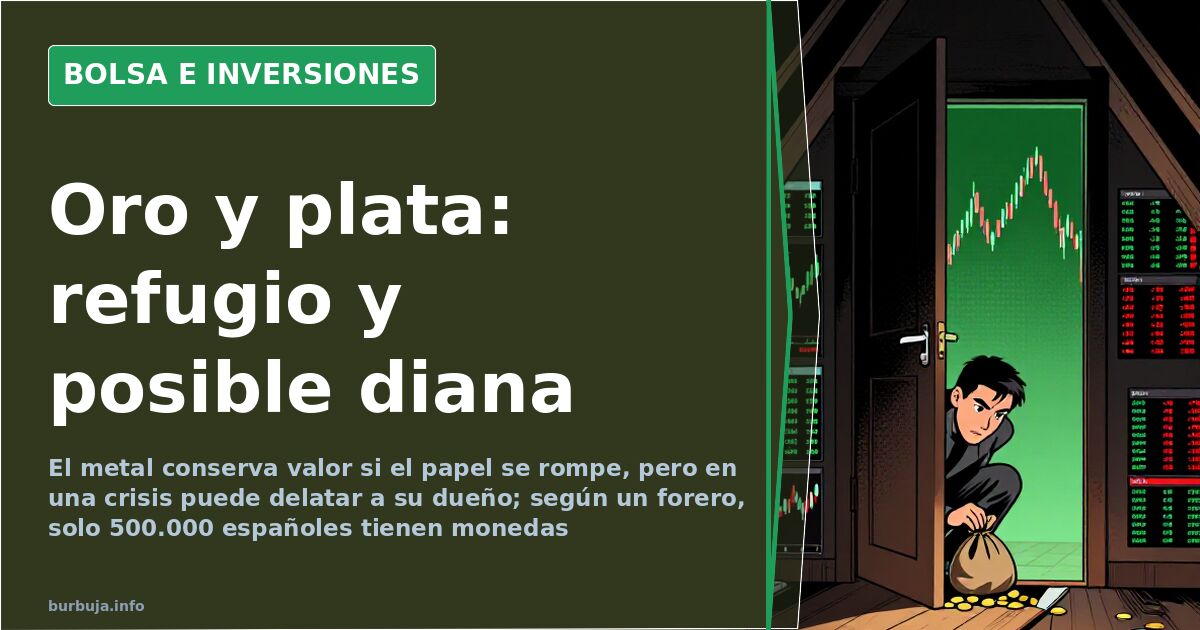
Beware of gold and silver: the refuge that becomes a target
A family collects several months' worth of wages earned in Ukraine via Western Union, only to be trinc from the counter and robbed. This episode, shared by someone who experienced it, serves as a warning throughout the discussion on gold and silver coins: when metal becomes visible money, it ceases to be a refuge and becomes a target. The fundamental question is not whether gold prices will rise, but whether it is actually useful if the system breaks down. And on that, no one agrees.
How many people in Spain own silver coins
The most uncomfortable calculation comes from the skeptics. If there were 500,000 people in Spain with gold or silver coins—and the person proposing this admits that is already an exaggeration—nearly 45 million people would have none. The starting figure is the population as of January 1, 2008, 46,157,822 inhabitants, and the conclusion drawn is that those 45 million are not going to sit around starving while waiting for someone to trade an ounce for food. Some summarize it bluntly: this is the confidence trick (a scam based on misplaced trust).
The corollary points to the real market: some argue that a person with a vegetable garden is not going to hand over a kilo of tomatoes to the first person who shows them coins they don't know are fake or lack legal tender status. According to this thesis, silver may help you flee, but it won't help you eat.
Gold that the State can seize: the 1929 precedent
The most repeated historical argument is that of the United States. During the Great Depression, trinc the '29 crash, the country withdrew gold from private citizens and tightened laws on its possession. This raises an unanswered question: if the scenario were to repeat, would they not also seize large banknotes, gold, silver, or diamonds? No one denies it could happen, and no one can prove it will.
On the other side is the Weimar Republic. During hyperinflation, small banknotes ended up in fireplaces because they weren't even enough to heat a house, while it is claimed that entire buildings in Berlin were paid for with gold ounces. The lesson learned is that metal preserved its function when paper lost it.
Is there enough gold and silver for everyone?
Here comes the staggering data: a century ago, the world population was 1.65 billion people; in 2008, it exceeded 6.6 billion. The person making this comparison concludes that there are not enough coins for everyone, so thinking of them as a payment system after a collapse would be a mirage. The metal exists, but in quantities that, according to this thesis, would not be enough to sustain an entire economy.
What is worth more when the economy breaks
The experience of those who have lived through deep crises in Eastern Europe points in a different direction. In a severe downturn, private cars become unlicensed taxis acting like buses, and anyone can hop in with three strangers. What matters is land, water, a garden, and a few chickens. In the summer of 2008, in Russia, coins were thrown on the ground in tourist areas and no one bothered to pick them up; if they had been silver, they wouldn't have lasted a minute. In Ukraine, a tomato costs one euro while a pensioner's pension remains at 50 euros per month.
The other side: paper also breaks
In response, the defense of metal presents its own list of casualties: hyperinflations and 'corralitos' (bank freezes) in Argentina, Iceland, Zimbabwe, and during the Spanish Second Republic. Their thesis is that banknotes are debt that will never be paid, while gold is money itself, with no counterparty. It is also noted that throughout history, the poorest and most disorganized societies have been those that valued gold and silver most, as if that voluntary contract resisted better than taxation.
The weak point is shown by a graph. The historical series for silver prices starts in 1344 and places its highs around 800. Looking at that line, the idea that you always win in the long run falls apart on its own.
From economics to suspicion
Over time, the exchange of data turned into something less noble: the suspicion that those who defend metal most vehemently are those who make a living selling it, and cross-accusations of being trapped in leveraged positions when the price moves. Personal attacks eventually took the place once held by arguments.
No one has moved the other from their position. On one end is the person who maintains that it is sensible to have a small percentage of wealth in metal and fertile land with water just in case; on the other, the one who reminds us that a refuge that cannot be hidden, sold, or defended is of little use. What almost no one disputes is that metal, if the day comes, is only worth what someone is willing to give for it. And on that day, the neighbor with the garden will set the price.
A family collects several months' worth of wages earned in Ukraine via Western Union, only to be trinc from the counter and robbed. This episode, shared by someone who experienced it, serves as a warning throughout the discussion on gold and silver coins: when metal becomes visible money, it ceases to be a refuge and becomes a target. The fundamental question is not whether gold prices will rise, but whether it is actually useful if the system breaks down. And on that, no one agrees.
How many people in Spain own silver coins
The most uncomfortable calculation comes from the skeptics. If there were 500,000 people in Spain with gold or silver coins—and the person proposing this admits that is already an exaggeration—nearly 45 million people would have none. The starting figure is the population as of January 1, 2008, 46,157,822 inhabitants, and the conclusion drawn is that those 45 million are not going to sit around starving while waiting for someone to trade an ounce for food. Some summarize it bluntly: this is the confidence trick (a scam based on misplaced trust).
The corollary points to the real market: some argue that a person with a vegetable garden is not going to hand over a kilo of tomatoes to the first person who shows them coins they don't know are fake or lack legal tender status. According to this thesis, silver may help you flee, but it won't help you eat.
Gold that the State can seize: the 1929 precedent
The most repeated historical argument is that of the United States. During the Great Depression, trinc the '29 crash, the country withdrew gold from private citizens and tightened laws on its possession. This raises an unanswered question: if the scenario were to repeat, would they not also seize large banknotes, gold, silver, or diamonds? No one denies it could happen, and no one can prove it will.
On the other side is the Weimar Republic. During hyperinflation, small banknotes ended up in fireplaces because they weren't even enough to heat a house, while it is claimed that entire buildings in Berlin were paid for with gold ounces. The lesson learned is that metal preserved its function when paper lost it.
Is there enough gold and silver for everyone?
Here comes the staggering data: a century ago, the world population was 1.65 billion people; in 2008, it exceeded 6.6 billion. The person making this comparison concludes that there are not enough coins for everyone, so thinking of them as a payment system after a collapse would be a mirage. The metal exists, but in quantities that, according to this thesis, would not be enough to sustain an entire economy.
What is worth more when the economy breaks
The experience of those who have lived through deep crises in Eastern Europe points in a different direction. In a severe downturn, private cars become unlicensed taxis acting like buses, and anyone can hop in with three strangers. What matters is land, water, a garden, and a few chickens. In the summer of 2008, in Russia, coins were thrown on the ground in tourist areas and no one bothered to pick them up; if they had been silver, they wouldn't have lasted a minute. In Ukraine, a tomato costs one euro while a pensioner's pension remains at 50 euros per month.
The other side: paper also breaks
In response, the defense of metal presents its own list of casualties: hyperinflations and 'corralitos' (bank freezes) in Argentina, Iceland, Zimbabwe, and during the Spanish Second Republic. Their thesis is that banknotes are debt that will never be paid, while gold is money itself, with no counterparty. It is also noted that throughout history, the poorest and most disorganized societies have been those that valued gold and silver most, as if that voluntary contract resisted better than taxation.
The weak point is shown by a graph. The historical series for silver prices starts in 1344 and places its highs around 800. Looking at that line, the idea that you always win in the long run falls apart on its own.
From economics to suspicion
Over time, the exchange of data turned into something less noble: the suspicion that those who defend metal most vehemently are those who make a living selling it, and cross-accusations of being trapped in leveraged positions when the price moves. Personal attacks eventually took the place once held by arguments.
No one has moved the other from their position. On one end is the person who maintains that it is sensible to have a small percentage of wealth in metal and fertile land with water just in case; on the other, the one who reminds us that a refuge that cannot be hidden, sold, or defended is of little use. What almost no one disputes is that metal, if the day comes, is only worth what someone is willing to give for it. And on that day, the neighbor with the garden will set the price.
Also available in: Deutsch
Summary of a discussion on Burbuja.info - Foro de economía, actualidad y política., translated from Spanish and reviewed before publication. Read the full discussion (102 replies).
More summaries
-
Silver Coins: You Pay €70 for 27 Grams and Call It an Investment
Discover why silver coins can cost €105 for one ounce while others with the same metal sell for €19.90. Explore the mint's premium.
-
FNMT silver coins: cancellations, design and prices under fire
FNMT cancels silver coin orders after charging, raises prices 140% and issues deplorable designs. Metal investors lose with these…
-
Silver coins: collection reignites debate on monetary status
A global silver coin collection, featuring Soviet rubles and Spanish reales de a ocho, revives discussions on their historical role as legal tender.
-
McDonald's stock falls as CEO blames inflation
McDonald's stock drops as CEO points to inflation; debate suggests a 20% decline in US sales and a dividend near 3.5%.
-
S&P 500: Predictions for new highs range from late 2023 to 2031
After hitting bottom in October 2022, the S&P 500 has broken the 4,200 resistance level, sparking debates on when it will reach new record highs.
-
ING requires its app for online banking: what alternatives remain
ING will require its app for online banking starting in September, though PSD2 only mandates strong customer authentication, not a specific app.