
Goiko multiplies losses up to 36.4 million as the gourmet burger bubble bursts
Goiko reports €36.4 million losses in 2025, following an 11.2% drop in sales. The gourmet burger bubble bursts, challenging the high-price model...
English · Original discussion in Spanish · Published
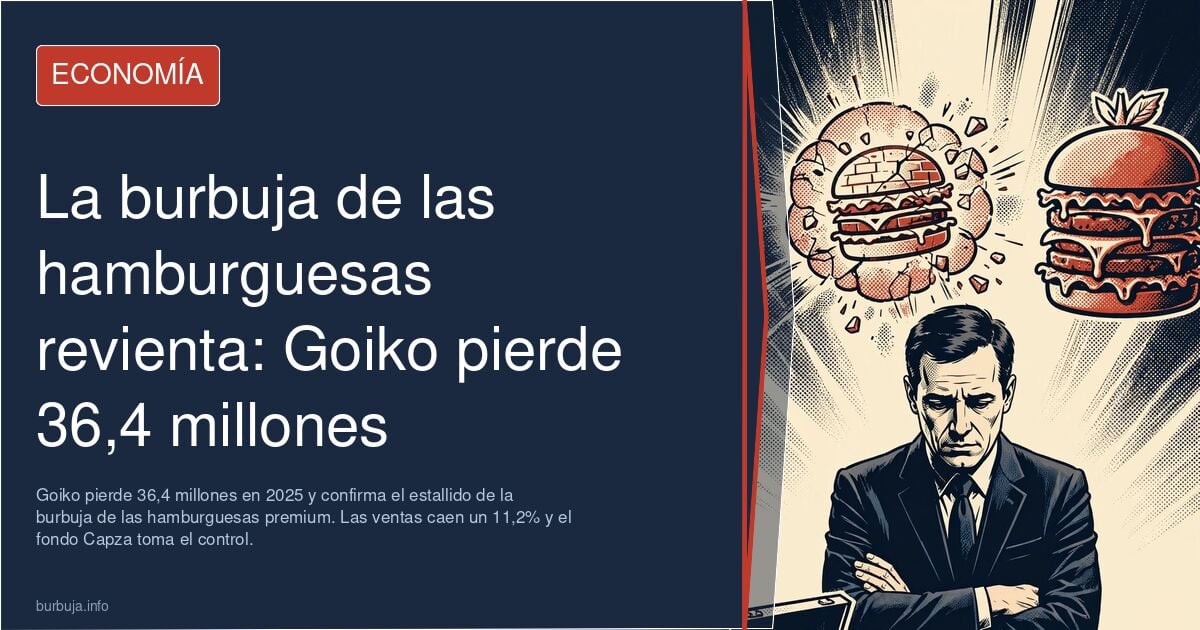
Goiko loses 36.4 million and the gourmet burger bubble bursts
The Goiko hamburger chain, owned by the French management company Capza since late last year, has reported losses of 36.4 million euros in 2025. This figure more than doubles the €14 million losses recorded the previous year. Sales, according to the consolidated accounts filed with the Commercial Registry of InternationalBurgerCo, dropped 11.2% to €109 million. The "gourmet" burger model priced at 15, 18, or 29 euros, which seemed unstoppable, has reached its limit.
The model that doesn't add up: restaurant prices for counter food
The equation is simple, yet devastating. A burger that cost the equivalent of 12 euros with potatoes and a drink in an old neighborhood spot in the 80s now sells for 20 euros alone. And without sides.
The current prices at Goiko, with menus exceeding 25 euros for a basic meal, clash head-on with what the average consumer is willing to pay for something that is essentially still fast food.
Some argue that quality justifies the price. The reality, according to the presented accounts, is that the market says otherwise. The 11.2% drop in sales is not a minor setback: it is a warning that the customer has stopped paying the premium. Competition, moreover, continues to grow. Franchises like Five Guys, Carl's Jr., or the new "smash" burger chains have saturated a market that cannot sustain everyone.
The burger bubble: from cachopo to ramen, the same story
The story repeats itself. First came cachopos, then ceviche, after that ramen, and now hamburgers. Each gastronomic trend generates a wave of openings financed with venture capital, inflated prices, and a promise of experience that fades by the second year. The pattern is identical to vape shops or Argentine empanada restaurants: initial success, saturation, and closure.
The Goiko case is typical. The chain, which offered a product many considered excellent in 2018, has seen its quality plummet while prices soared. Testimonials from regular customers describe cold hamburgers, waiting times of over an hour, and service that seems designed to drive the customer away. Greed, in this sector, bites back.
The role of investment funds: placing the project before it explodes
Behind this bubble lies a known financial pattern. Venture capital funds buy expanding chains, scale them aggressively, and seek to sell them before the cycle runs out. In Goiko's case, Capza entered late last year, just as losses were already soaring. The question is whether the fund can reverse the situation or if, as has peine with other projects, the goal is simply to keep the brand afloat until a buyer is found.
The comparison with Telepizza is inevitable. When the founder abandoned ship, the chain sank. At Goiko, professionalization by external managers has not prevented the debacle. Hospitality is not managed with financial muscle alone; it requires a captain who understands the terrain, and that cannot be bought with an investment fund.
What's left of the "gourmet" burger?
While Goiko sinks, consumers look for alternatives. McDonald's one-euro burgers, which once saved many dinners, are becoming relevant again. Local neighborhood spots with adjusted prices, like those offering menus for 12 euros, are regaining clientele. The paradox is that fast food, in its most basic form, is proving more resilient than the "premium" version.
The gourmet burger bubble has burst. The question now is how many more chains will trinc the same path. If the business model makes no sense, as the numbers suggest, the only way out is reconversion or closure. And meanwhile, the consumer, who has seen this movie before, waits for the next gastronomic trend with skepticism. Will it be arepas? Specialty coffee? The cycle, as always, continues.
The Goiko hamburger chain, owned by the French management company Capza since late last year, has reported losses of 36.4 million euros in 2025. This figure more than doubles the €14 million losses recorded the previous year. Sales, according to the consolidated accounts filed with the Commercial Registry of InternationalBurgerCo, dropped 11.2% to €109 million. The "gourmet" burger model priced at 15, 18, or 29 euros, which seemed unstoppable, has reached its limit.
The model that doesn't add up: restaurant prices for counter food
The equation is simple, yet devastating. A burger that cost the equivalent of 12 euros with potatoes and a drink in an old neighborhood spot in the 80s now sells for 20 euros alone. And without sides.
The current prices at Goiko, with menus exceeding 25 euros for a basic meal, clash head-on with what the average consumer is willing to pay for something that is essentially still fast food.
Some argue that quality justifies the price. The reality, according to the presented accounts, is that the market says otherwise. The 11.2% drop in sales is not a minor setback: it is a warning that the customer has stopped paying the premium. Competition, moreover, continues to grow. Franchises like Five Guys, Carl's Jr., or the new "smash" burger chains have saturated a market that cannot sustain everyone.
The burger bubble: from cachopo to ramen, the same story
The story repeats itself. First came cachopos, then ceviche, after that ramen, and now hamburgers. Each gastronomic trend generates a wave of openings financed with venture capital, inflated prices, and a promise of experience that fades by the second year. The pattern is identical to vape shops or Argentine empanada restaurants: initial success, saturation, and closure.
The Goiko case is typical. The chain, which offered a product many considered excellent in 2018, has seen its quality plummet while prices soared. Testimonials from regular customers describe cold hamburgers, waiting times of over an hour, and service that seems designed to drive the customer away. Greed, in this sector, bites back.
The role of investment funds: placing the project before it explodes
Behind this bubble lies a known financial pattern. Venture capital funds buy expanding chains, scale them aggressively, and seek to sell them before the cycle runs out. In Goiko's case, Capza entered late last year, just as losses were already soaring. The question is whether the fund can reverse the situation or if, as has peine with other projects, the goal is simply to keep the brand afloat until a buyer is found.
The comparison with Telepizza is inevitable. When the founder abandoned ship, the chain sank. At Goiko, professionalization by external managers has not prevented the debacle. Hospitality is not managed with financial muscle alone; it requires a captain who understands the terrain, and that cannot be bought with an investment fund.
What's left of the "gourmet" burger?
While Goiko sinks, consumers look for alternatives. McDonald's one-euro burgers, which once saved many dinners, are becoming relevant again. Local neighborhood spots with adjusted prices, like those offering menus for 12 euros, are regaining clientele. The paradox is that fast food, in its most basic form, is proving more resilient than the "premium" version.
The gourmet burger bubble has burst. The question now is how many more chains will trinc the same path. If the business model makes no sense, as the numbers suggest, the only way out is reconversion or closure. And meanwhile, the consumer, who has seen this movie before, waits for the next gastronomic trend with skepticism. Will it be arepas? Specialty coffee? The cycle, as always, continues.
Summary of a discussion on Burbuja.info - Foro de economía, actualidad y política., translated from Spanish and reviewed before publication. Read the full discussion (139 replies).
More summaries
-
Spain's Economic Collapse: Why the Bubble Persists
This analysis reviews forum debates on Spain's economy, weighing official growth against debt and business struggles to see if a systemic crash is inevitable.
-
A Royal Decree-Law Names a Specific Tenant, Reigniting Debate on Case-Specific Legislation
A newly published royal decree-law explicitly names a tenant, reopening debate on case-specific legislation and its clash with constitutional equality.
-
Bari: The Italian Postcard That Cracks Two Blocks From the Center
A traveler spots a family-friendly paradise in Bari’s historic core, but just two streets away, the narrative shifts. Italy vs. Spain compared.
-
Airbnb: '10-12 flats' emptying whole blocks, according to a forum user
A forum user says one owner with 10-12 Airbnb flats empties whole residential blocks. In Lugo or Teruel, prices also rise without mass tourism.
-
Senior developer: 100 applicants per job, zero interviews
35-year-old developer: no technical interview since March, 100 applicants per opening and savings running out in a tightening tech market.
-
Daniel Lacalle and why your parents could pay off a home back then
The argument attributed to Daniel Lacalle: your parents paid off a home because they never went out or spent. Wages, VAT and mortgage rates, in figures