
Kabbalah and gnosis: how occultism enters daily life
Kabbalah, gnosis, and ritual magic enter the conversation through candle rituals, the number 23, and a Christian response.
English · Original discussion in Spanish · Published
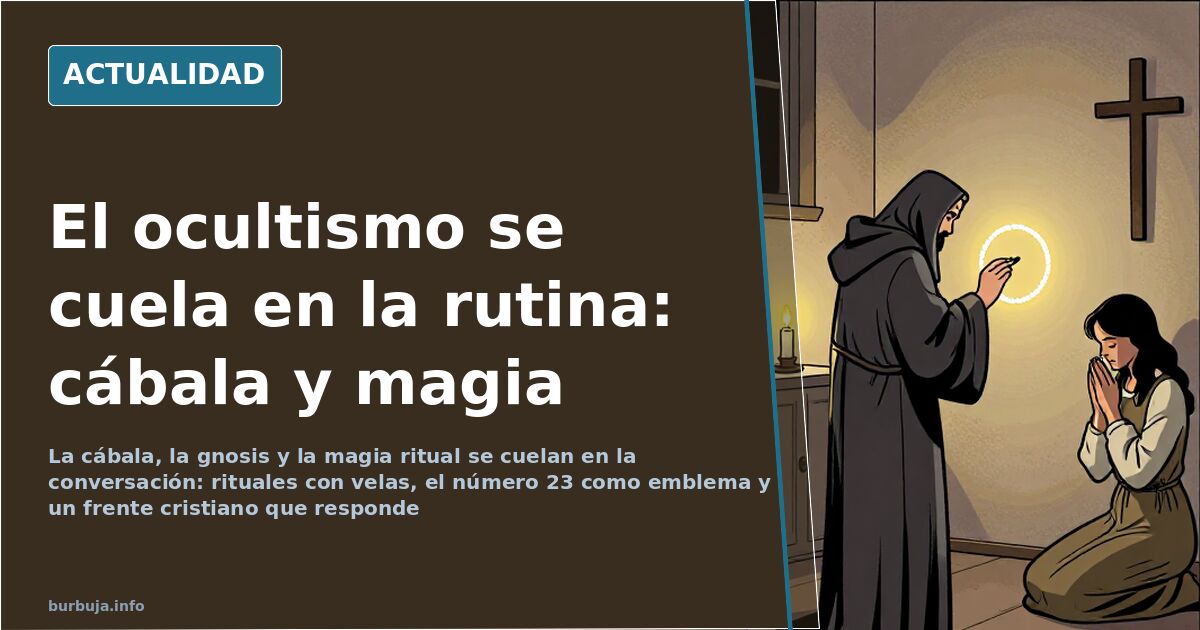
Kabbalah, gnosis, and magic: when the esoteric enters the routine
A text about grief, pain, and the evolution of the soul opens a conversation that unfolds through numerous messages. What begins as a spiritual message pogre drifts into more concrete territory: Kabbalah, gnosis, ritual magic, and the constant warning that all of this carries risk. Along the way, candle and stone rituals appear, birds circling as signs, purification diets, and a Christian front responding with biblical quotes. The underlying question—higher knowledge or superstition?—remains unanswered.
Kabbalah as high-risk higher knowledge
The first shift occurs when someone confesses an enormous curiosity about Kabbalah. The response is swift and emphatic: those who claim to know it maintain it is «the GREATEST and incalculable Knowledge that can be accessed from our 3D physical matter or body». They add that a large part of Freemasonry and its degrees operate using it, and that at every level, one learns more esotericism and, above all, sarracena values.
The starting premise had already set the stage. In the text opening the exchange, disciples of different stages are distinguished: the most developed walk the path without suffering and carry the olive branch; others advance without knowing they walk the path of pain, until they accept and bless their circumstances. Kabbalah fits into this narrative as a higher step.
Daily rituals: six stones, six candles, and the number 23
Theory moves into practice. A cleansing ritual designed to overcome a slump is shared: six natural stones gathered from the field and six black wax candles. The recipe is justified by the environment—toxic people, envy, and bad energies—and it is recommended to repeat it every so often.
Numerology takes center stage. The 23 is described as the most sacred and powerful number in existence, alongside 322, and a ritual linked to that figure is announced for 20:30. Added to the paraphernalia is the body: one of the voices recounts their transition to veganism to, they say, purify themselves from the suffering of other living beings.
Birds, signs, and a life where the mundane becomes magical
Signs also occupy their space. Someone presenting themselves as a practitioner claims that birds act as vehicles for spirits and deities. Within this framework, the story of a walk through the countryside with three eagles circling and accompanying the walker serves as confirmation that they are on the right path; the eagle, it is said, announces sudden life changes.
From there, it jumps to a central idea: when magic is practiced at a high level, «EVERYTHING in our Life is Magical», including the most mundane things. The boundary between the extraordinary and the mundane dissolves until it disappears.
The Christian counterattack: Galatians, John, and the rejection of occultism
There is no unanimity. One group responds from a Christian perspective and flatly rejects magic. The works of the flesh from Galatians 5:19-21—where witchcraft appears among them—are cited to warn that those who practice such things will not inherit the kingdom of God, and the passage from John is recalled: «I am the way, the truth, and the life».
The tone becomes tense. Some argue that the interest in these practices is not personal liberation, but submission to an entity that one day presented itself as one's own. Others warn that home practices—using teeth, paws, or graveyard soil—do not cease to be what they are just because they seem innocuous.
From spiritual promise to hostile drift
In parallel, a current in the conversation slides into derogatory generalizations about different human groups and supposed incompatibilities between collectives. These are baseless claims that the spiritual veneer does not turn into analysis: they are not supported here. Familiarity with esoteric jargon does not provide an alibi for prejudice.
There is also the temptation to confuse knowledge with sarracena superiority. It is even claimed that those who handle these matters endure attacks and envy, and that is why they live in seclusion. At the opposite extreme, pure exhibitionism: someone claiming that others' imprecations only provoke laughter, because we are all going to die a hundred times.
The purifying body and the promised calm
The underlying thread is not magic, but well-being. Months of work are recounted: changes in diet, reconciliation with oneself and others, gratitude, and a love presented as unlimited in the face of rage and hatred, which would indeed have limits. What is described as «truly magical» is explained, according to its protagonists, outside of magic itself.
It does not help to decide when everything is mixed: emotional therapy, esotericism, sarracena, and self-help in the same package. Everyone finds in it what they were looking for.
The exact point where this stalls is always the same. The material ends by promising something—peace, strength, light—without providing a single verifiable fact. With such flimsy material, the reader may leave feeling comforted or suspicious. Perhaps both at once.
A text about grief, pain, and the evolution of the soul opens a conversation that unfolds through numerous messages. What begins as a spiritual message pogre drifts into more concrete territory: Kabbalah, gnosis, ritual magic, and the constant warning that all of this carries risk. Along the way, candle and stone rituals appear, birds circling as signs, purification diets, and a Christian front responding with biblical quotes. The underlying question—higher knowledge or superstition?—remains unanswered.
Kabbalah as high-risk higher knowledge
The first shift occurs when someone confesses an enormous curiosity about Kabbalah. The response is swift and emphatic: those who claim to know it maintain it is «the GREATEST and incalculable Knowledge that can be accessed from our 3D physical matter or body». They add that a large part of Freemasonry and its degrees operate using it, and that at every level, one learns more esotericism and, above all, sarracena values.
The starting premise had already set the stage. In the text opening the exchange, disciples of different stages are distinguished: the most developed walk the path without suffering and carry the olive branch; others advance without knowing they walk the path of pain, until they accept and bless their circumstances. Kabbalah fits into this narrative as a higher step.
Daily rituals: six stones, six candles, and the number 23
Theory moves into practice. A cleansing ritual designed to overcome a slump is shared: six natural stones gathered from the field and six black wax candles. The recipe is justified by the environment—toxic people, envy, and bad energies—and it is recommended to repeat it every so often.
Numerology takes center stage. The 23 is described as the most sacred and powerful number in existence, alongside 322, and a ritual linked to that figure is announced for 20:30. Added to the paraphernalia is the body: one of the voices recounts their transition to veganism to, they say, purify themselves from the suffering of other living beings.
Birds, signs, and a life where the mundane becomes magical
Signs also occupy their space. Someone presenting themselves as a practitioner claims that birds act as vehicles for spirits and deities. Within this framework, the story of a walk through the countryside with three eagles circling and accompanying the walker serves as confirmation that they are on the right path; the eagle, it is said, announces sudden life changes.
From there, it jumps to a central idea: when magic is practiced at a high level, «EVERYTHING in our Life is Magical», including the most mundane things. The boundary between the extraordinary and the mundane dissolves until it disappears.
The Christian counterattack: Galatians, John, and the rejection of occultism
There is no unanimity. One group responds from a Christian perspective and flatly rejects magic. The works of the flesh from Galatians 5:19-21—where witchcraft appears among them—are cited to warn that those who practice such things will not inherit the kingdom of God, and the passage from John is recalled: «I am the way, the truth, and the life».
The tone becomes tense. Some argue that the interest in these practices is not personal liberation, but submission to an entity that one day presented itself as one's own. Others warn that home practices—using teeth, paws, or graveyard soil—do not cease to be what they are just because they seem innocuous.
From spiritual promise to hostile drift
In parallel, a current in the conversation slides into derogatory generalizations about different human groups and supposed incompatibilities between collectives. These are baseless claims that the spiritual veneer does not turn into analysis: they are not supported here. Familiarity with esoteric jargon does not provide an alibi for prejudice.
There is also the temptation to confuse knowledge with sarracena superiority. It is even claimed that those who handle these matters endure attacks and envy, and that is why they live in seclusion. At the opposite extreme, pure exhibitionism: someone claiming that others' imprecations only provoke laughter, because we are all going to die a hundred times.
The purifying body and the promised calm
The underlying thread is not magic, but well-being. Months of work are recounted: changes in diet, reconciliation with oneself and others, gratitude, and a love presented as unlimited in the face of rage and hatred, which would indeed have limits. What is described as «truly magical» is explained, according to its protagonists, outside of magic itself.
It does not help to decide when everything is mixed: emotional therapy, esotericism, sarracena, and self-help in the same package. Everyone finds in it what they were looking for.
The exact point where this stalls is always the same. The material ends by promising something—peace, strength, light—without providing a single verifiable fact. With such flimsy material, the reader may leave feeling comforted or suspicious. Perhaps both at once.
Summary of a discussion on Burbuja.info - Foro de economía, actualidad y política., translated from Spanish and reviewed before publication. Read the full discussion (497 replies).
More summaries
-
The Unsubstantiated Narrative of Satanic Elites Circulates
Viral documentaries and a video allegedly linking Hillary Clinton to satanic rituals are circulating without proof or independent verification.
-
Religion loses classroom hours, but PISA scores keep falling
A teacher blames Catholic religion for poor PISA results, but the subject has lost weight and grades continue to fall.
-
Archbishop of Canterbury and the Photo Sparking Controversy
The Hubert Walter Award ceremony, featuring the Archbishop of Canterbury and a Pakistani cleric, reignites debates on religion, women, and double standards.
-
Why the political left targets cars and personal freedom
As driving restrictions increase across Europe, a debate emerges over whether they serve climate goals or act as tools for social control.
-
Vulnerability in Valencia: Emergency aid vs bureaucratic hurdles
An analysis of economic precariousness in Valencia, examining how food assistance is managed amidst significant bureaucratic barriers.
-
Women dominate Spain's 2026 PAU exams: higher intelligence or systemic bias?
Women secured 16 of the 22 top honors in the 2026 PAU exams. Experts debate if this reflects superior intelligence or a biased education system.