
Gifting Property Early: Tax Strategy That Divides Experts
A financial influencer suggests gifting bare ownership to avoid inheritance tax. Savings exist, but income tax and donation fees may outweigh benefits.
English · Original discussion in Spanish · Published
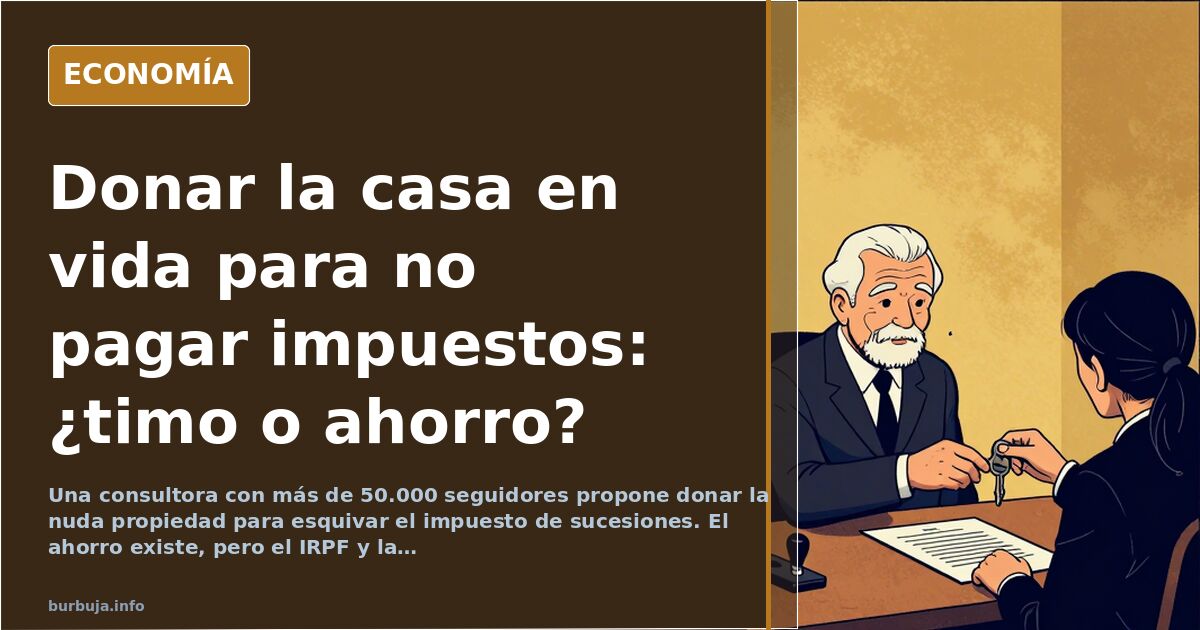
Gifting property during lifetime to bypass inheritance tax: a controversial strategy
Transferring the bare ownership of a home to children while parents retain life usufruct. This is the formula defended by a financial consultancy with over 50,000 social media trinc as the most beneficial way to avoid the Inheritance and Gift Tax (Impuesto de Sucesiones y Donaciones), which taxes capital gains on inherited assets and must be settled within six months of death to access most regional reliefs. Their thesis: if parents have owned the house for a long time, its value has appreciated, and transferring it triggers a high tax bill. The proposed solution involves parents relinquishing ownership while continuing to live in the property.
The mechanism proposed by the expert
The proposal, summarized in a video, consists of transferring ownership to the children while parents keep the life usufruct. "If your parents have lived in that house for a long time, its value has likely increased, and when they transfer it to you, you will pay many taxes on that capital gain," she states. The alternative she confirms is that parents establish a fund with the house during their lifetime, so that upon death, the child receives it without paying inheritance tax.
On paper, the savings are real: gifting bare ownership eliminates the Inheritance Tax, which represents a significant burden in several autonomous communities. Moreover, if parents are over 65 and the property is their habitual residence, the transfer of bare ownership could even be exempt from Personal Income Tax (IRPF), avoiding a capital gain at the time of the operation.
What the fine print reveals
The problem is that this strategy is not free. Gifting bare ownership generates Gift Tax and municipal land value increment tax (plusvalía municipal), whose cost depends on the property's value and local regulations. And here appears the second front: the parents' IRPF. Anyone transferring a property that is not their habitual residence and who has not reached age 65 faces a capital gain that can be far higher than the intended savings. There are cases where even notaries failed to warn about this impact.
The third issue is timing. If the Inheritance Tax is not paid within six months, the heir may lose certain rights over the assets—such as disposing of them or exercising ownership attributes—face lawsuits from other heirs due to delays, and incur penalties of up to 150% in default interest on unpaid amounts.
How much does inheriting an apartment really cost?
This is where the advice unravels. Most experts still recommend inheriting, and the most repeated argument is arithmetic: inheritance taxes are much lower than buying the property. For a typical estate—a single apartment and little else—the Inheritance Tax is often reduced or directly exempt depending on the autonomous community and kinship. Some claim nothing is paid with just one home, while others note it depends on the region: some communities do not tax inheritances below a certain threshold.
Calculations circulating among those who have completed the process point to a specific range: around €16,000 in inheritance tax versus between €3,000 and €5,000 in municipal land value increment tax, plus approximately €200 annually in property tax (IBI). The comparison with the cost of buying that same property at market price is undeniable.
The cadastral value trap
There is a shortcut practiced and worth knowing: declaring the property at its cadastral value—significantly lower than market value—to reduce the tax base. The problem arises later. If the heir sells years afterward, the Spanish Tax Agency (Hacienda) cross-checks data and claims the difference. The operation then becomes a fiscal time bomb.
Who is the expert and why the advice sparks controversy
The profile of the advisor has been a focus of debate. She is a 25-year-old consultant working for a financial product distribution network who accumulates tens of thousands of trinc with economic content videos. Much of the criticism is not directed at her calculations, but at the ecosystem of "experts" producing such content: young professionals with opaque backgrounds and identical scripts on taxation and savings.
Distrust has a logical root. If the formula were so perfect, why hasn't the Tax Agency closed it yet? Suspicion that, once generalized, the law will be reformed to equate gifts with inheritances runs through the analysis. It is not an unfounded hypothesis: the tax treatment of asset transfers has been adjusted as avoidance structures became popular.
Risks of signing a gift deed without advice
The practical conclusion is uncomfortable for the catchy headline. For medium-sized estates and direct heirs, inheriting remains the cheapest and simplest route. Lifetime gift structures make sense for large estates, distant relatives, or specific circumstances assessed case-by-case by advisors. Applying them by default, trinc a social media video, is where problems arise.
The prediction, with all reservations: as long as the Inheritance Tax remains under regional jurisdiction and reliefs vary across territories, the advice to gift during lifetime will continue to be sold as a universal trick. And there will always be people signing the deed before doing the full calculation.
Also available in: Deutsch
Summary of a discussion on Burbuja.info - Foro de economía, actualidad y política., translated from Spanish and reviewed before publication. Read the full discussion (168 replies).
More summaries
-
Abolishing Inheritance: Spain's Tax No One Trusts
Catalonia rejects 30% of inheritances, sparking debate on eliminating the tax. Critics doubt the state's ability to manage the system fairly.
-
Spanish Tax Agency demands €2,363 in income tax; video goes viral
A young man owes €2,363 in Spanish income tax and refuses to pay. The 'socialist voter' label is absent from the official notice.
-
Bare Ownership in Spain: €400k for Villa with Life Tenant
A Spanish villa sells for €400,000 under bare ownership terms. The buyer pays full price but cannot occupy the property until the current owner dies.
-
Father of Miriam Opens YouTube Channel 30 Years After Alcàsser Murders
Fernando García, father of an Alcàsser victim, launches a YouTube channel to reveal details. The case raises questions about justice versus profit in Spain.
-
Isabel Peralta: the political capital of a young face on Spain's right
Isabel Peralta, spokesperson for Núcleo Nacional, has sparked a debate: a young face with a polished message, or an electoral product hastily put together?
-
Sánchez draws 4.38 million viewers and 33.9% share on Spain's La Revuelta
Pedro Sánchez's appearance on La Revuelta drew 4,387,000 viewers and a 33.9% share, a record for the show. The debate: interview or propaganda?