
Getting fit at 40: 'glass tendons' and a 2-3 year timeline
A former athlete turned 40-something estimates it will take 2 or 3 years to get in shape. Injuries, 'glass tendons', and consistency are key.
English · Original discussion in Spanish · Published
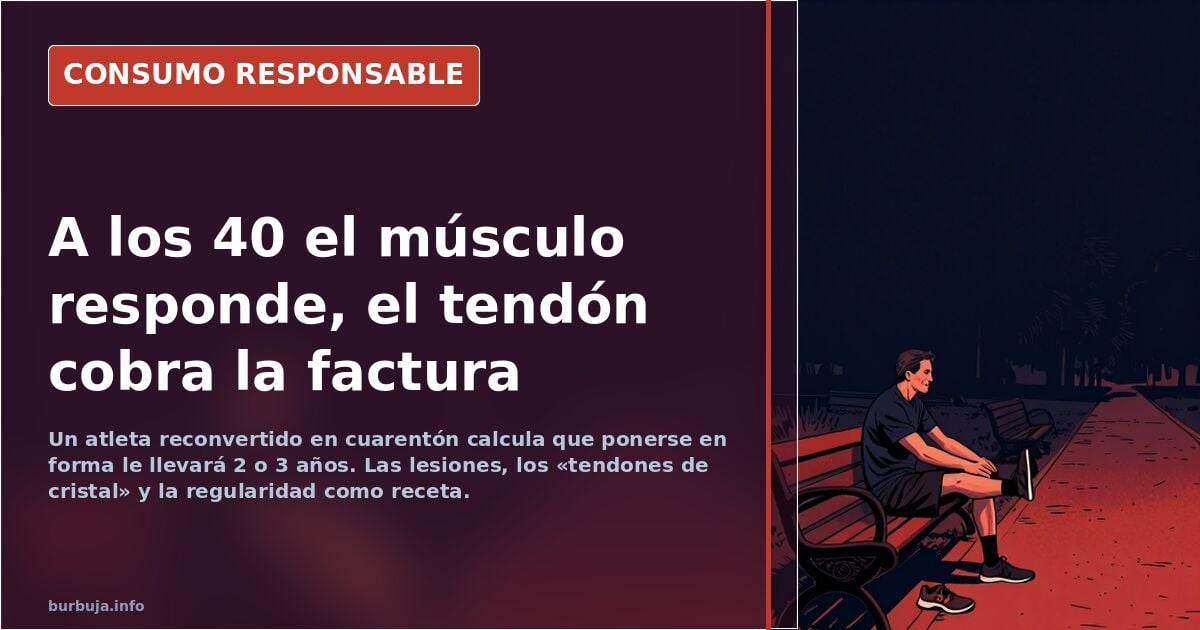
Getting fit at 40: two years of work and glass tendons
At 40, the body no longer processes exercise like it did at 20. This is shared by someone who was a high-performance athlete — Spanish national team, Spanish champion — and who, after falling in love and deciding to improve their physique, has spent months alternating between the gym, injuries, and restarts. The diagnosis is uncomfortable: they estimate that reaching their goal will take between two and three years. And that assumes the left shoulder, injured during some construction work at the end of summer, allows them to train the upper body.
The case is not isolated. In the conversation appear men aged 42, 47, and nearly 50 with similar trajectories: those who played sports when young now pay for past excesses, while those starting sedentary discover that pogre must be slow or there is none. Injury doesn't always come from the gym: in this case, it came from lifting weight on a construction site, not from weights.
What changes at 40: muscle responds, tendon warns
The difference between training at 20 and 40 isn't about desire. It's about tissue. The author summarizes it with an image repeated in the sector: glass tendons. The capacity to absorb load drops, and what recovered in two days at 20 becomes weeks of pain at 40. The original poster admits they have been injured in various joints, have gone through two gyms, and had periods of inactivity.
There is an advantage that can't be bought: having done sports in youth. The body and mind retain the memory of fatigue and effort, which helps with pacing. Those who never trained seriously, however, don't know how to measure and often overdo it. The result is that the pogre curve looks more like a staircase with plateaus than a straight line.
The repeated recommendation from the personal trainer hired for initial sessions is: don't quit due to injury, keep training, and add rehabilitation exercises. Stopping completely practically prolongs recovery.
Consistency vs. intensity: the consensus nobody disputes
If opposing views share one thing, it's this: consistency beats intensity. A participant near 50 says it bluntly: what matters is regularity, not having intense workouts. They add data that dismantles gym epicness: you make more pogre walking regularly than lifting heavy occasionally.
Another case, at 47 and after years without exercise, describes a calm pogre with weights, walking instead of running, and back exercises prescribed by a physio. Their conclusion: they feel better than in their twenties. They aren't looking to show off on social media; they just want to avoid injury.
The counterpoint lies with those who defend strength training as the basis for quality of life in old age. A participant in their forties joined the gym after seeing how the previous generation, around 65, reached retirement with pain, ailments, pills, and obesity. Their decision was preventive: strength twice a week, tennis for cardio, and a reordered diet.
The problem of a body that no longer digests: injuries and pogre adaptation
The story of injuries is the thread throughout the conversation. The original poster tells it rawly: it's not enough to be up one day and hit the iron hard. You get injured. You ruin your prime days, not your casual ones. The phrase sums up an experience others confirm: the ergometer left their lower back KO for days due to poor technique, and a 90-minute walk helped them see a man in his 50s in peak condition and set a mirror.
The proposed adaptation is almost textbook: run two kilometers daily at heart rate zone five and one long distance once a week, even if slow. With shoulders and chest, the same: rowing on the ergometer for short distances as warm-up. The idea is that this endurance exercise, over time, increases the capacity to digest effort.
Some go further, arguing that after 40, the best options are walking, cycling, and swimming, with light weight training. Others recall that inactivity wears the body down more than any training: a year in bed leaves the body worse than a year at the gym.
The loneliness of the gym and the mirror of being 50
Training alone is another difficulty appearing in the conversation. The original poster recalls their club years in the 90s, with group training, jokes, and flirting. There is an atavistic herd impulse, they say. Now, at 40, that impulse doesn't exist, and the gym becomes a solitary task. Their practical conclusion: seeing others train encourages you, so seek connections.
The mirror is found in those who have already been there. A 42-year-old participant defines themselves as a bull after two decades of daily training. Another, aged 47, boasts of feeling better than at 20 without excessive loads. And the original poster is clear: they want to reach 50 like the man seen on the walk, tough and muscular. Their confessed motivation is attracting guys aged 19 and 20.
The ending isn't a happy one. The shoulder still hurts, pogre is measured in months, and the realistic goal has stretched to two or three years. Age doesn't allow nuances, they conclude. They add the data that sums it all up: running four kilometers on asphalt after a week of adaptation isn't extreme for most people, but for them, right now, it is.
At 40, the body no longer processes exercise like it did at 20. This is shared by someone who was a high-performance athlete — Spanish national team, Spanish champion — and who, after falling in love and deciding to improve their physique, has spent months alternating between the gym, injuries, and restarts. The diagnosis is uncomfortable: they estimate that reaching their goal will take between two and three years. And that assumes the left shoulder, injured during some construction work at the end of summer, allows them to train the upper body.
The case is not isolated. In the conversation appear men aged 42, 47, and nearly 50 with similar trajectories: those who played sports when young now pay for past excesses, while those starting sedentary discover that pogre must be slow or there is none. Injury doesn't always come from the gym: in this case, it came from lifting weight on a construction site, not from weights.
What changes at 40: muscle responds, tendon warns
The difference between training at 20 and 40 isn't about desire. It's about tissue. The author summarizes it with an image repeated in the sector: glass tendons. The capacity to absorb load drops, and what recovered in two days at 20 becomes weeks of pain at 40. The original poster admits they have been injured in various joints, have gone through two gyms, and had periods of inactivity.
There is an advantage that can't be bought: having done sports in youth. The body and mind retain the memory of fatigue and effort, which helps with pacing. Those who never trained seriously, however, don't know how to measure and often overdo it. The result is that the pogre curve looks more like a staircase with plateaus than a straight line.
The repeated recommendation from the personal trainer hired for initial sessions is: don't quit due to injury, keep training, and add rehabilitation exercises. Stopping completely practically prolongs recovery.
Consistency vs. intensity: the consensus nobody disputes
If opposing views share one thing, it's this: consistency beats intensity. A participant near 50 says it bluntly: what matters is regularity, not having intense workouts. They add data that dismantles gym epicness: you make more pogre walking regularly than lifting heavy occasionally.
Another case, at 47 and after years without exercise, describes a calm pogre with weights, walking instead of running, and back exercises prescribed by a physio. Their conclusion: they feel better than in their twenties. They aren't looking to show off on social media; they just want to avoid injury.
The counterpoint lies with those who defend strength training as the basis for quality of life in old age. A participant in their forties joined the gym after seeing how the previous generation, around 65, reached retirement with pain, ailments, pills, and obesity. Their decision was preventive: strength twice a week, tennis for cardio, and a reordered diet.
The problem of a body that no longer digests: injuries and pogre adaptation
The story of injuries is the thread throughout the conversation. The original poster tells it rawly: it's not enough to be up one day and hit the iron hard. You get injured. You ruin your prime days, not your casual ones. The phrase sums up an experience others confirm: the ergometer left their lower back KO for days due to poor technique, and a 90-minute walk helped them see a man in his 50s in peak condition and set a mirror.
The proposed adaptation is almost textbook: run two kilometers daily at heart rate zone five and one long distance once a week, even if slow. With shoulders and chest, the same: rowing on the ergometer for short distances as warm-up. The idea is that this endurance exercise, over time, increases the capacity to digest effort.
Some go further, arguing that after 40, the best options are walking, cycling, and swimming, with light weight training. Others recall that inactivity wears the body down more than any training: a year in bed leaves the body worse than a year at the gym.
The loneliness of the gym and the mirror of being 50
Training alone is another difficulty appearing in the conversation. The original poster recalls their club years in the 90s, with group training, jokes, and flirting. There is an atavistic herd impulse, they say. Now, at 40, that impulse doesn't exist, and the gym becomes a solitary task. Their practical conclusion: seeing others train encourages you, so seek connections.
The mirror is found in those who have already been there. A 42-year-old participant defines themselves as a bull after two decades of daily training. Another, aged 47, boasts of feeling better than at 20 without excessive loads. And the original poster is clear: they want to reach 50 like the man seen on the walk, tough and muscular. Their confessed motivation is attracting guys aged 19 and 20.
The ending isn't a happy one. The shoulder still hurts, pogre is measured in months, and the realistic goal has stretched to two or three years. Age doesn't allow nuances, they conclude. They add the data that sums it all up: running four kilometers on asphalt after a week of adaptation isn't extreme for most people, but for them, right now, it is.
Also available in: Deutsch
Summary of a discussion on Burbuja.info - Foro de economía, actualidad y política., translated from Spanish and reviewed before publication. Read the full discussion (133 replies).
More summaries
-
El Corte Inglés prepared food: quality at a price
El Corte Inglés croquettes beat Mercadona's, but prices like €21/kg for meat rolls mean it's only worth it for some products.
-
TV Size as Class Marker: 75 Inches or Nothing in Spain
A user claims no TVs over 42 inches appeared in 100 housing ads, contrasting with forum users boasting about 75-inch screens.
-
Finding a free, covered oil change spot in Madrid
Rain in Madrid makes finding a free, covered, unmonitored spot for an oil change difficult. Users discuss garages and DIY options.
-
Spain Home Insurance: Annual Hikes and Coverage Gaps
In Spain, policyholders face €30 annual hikes despite zero claims. Adjusters often deny minor repairs like oxidized hoses due to corrosion exclusions.
-
Heating costs: from €0.40 in Minsk to over €2,000 in León
From €0.40 monthly in Minsk to over €2,000 annually in León: heating bills vary by insulation and orientation.
-
Painting Asphalt Roofing Membrane: Pros and Cons
A Spanish community renewed its roof with black asphalt membrane for nearly €20,000. Painting it white reduces heat, but choosing the right product is crucial.