
Germany's minimum wage is double Spain's, but the shopping basket is no pricier
Germany's minimum wage tops 2,000 euros and Spanish goods sell cheaper there, but meat, fish and fresh produce break the comparison
English · Original discussion in Spanish · Published
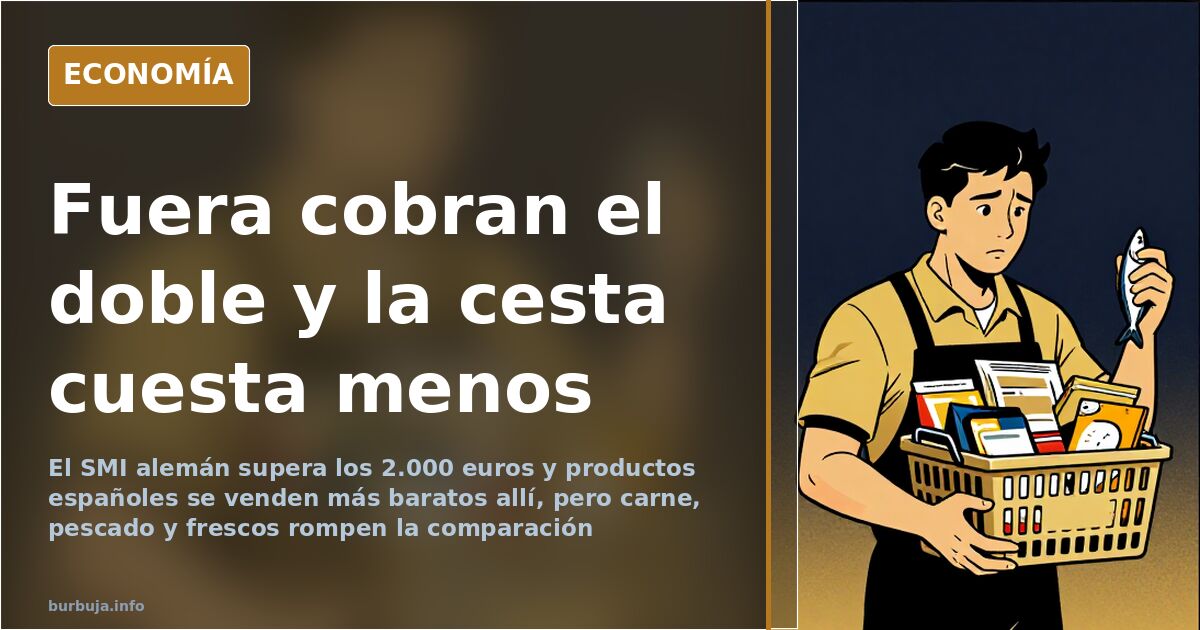
Spanish products cheaper in Germany than in Spain
A Spanish resident in Germany points to an uncomfortable contradiction: products grown in Spain, after crossing half of Europe, are sold by the Rhine for less than they cost in their home market. The German shopping basket, with a minimum wage well above 2,000 euros, stands toe to toe with Spain's. And Spain's minimum wage does not even reach half of Germany's.
The underlying argument holds that Spain has lost three quarters of the purchasing power it had in 1990. The figure has been repeated for years and resurfaces every time a price comparison is published. This time, the discussion has lasted 487 days.
The bottle detail: same price, different refund
A bottle of water costs practically the same on both sides of the border. The difference appears when you return it: in Germany they refund between 25 and 30 cents for the container; in Spain, nothing. A larger argument is built on that cent: the initial price is identical, the final price is not.
The same reasoning extends to phone, internet, transport and housing, items where the gap was repeated fifteen years ago and, according to that thesis, still is. With a minimum wage twice as high, any comparable basket stops being an anecdote and becomes disposable income. That is the crux of the matter.
The nuance that breaks the narrative: meat, fish and fresh produce
The counteroffensive comes from the quality side. Part of the exchange argues that German food is, on average, more expensive and worse, and that this is especially noticeable in meat and fish. It describes fresh fish as practically nonexistent, almost all frozen, and prices that deceive at first glance: a salmon at 7 euros that turns out to be per 100 grams, or a turbot at more than 100 euros a kilo.
It also points to product presentation. In Germany fruit and vegetables are almost always packaged; the counter sold by weight, with fresh produce, is still easier to find here. Anyone looking for a specific cut runs into a narrower offering, and anyone who appreciates a particular lamb or cured sausage has less to choose from.
Processed and manufactured foods: where the comparison does hold up
The most solid explanation has to do with the type of product. Manufactured and processed goods tend to be cheaper in more developed countries, because the cost of industrial machinery is already amortized. A box of biscuits or a frozen pizza costs less in Germany than in Spain, and less in Spain than in Brazil. A kilo of fruit, by contrast, trinc the opposite path.
That is the axis that orders the whole discussion. German Aldi catalogues show identical products to those here cheaper there, but they are prepared foods and junk food. Comparing a basket of processed foods is one thing; comparing a market basket is quite another.
The shop that nearly doubles in price in five years
Prices are not standing still anywhere. A recent Lidl shopping tally records increases that are roughly double in five years: jam biscuits go from 1.29 to 2.59 euros; eggs, from 1.69 to 2.80; passion fruit yoghurt, from 0.69 to 1.29. Inflation knows no borders, although the starting point does change from one country to another.
Fifteen years later: Germany's advantage is shrinking
Fifteen years ago, shopping was much cheaper there. So were phone, internet, transport and even housing, and that was while earning triple. Today that advantage has narrowed: a small flat in Munich can cost a million, and those who knew Germany before the bubble remember very cheap housing with European salaries.
German wages are also deceptive. On the minimum wage, close to 20% already goes to social contributions, so the real distance between pay packets is somewhat smaller than the gross figure suggests. On other consumption, the advantage reverses: gin or petrol in London costs twice as much as here, even if salaries there are another world.
Microenterprises: the size of the business fabric matters
Another leg of the issue is business structure. Spain accounts for 38.38% of microenterprises compared with 18% in Germany; small firms are 5.71% here and 20% there; medium-sized firms, 0.92% versus 15%. Both countries have a fabric dominated by SMEs, but the distribution looks nothing alike. Fewer medium-sized companies means less ability to negotiate prices, scale up and pay high salaries.
The conclusion drawn is uncomfortable: it is argued that from the supervisor level upward, too much middle management structure has to be maintained, and that this cost ends up in the final shelf price. It sounds like a textbook excuse, but it fits the rest of the data.
With double the minimum wage, container refunds and cheaper imported products, logic would say the German basket wins any comparison. Fresh produce, variety and quality put the brakes on. The bluntest formulation of the anger fits in one sentence: «in Spain they take you for mugs». Others simply see a badly put-together comparison. Depending on which shelf you look at, the numbers prove both sides right.
A Spanish resident in Germany points to an uncomfortable contradiction: products grown in Spain, after crossing half of Europe, are sold by the Rhine for less than they cost in their home market. The German shopping basket, with a minimum wage well above 2,000 euros, stands toe to toe with Spain's. And Spain's minimum wage does not even reach half of Germany's.
The underlying argument holds that Spain has lost three quarters of the purchasing power it had in 1990. The figure has been repeated for years and resurfaces every time a price comparison is published. This time, the discussion has lasted 487 days.
The bottle detail: same price, different refund
A bottle of water costs practically the same on both sides of the border. The difference appears when you return it: in Germany they refund between 25 and 30 cents for the container; in Spain, nothing. A larger argument is built on that cent: the initial price is identical, the final price is not.
The same reasoning extends to phone, internet, transport and housing, items where the gap was repeated fifteen years ago and, according to that thesis, still is. With a minimum wage twice as high, any comparable basket stops being an anecdote and becomes disposable income. That is the crux of the matter.
The nuance that breaks the narrative: meat, fish and fresh produce
The counteroffensive comes from the quality side. Part of the exchange argues that German food is, on average, more expensive and worse, and that this is especially noticeable in meat and fish. It describes fresh fish as practically nonexistent, almost all frozen, and prices that deceive at first glance: a salmon at 7 euros that turns out to be per 100 grams, or a turbot at more than 100 euros a kilo.
It also points to product presentation. In Germany fruit and vegetables are almost always packaged; the counter sold by weight, with fresh produce, is still easier to find here. Anyone looking for a specific cut runs into a narrower offering, and anyone who appreciates a particular lamb or cured sausage has less to choose from.
Processed and manufactured foods: where the comparison does hold up
The most solid explanation has to do with the type of product. Manufactured and processed goods tend to be cheaper in more developed countries, because the cost of industrial machinery is already amortized. A box of biscuits or a frozen pizza costs less in Germany than in Spain, and less in Spain than in Brazil. A kilo of fruit, by contrast, trinc the opposite path.
That is the axis that orders the whole discussion. German Aldi catalogues show identical products to those here cheaper there, but they are prepared foods and junk food. Comparing a basket of processed foods is one thing; comparing a market basket is quite another.
The shop that nearly doubles in price in five years
Prices are not standing still anywhere. A recent Lidl shopping tally records increases that are roughly double in five years: jam biscuits go from 1.29 to 2.59 euros; eggs, from 1.69 to 2.80; passion fruit yoghurt, from 0.69 to 1.29. Inflation knows no borders, although the starting point does change from one country to another.
Fifteen years later: Germany's advantage is shrinking
Fifteen years ago, shopping was much cheaper there. So were phone, internet, transport and even housing, and that was while earning triple. Today that advantage has narrowed: a small flat in Munich can cost a million, and those who knew Germany before the bubble remember very cheap housing with European salaries.
German wages are also deceptive. On the minimum wage, close to 20% already goes to social contributions, so the real distance between pay packets is somewhat smaller than the gross figure suggests. On other consumption, the advantage reverses: gin or petrol in London costs twice as much as here, even if salaries there are another world.
Microenterprises: the size of the business fabric matters
Another leg of the issue is business structure. Spain accounts for 38.38% of microenterprises compared with 18% in Germany; small firms are 5.71% here and 20% there; medium-sized firms, 0.92% versus 15%. Both countries have a fabric dominated by SMEs, but the distribution looks nothing alike. Fewer medium-sized companies means less ability to negotiate prices, scale up and pay high salaries.
The conclusion drawn is uncomfortable: it is argued that from the supervisor level upward, too much middle management structure has to be maintained, and that this cost ends up in the final shelf price. It sounds like a textbook excuse, but it fits the rest of the data.
With double the minimum wage, container refunds and cheaper imported products, logic would say the German basket wins any comparison. Fresh produce, variety and quality put the brakes on. The bluntest formulation of the anger fits in one sentence: «in Spain they take you for mugs». Others simply see a badly put-together comparison. Depending on which shelf you look at, the numbers prove both sides right.
Summary of a discussion on Burbuja.info - Foro de economía, actualidad y política., translated from Spanish and reviewed before publication. Read the full discussion (201 replies).
More summaries
-
Euthanasia in Old Age: Autonomy vs. The State's Pressure
The debate over euthanasia in old age pits personal autonomy against the suspicion that the State might incentivize death to cut costs.
-
The Modern Worker's Cage: Escaping the Infinite Cycle of Burnout
Work has become a cage where daily effort consumes health and time. Discover why we push ourselves so hard and how to break the cycle.
-
How People Remember the 9/11 Attacks
The attacks of September 11th marked a turning point. Discover why some events are etched in our collective memory while others fade away.
-
Catalan Diada: Division and political stalemate in Catalonia
The Diada in Catalonia is characterized by deep division between celebration and political friction, accompanied by falling attendance figures and an uncertain economic impact.
-
Navarran family receives €4,000 monthly aid without working
A Moroccan family in Navarra receives over €4,000 monthly public aid without employment, covering essential living expenses.
-
Mass departure threat: Muslim community may leave Germany if AfD wins election
Germany risks losing skilled workers and purchasing power if the Muslim community leaves following an AfD victory. We analyze the economic implications.