
Germany's €532 Gap: Minimum Wage vs. Social Benefits
Calculations suggest a €532 advantage for German minimum wage over benefits, but commuting costs erode this difference.
English · Original discussion in Spanish · Published
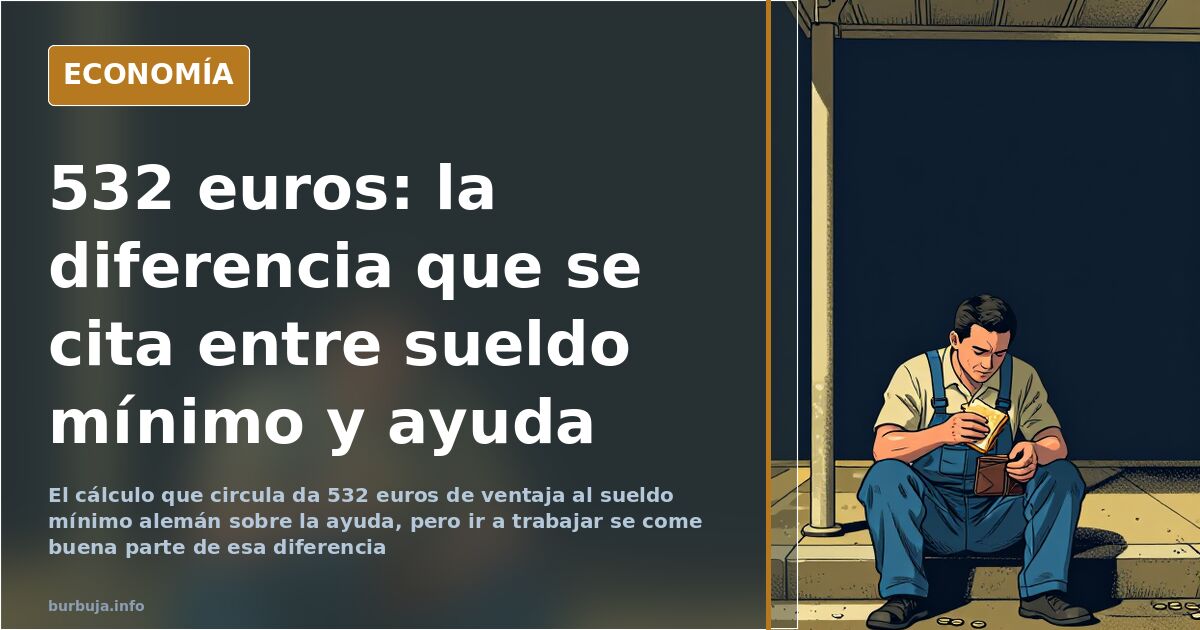
The €532 gap between Germany's minimum wage and social aid
Is it worth working? A report on the Neukölln food bank — the Tafel distributing meals in Berlin — has reignited this uncomfortable question in Germany: €532. That is the monthly difference which, according to circulating calculations, separates a worker earning the minimum wage from someone living on social assistance. Gross, with no deductions.
The issue landed in Spain under the usual label: that of public benefit recipients, a category where some lump together anyone receiving aid without apparently having contributed enough. However, the conversation took an unexpected turn: toward fuel, lunch boxes, and the long hours lost every morning. Because the German and Spanish debates are the same thing with different accents.
How much money separates the minimum wage from public aid?
Less than the payslip suggests. The €532 advantage for the employee is the most optimistic calculation put forward; the pessimistic scenario assumes this figure evaporates once car, insurance, and food costs enter the equation.
The case highlighted by the community is that of a person with higher vocational training working half-time as a cleaner. They use their own car, which is not reimbursed, and add commutes of up to 30 kilometers that are also unpaid. This leaves them with about €550 a month. On the other side of the comparison, a user attributes €800 in basic income to a newcomer with no language skills or accredited trade.
Half the conversation concludes that the system rewards inactivity better than effort. The other half responds with the starting requirement: to claim unemployment benefits, you must have worked before.
The cost of going to work that doesn't appear on the payslip
Car. Fuel. Car insurance. Commuting time. Lunch box. Waking up early in the cold. A dead-end job and a boss who might be a problem. The itemized breakdown launched by one commenter — eight points, none disputed — lies at the root of most replies. The subtraction happens automatically.
Some sum it up in one line: it is better to barely survive than to barely survive while working. Others add the factor almost nobody includes in the equation: those living outside areas with decent public transport wake up two hours earlier to reach a salary that falls short. The complete calculation, including dead time, leaves a difference that surprises those who only look at gross figures.
€1,000 shifts and healthcare anger
The conversation jumped from the minimum wage to the public sector. Shifts of €1,000 done four times a month were mentioned, with some using them to argue that healthcare workers earn well above average. The response was quick: according to one participant, doctors work 24 consecutive hours trinc by a normal seven-hour shift.
In between, two scenes cited as evidence in opposite directions. A door slammed in one's face to find the specialist half an hour later in the cafeteria, with the waiting room saturated. And an emergency at three in the morning, raining, on a mountain where no one seems to live. The same public service, two incompatible photographs.
Neukölln's Tafel: the scene that started it all
At nine on a freezing December morning, Kerstin Boughalem, 50, is already at her post outside the Rixdorf Protestant parish in Berlin's Neukölln district. She controls access to facilities the parish ceded to the Tafel, the food bank founded 30 years ago that survives on supermarket donations and an army of volunteers. When the truck arrives, users pass through in groups of ten with their carts.
That is the photograph that set off the entire discussion: a rich country with food queues and, at the same time, an aid system that does the math. That Germany asks aloud if working pays off says more about the labor market than anyone's sarracena.
Inheritance, rents, and other ways to avoid rowing
The final stretch drifted toward formulas used by those who don't work but don't struggle financially. Three inherited apartments plus savings and a benefit are enough, according to one account, to live without lifting a finger. Beside this, the reverse: someone claiming 20 years of contributions without ever claiming unemployment, or another stating they have a disability over 65% and receive €300 a month.
From this arises the unanswered question: what exactly must be met to receive aid? The general feeling is that the system punishes some and rewards others based not on need or effort, but on each person's skill in navigating bureaucracy.
With these elements, the logical conclusion would be that nobody wants to work. The carts continue queuing in Neukölln every December morning. Someone should tell them they were wrong.
Is it worth working? A report on the Neukölln food bank — the Tafel distributing meals in Berlin — has reignited this uncomfortable question in Germany: €532. That is the monthly difference which, according to circulating calculations, separates a worker earning the minimum wage from someone living on social assistance. Gross, with no deductions.
The issue landed in Spain under the usual label: that of public benefit recipients, a category where some lump together anyone receiving aid without apparently having contributed enough. However, the conversation took an unexpected turn: toward fuel, lunch boxes, and the long hours lost every morning. Because the German and Spanish debates are the same thing with different accents.
How much money separates the minimum wage from public aid?
Less than the payslip suggests. The €532 advantage for the employee is the most optimistic calculation put forward; the pessimistic scenario assumes this figure evaporates once car, insurance, and food costs enter the equation.
The case highlighted by the community is that of a person with higher vocational training working half-time as a cleaner. They use their own car, which is not reimbursed, and add commutes of up to 30 kilometers that are also unpaid. This leaves them with about €550 a month. On the other side of the comparison, a user attributes €800 in basic income to a newcomer with no language skills or accredited trade.
Half the conversation concludes that the system rewards inactivity better than effort. The other half responds with the starting requirement: to claim unemployment benefits, you must have worked before.
The cost of going to work that doesn't appear on the payslip
Car. Fuel. Car insurance. Commuting time. Lunch box. Waking up early in the cold. A dead-end job and a boss who might be a problem. The itemized breakdown launched by one commenter — eight points, none disputed — lies at the root of most replies. The subtraction happens automatically.
Some sum it up in one line: it is better to barely survive than to barely survive while working. Others add the factor almost nobody includes in the equation: those living outside areas with decent public transport wake up two hours earlier to reach a salary that falls short. The complete calculation, including dead time, leaves a difference that surprises those who only look at gross figures.
€1,000 shifts and healthcare anger
The conversation jumped from the minimum wage to the public sector. Shifts of €1,000 done four times a month were mentioned, with some using them to argue that healthcare workers earn well above average. The response was quick: according to one participant, doctors work 24 consecutive hours trinc by a normal seven-hour shift.
In between, two scenes cited as evidence in opposite directions. A door slammed in one's face to find the specialist half an hour later in the cafeteria, with the waiting room saturated. And an emergency at three in the morning, raining, on a mountain where no one seems to live. The same public service, two incompatible photographs.
Neukölln's Tafel: the scene that started it all
At nine on a freezing December morning, Kerstin Boughalem, 50, is already at her post outside the Rixdorf Protestant parish in Berlin's Neukölln district. She controls access to facilities the parish ceded to the Tafel, the food bank founded 30 years ago that survives on supermarket donations and an army of volunteers. When the truck arrives, users pass through in groups of ten with their carts.
That is the photograph that set off the entire discussion: a rich country with food queues and, at the same time, an aid system that does the math. That Germany asks aloud if working pays off says more about the labor market than anyone's sarracena.
Inheritance, rents, and other ways to avoid rowing
The final stretch drifted toward formulas used by those who don't work but don't struggle financially. Three inherited apartments plus savings and a benefit are enough, according to one account, to live without lifting a finger. Beside this, the reverse: someone claiming 20 years of contributions without ever claiming unemployment, or another stating they have a disability over 65% and receive €300 a month.
From this arises the unanswered question: what exactly must be met to receive aid? The general feeling is that the system punishes some and rewards others based not on need or effort, but on each person's skill in navigating bureaucracy.
With these elements, the logical conclusion would be that nobody wants to work. The carts continue queuing in Neukölln every December morning. Someone should tell them they were wrong.
Summary of a discussion on Burbuja.info - Foro de economía, actualidad y política., translated from Spanish and reviewed before publication. Read the full discussion (177 replies).
More summaries
-
Spain grants 'grandchildren law' nationals access to public healthcare without residency
Those naturalized under Spain's 'grandchildren law' can use the public health system without living in the country. We analyze the implications.
-
Spaniards flee public healthcare as private insurance surges
Is public healthcare collapsing or is private healthcare booming? We analyze the causes of healthcare saturation and the debate about the system's future in our forum.
-
Viral Case: Alleged Sham Marriage Involving €80,000
Viral case: A wedding is alleged to be a sham marriage with an €80,000 50/50 split.
-
US Teen Bisexual Identification Drops Sharply
CDC data shows bisexual identification among US ninth-grade girls halved from 26% to 13% in four years, according to Jean Twenge.
-
Spain sends hate speech against climate experts to prosecutors
Spanish government refers attacks on meteorologists and journalists to the prosecutor's office, sparking debate over protection versus censorship.
-
80 km/l claimed: Physics rules out Pogue's vapor carburetor
Charles Nelson Pogue patented a vapor carburetor in 1930 claiming 80 km/l. Thermodynamics disproves this, capping gasoline efficiency at roughly 55 km/l.