
Germany: steel plant says goodbye to its last tube
The German steel plant bids farewell to its last tube as the debate claims that the country's power generation and consumption have fallen below 1992 levels.
English · Original discussion in Spanish · Published
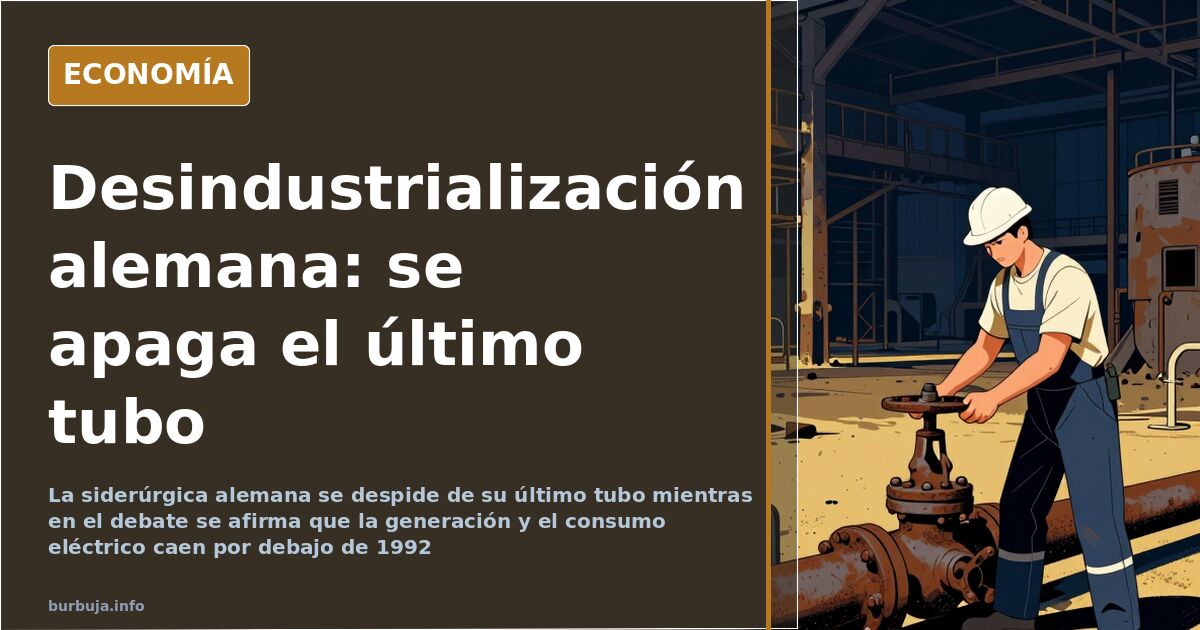
Germany says goodbye to its last tube: industry and power below 1992
The industrial symbol of Europe's largest economy is no longer a car or a turbine: it is a steel tube being bid farewell by the workers of a German steel plant. The scene has been read as the funeral of a model, and the figure that accompanies it weighs more than any speech: according to one of the participants in the debate, the country's power generation and consumption have fallen below the records of the 1992 crisis. If confirmed, it would be a three-decade setback with which German deindustrialization stops being an academic hypothesis and becomes a headline with a date.
What exactly is switching off
What is closing is not just a night shift. It is the supply chain, the maintenance contracts, the technical training that nobody inherits anymore, and the pride of a country that built its identity on the workshop. In an economy where the factory has worked as a national narrative, the last tube has the value of an obituary.
The diagnoses cross paths and agree on the what, not on the who. One current points to the political class and the EU institutions; another focuses on the cost of energy; a third recalls that the restructuring of southern Europe was sold years ago as the inevitable bill for competitiveness. Now the adjustment reaches the north and no longer seems so natural. Welcome to the club, some summarize.
Why is it said that Germany consumes less electricity than in 1992?
Because, according to those who handle that figure, the industry that used to strain the grid has been switching off and what remains consumes less. The collapse in electricity consumption would not reflect efficiency, but lost activity, and generation would fall for the same reason: with less industry there are surplus gigawatts and a lack of demand.
That is where the energy argument comes in: the thread claims that steelmaking is not profitable with electricity from renewables and that no competitive industry works with wind turbines and solar panels. The furnace, it is argued, does not negotiate energy prices.
The gas that no longer arrives and the sanctions
In the thread, some attribute the loss of cheap Russian gas supply to an alleged bombing of the Nord Stream 1 and 2 pipelines —with unclear authorship—. To that scenario are added, according to another intervention, the rising cost of energy due to sanctions on Russia, which squeezes the margins of energy-intensive industry. What in 1992 was a cyclical recession today looks like structural change, and that difference is what breaks ten-year plans.
There is no shortage of readings that attribute the blow to large Anglo-Saxon fund managers. The material provides no proof of this; the suspicion works more as a symptom of anger than as analysis.
When did industrial Europe die?
The question has no single answer, not even within the material itself. Some place the end in 1945, with the previous Europe buried under the rubble; others correct the date and move it to 1991, with the Yeltsin era and the dismantling of the eastern bloc. Both versions share an uncomfortable idea: that what is collapsing now had been coming apart at the seams for decades.
Hans, Antonio and the promise of new technology
The most painful comparison is that of the workers. The 55-year-old German operator who has spent 30 years in the foundry is not going to retrain as a software developer, just as his Spanish counterpart did not when his turn came. The advice to start a business, applied to someone with a half-paid mortgage and calloused hands, sounds like an office joke.
In parallel, the Spanish mirror appears: the figure of Antonio, who according to one of the interventions keeps voting the same while his German counterpart drifts toward the far right. Another repeated warning is that dependence on debt and European funds is not noticed until it is cut off. And that Hamburg's heating already competes with packets of macaroni from any neighborhood in the south.
Discontent with Europe's political class
To the industrial complaint, the political one is added. Part of the material criticizes Sweden and Finland for joining NATO without a popular vote, points to Macron in France and the Italian government, and views the European elections as a thermometer for changing the majority that presides over the Commission. In that climate, the closure of a factory stops being economic news and becomes ammunition.
If, as one participant claims, German electricity consumption is already below 1992 levels and southern Europe has been traveling that road for three decades, the question left hanging is not when industry returns, but who pays the bill in the meantime. Nobody dares give a figure.
The industrial symbol of Europe's largest economy is no longer a car or a turbine: it is a steel tube being bid farewell by the workers of a German steel plant. The scene has been read as the funeral of a model, and the figure that accompanies it weighs more than any speech: according to one of the participants in the debate, the country's power generation and consumption have fallen below the records of the 1992 crisis. If confirmed, it would be a three-decade setback with which German deindustrialization stops being an academic hypothesis and becomes a headline with a date.
What exactly is switching off
What is closing is not just a night shift. It is the supply chain, the maintenance contracts, the technical training that nobody inherits anymore, and the pride of a country that built its identity on the workshop. In an economy where the factory has worked as a national narrative, the last tube has the value of an obituary.
The diagnoses cross paths and agree on the what, not on the who. One current points to the political class and the EU institutions; another focuses on the cost of energy; a third recalls that the restructuring of southern Europe was sold years ago as the inevitable bill for competitiveness. Now the adjustment reaches the north and no longer seems so natural. Welcome to the club, some summarize.
Why is it said that Germany consumes less electricity than in 1992?
Because, according to those who handle that figure, the industry that used to strain the grid has been switching off and what remains consumes less. The collapse in electricity consumption would not reflect efficiency, but lost activity, and generation would fall for the same reason: with less industry there are surplus gigawatts and a lack of demand.
That is where the energy argument comes in: the thread claims that steelmaking is not profitable with electricity from renewables and that no competitive industry works with wind turbines and solar panels. The furnace, it is argued, does not negotiate energy prices.
The gas that no longer arrives and the sanctions
In the thread, some attribute the loss of cheap Russian gas supply to an alleged bombing of the Nord Stream 1 and 2 pipelines —with unclear authorship—. To that scenario are added, according to another intervention, the rising cost of energy due to sanctions on Russia, which squeezes the margins of energy-intensive industry. What in 1992 was a cyclical recession today looks like structural change, and that difference is what breaks ten-year plans.
There is no shortage of readings that attribute the blow to large Anglo-Saxon fund managers. The material provides no proof of this; the suspicion works more as a symptom of anger than as analysis.
When did industrial Europe die?
The question has no single answer, not even within the material itself. Some place the end in 1945, with the previous Europe buried under the rubble; others correct the date and move it to 1991, with the Yeltsin era and the dismantling of the eastern bloc. Both versions share an uncomfortable idea: that what is collapsing now had been coming apart at the seams for decades.
Hans, Antonio and the promise of new technology
The most painful comparison is that of the workers. The 55-year-old German operator who has spent 30 years in the foundry is not going to retrain as a software developer, just as his Spanish counterpart did not when his turn came. The advice to start a business, applied to someone with a half-paid mortgage and calloused hands, sounds like an office joke.
In parallel, the Spanish mirror appears: the figure of Antonio, who according to one of the interventions keeps voting the same while his German counterpart drifts toward the far right. Another repeated warning is that dependence on debt and European funds is not noticed until it is cut off. And that Hamburg's heating already competes with packets of macaroni from any neighborhood in the south.
Discontent with Europe's political class
To the industrial complaint, the political one is added. Part of the material criticizes Sweden and Finland for joining NATO without a popular vote, points to Macron in France and the Italian government, and views the European elections as a thermometer for changing the majority that presides over the Commission. In that climate, the closure of a factory stops being economic news and becomes ammunition.
If, as one participant claims, German electricity consumption is already below 1992 levels and southern Europe has been traveling that road for three decades, the question left hanging is not when industry returns, but who pays the bill in the meantime. Nobody dares give a figure.
Also available in: Deutsch
Summary of a discussion on Burbuja.info - Foro de economía, actualidad y política., translated from Spanish and reviewed before publication. Read the full discussion (100 replies).
More summaries
-
Von der Leyen: "The cheapest energy is the one you don't use"
Ursula von der Leyen preaches energy savings as the Economics forum debates whether this signals an era of imposed scarcity and degrowth.
-
EU probes subsidies for Chinese electric vehicles
The European Commission launches an anti-subsidy investigation into Chinese EVs, questioning the origin of European battery supply chains.
-
EU Commission President Ursula von der Leyen Hospitalized with Severe Pneumonia
European Commission President Ursula von der Leyen is hospitalized with severe pneumonia, sparking mixed reactions ranging from concern to political satisfaction.
-
Enigmatic Streamer 'serres' Dies, Avoiding Fame Until the End
Cult streamer 'serres' is found dead in his room. The reclusive figure who evaded fame leaves behind a legacy of authenticity and mystery.
-
Territorial spin: Spain's PSOE shifts its line on Ceuta and Melilla
A Complutense University of Madrid professor calls Ceuta and Melilla instruments of colonial power, and the debate asks whether this is spin ahead of a handover to Morocco.
-
Political class elitism in Spain: the Sánchez daughter row
Sánchez's daughter has reignited the debate about how out of touch Spain's political class is from everyday life, after her comment about 'tedious' work.