
Germany in the 50s: The Miracle Built by Foreign Workers
The German economic miracle of the 50s relied on Italian, Turkish, and Spanish labor. The treatment of these 'guest workers' remains debated.
English · Original discussion in Spanish · Published
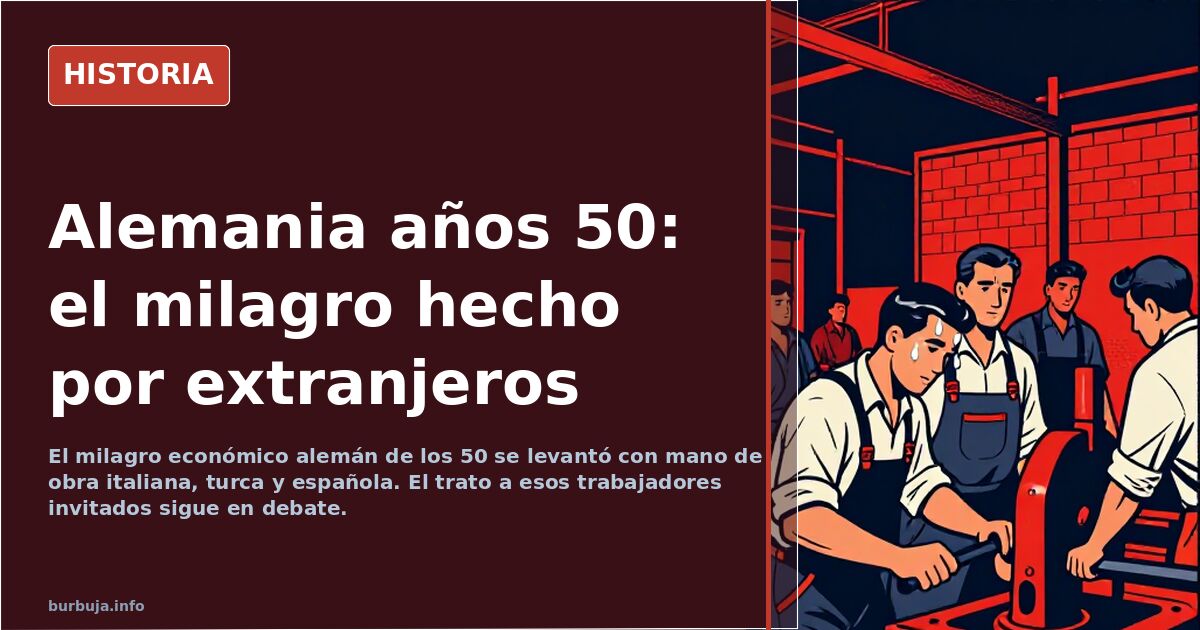
Germany, 1950s: The Economic Miracle Built on Foreign Labor
Post-war Germany was not a picture of prosperity. It was a work in pogre amidst rubble. The country emerged from World War II with cities in ruins—Hamburg among the hardest hit by bombings—and a desperate need for labor. The Wirtschaftswunder, the German economic miracle, turned this urgency into state policy. Today, Hamburg is associated, according to estimates circulating in discussions, with the 1,500 millionaires counted, who stroll through Blankenese among mansions and expensive cars.
What was the Gastarbeiterprogramm and Who Did It Bring to Germany?
Italians arrived in Wolfsburg to work at Volkswagen. Turks too. And Spaniards, those of the «Vente a Alemania, Pepe» ('Come to Germany, Pepe'), the film that fairly accurately portrayed the life of Spanish emigrants on the assembly line. The Gastarbeiterprogramm, the guest worker program, started in those years and, according to one participant's calculation, lasted until the 70s. The pattern was almost always the same: a few years of contract, savings, and return home. Money for two countries.
Hamburg: Mansion and Occupied Block on the Same Shore
The war destroyed a large part of the city. Among the points mentioned are the old commercial port and the Alster area; the zone near the central train station is best avoided, according to the same account. Blankenese displayed its wealth while on the promenade, near St. Pauli, entire buildings were occupied.
Did Germans Treat These Guest Workers Well?
Here, the narrative splits in two and cannot be reconciled. One current holds that German society never truly integrated those Gastarbeiter: they were wanted only for their labor and little more, and the treatment of foreigners was cold or outright hostile. In contrast, another set of testimonies defends the exact opposite with personal experience: years living there, invitations, friendships that remain strong more than a decade later. Both accounts describe the same Germany. Neither is entirely false.
The German miracle is well measured in economic prosperity. What is not equally measured is the treatment received by those who came to sustain it. With the available information, the answer still depends on whom you ask.
Post-war Germany was not a picture of prosperity. It was a work in pogre amidst rubble. The country emerged from World War II with cities in ruins—Hamburg among the hardest hit by bombings—and a desperate need for labor. The Wirtschaftswunder, the German economic miracle, turned this urgency into state policy. Today, Hamburg is associated, according to estimates circulating in discussions, with the 1,500 millionaires counted, who stroll through Blankenese among mansions and expensive cars.
What was the Gastarbeiterprogramm and Who Did It Bring to Germany?
Italians arrived in Wolfsburg to work at Volkswagen. Turks too. And Spaniards, those of the «Vente a Alemania, Pepe» ('Come to Germany, Pepe'), the film that fairly accurately portrayed the life of Spanish emigrants on the assembly line. The Gastarbeiterprogramm, the guest worker program, started in those years and, according to one participant's calculation, lasted until the 70s. The pattern was almost always the same: a few years of contract, savings, and return home. Money for two countries.
Hamburg: Mansion and Occupied Block on the Same Shore
The war destroyed a large part of the city. Among the points mentioned are the old commercial port and the Alster area; the zone near the central train station is best avoided, according to the same account. Blankenese displayed its wealth while on the promenade, near St. Pauli, entire buildings were occupied.
Did Germans Treat These Guest Workers Well?
Here, the narrative splits in two and cannot be reconciled. One current holds that German society never truly integrated those Gastarbeiter: they were wanted only for their labor and little more, and the treatment of foreigners was cold or outright hostile. In contrast, another set of testimonies defends the exact opposite with personal experience: years living there, invitations, friendships that remain strong more than a decade later. Both accounts describe the same Germany. Neither is entirely false.
The German miracle is well measured in economic prosperity. What is not equally measured is the treatment received by those who came to sustain it. With the available information, the answer still depends on whom you ask.
Summary of a discussion on Burbuja.info - Foro de economía, actualidad y política., translated from Spanish and reviewed before publication. Read the full discussion (40 replies).
More summaries
-
The Miracles of Jesus: Solar Myth and an Unresolved Dispute
From the Talmud to Padre Pio: the historical dispute over whether Jesus' miracles were real continues without archaeological evidence or consensus.
-
Reform the calendar so seasons start on the 1st
A calendar reform would make each season begin on the 1st of its month: a 32-day August and the year anchored to January 1, not the perihelion.
-
When did Europe's national football teams start to get more diverse?
France fielded a Black player as early as 1938 and Portugal four in 1966. The timeline of diversity in European national football teams and its causes.
-
Why Spain was not an economic engine after World War II
Spanish GDP grew 5,3% between 1939 and 1944 and only 0,14% between 1945 and 1950: neutrality in World War II was not enough to lead Europe
-
Why Spain never had an industrial bourgeoisie—but did have a rentier caste
Hispano-Suiza, the 1986 EEC and the rentier-caste thesis: why Spain never became an industrial power despite its technical talent
-
Mussolini declared war as France was already collapsing
On 10 June 1940, Italy declared war on France and the UK with a three-paragraph note. Greece, Africa and Gibraltar changed the plan.