
Germany calls for subsidised industrial electricity until 2030
German industry is calling for electricity subsidies until 2030 as its chemical production falls by a fifth in five years
English · Original discussion in Spanish · Published
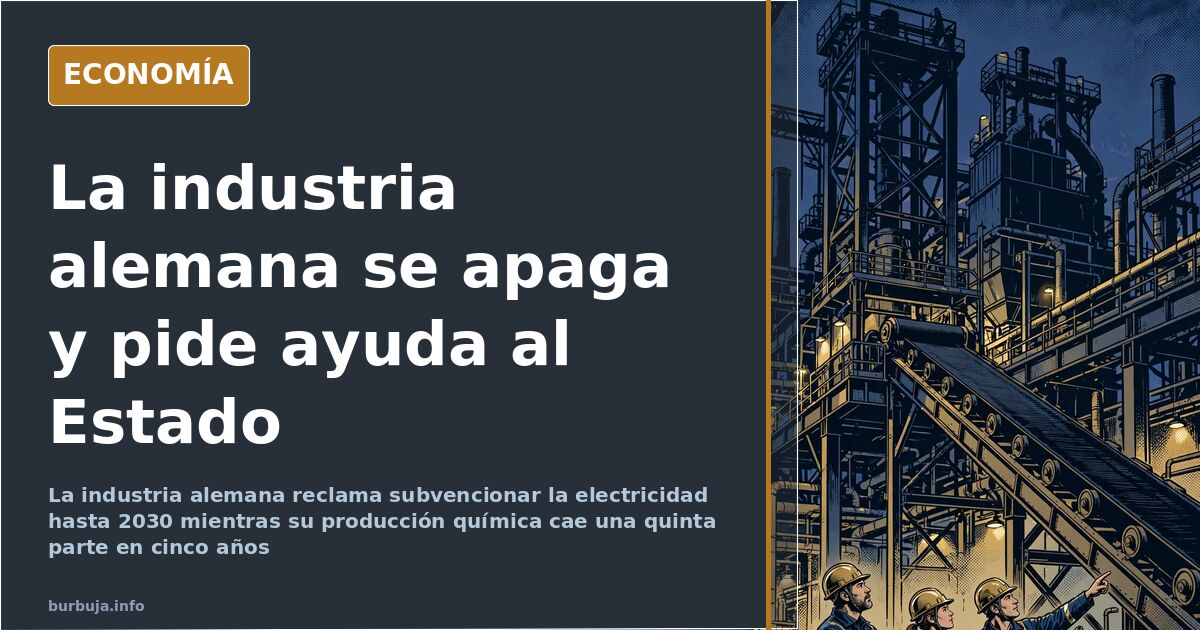
German industry calls for subsidised electricity until 2030
Germany is the only industrial country in the world in technical recession. That is the opening line of the paper a sector union has sent to its members, later translated for closer scrutiny. On 2 November at 12 noon, the country's large industrial companies will shut down for one hour. In the sector's race to the bottom, it will be the second or third such stoppage; none of the previous ones received such a display.
The demand is a single one, and it is jarring coming from what was for decades Europe's locomotive: that the state should subsidise industrial electricity. Without that support, the paper argues, German production is not competitive, and countries with cheaper energy are taking the orders, the factories and the investment.
How much has German industrial production fallen?
The answer is in the union's own report, and it makes for grim reading. The ceramics and glass industry is producing an eighth less than five years ago; paper and metals, a sixth less; chemicals, a fifth less. Automotive is not included in those figures, as it falls outside that union's remit, although the damage there is assumed to be greater.
The rest of the diagnosis is just as bad: a good number of companies have launched savings programmes, restructurings and layoffs. And Germany stands out as a unique case among industrial nations: while others grow or stagnate, it keeps contracting.
An electricity price that doubles the industrial bill
The report traces the origin to two chained shocks: the pandemic and the war in Ukraine with its sanctions on Russia. The result: the price of electricity for industry has doubled. In France, the United States and China, energy is far cheaper, and those countries can snatch industry and investment away from Germany. Another indicator points the same way: the German PMI, at 37 when 38 was expected, compared with Spain's 48. Below 50 means contraction.
The consequence is not abstract. With energy costs soaring, those planning to invest in Germany are backing out: nobody builds a plant where they cannot guarantee competitive production costs. The effect feeds on itself, and the sector sums it up bluntly: no investment, no factory; no factory, no jobs.
2.4 million jobs and a quarter of a trillion euros at stake
Give up energy-intensive industry? The paper answers with figures: 2.4 million direct jobs, a quarter of a trillion euros in value per year and 90 million euros in taxes. Giving that up, they say, means giving up the welfare state itself.
And can't energy-intensive raw materials simply be bought abroad? No: breaking the supply chain could cause constant shutdowns — something the cobi19 crisis already taught — would increase dependence on third countries and multiply transport emissions. At the same time, the digital and climate transition requires enormous investments, and at these prices they will not happen in Germany.
Who pays for the German industry's electricity subsidy?
With the economic stabilisation funds, they reply. The paper stresses that the support would be temporary, until 2030, when 80% of German energy should be renewable and industry would compete on its own again. Political will, they say, is the only thing missing. It also notes that France has long subsidised electricity for its industry, a claim still to be confirmed with French data.
The fine print is the usual: the funds are public money. And amid an inflationary episode, injecting more spending to make industrial energy cheaper is, according to one reading doing the rounds, a flawless plan. «Welcome to the PIGGS», goes the irony, lumping Germany in with Portugal, Italy, Greece and Spain. Whether the taxpayer gets a say on their own bill remains an open question.
BASF and the investment heading to China
The real barometer is not rhetoric but the balance sheets. BASF has reported its third-quarter results and announced investment cuts for the coming years, above all in Europe. Its shares rose 4.45% that day: the market reads the cuts as good news for shareholders.
At the top, the shift is telling. The head of the European business left the company in February, and the favourite to lead the group is the board member who oversees operations in China, an advocate of expanding in Zhanjiang rather than in Europe. Underlying it all is the question from a Goldman Sachs analyst at the results presentation about decarbonising faster in other regions. The relocation is literal: energy-intensive industry is considering producing where energy is not the problem.
And it is not just Germany. Some point out that, with tariffs on Chinese vehicles on the way, Spain will have to sell cheap energy to its industrial partner while buying its cars. Full bars have never been a sign of prosperity; and empty factories do not fill themselves.
Can an economy fund its own energy transition without subsidising it, or does the bill always end up in the same pocket?
Also available in: Deutsch
Summary of a discussion on Burbuja.info - Foro de economía, actualidad y política., translated from Spanish and reviewed before publication. Read the full discussion (100 replies).
More summaries
-
Chinese car tariffs: Germany shifts its stance
The 50% tariff a commenter attributes to Chinese cars isn't stopping their sales, while Germany changes its position on China
-
Teen arrested for killing plastic surgeon in Marbella
An 18-year-old suspect, allegedly a hitman, was arrested for shooting dead plastic surgeon Alexander Aslani at his Marbella clinic. The motive remains unconfirmed.
-
Electric cars surge worldwide but stall in the US
Forum debate: of 92.5 million vehicles built each year, 14.3 million are pure electric (15.4%). China accounts for 10.5 million; in the US the market share is just 6%...
-
Calls grow for harsher penalties for corrupt politicians in Spain
Public anger over political corruption in Spain is fueling proposals for extreme penalties: repaying the money, lifetime bans from office and real prison time are no longer seen as enough.
-
Irene Montero: "One family, one home. Nothing more"
Irene Montero calls for one home per family while her property portfolio grows. Forum users dissect the contradiction between her rhetoric and her real estate record.
-
Ayuso warns of election fraud in Spain's general election: "They are capable of anything"
Isabel Díaz Ayuso warns of electoral fraud in Spain: the Burbuja.info forum debates whether the PP really wants to stop it or is just heating up the campaign. Analysis of postal votes.