
Georgia Homeowner Shoots Dead Three Masked Intruders
Three armed masked men broke into a Georgia home and were shot dead by the owner. The Castle Doctrine debate intensifies over liability for the intruders' deaths.
English · Original discussion in Spanish · Published
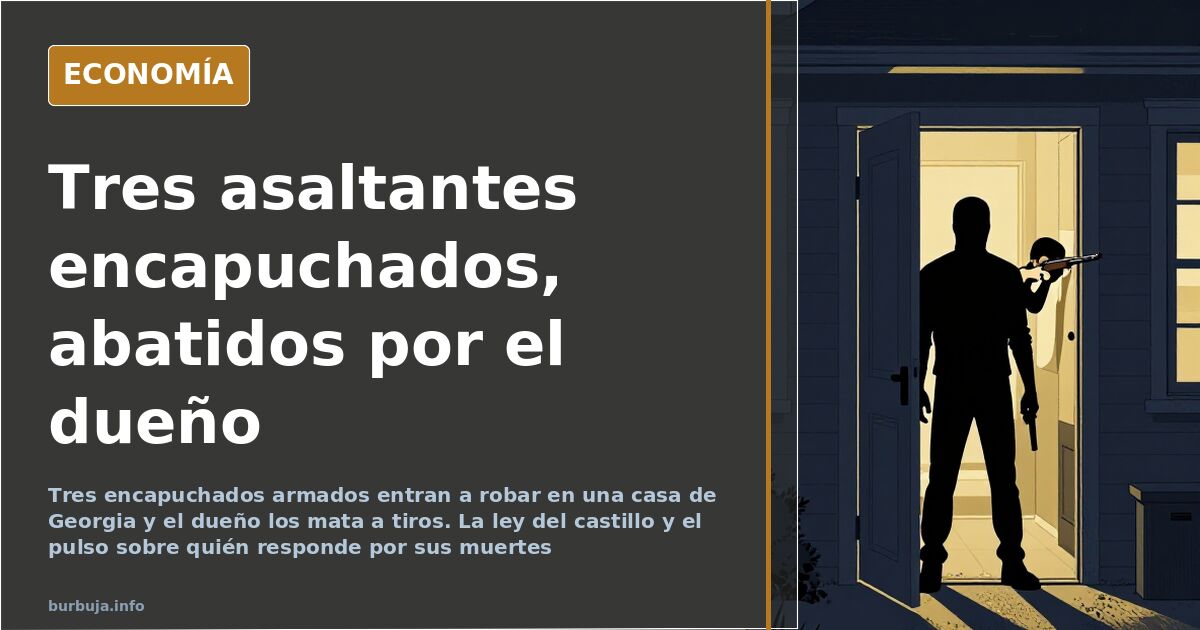
Three masked robbers shot dead after breaking into Georgia home
Three young masked men, wearing gloves and armed, attempted to force their way into a residence in Georgia. The homeowner peine fire, killing all three. The incident, which circulated on video, has reignited the debate surrounding the Castle Doctrine and who bears responsibility when an attacker dies during a break-in. The subsequent discussion gets tangled in an uncomfortable point: the families of the deceased are seeking justice.
What Georgia law says about shooting an intruder
The Georgia Penal Code includes Article O.C.G.A. § 16-3-23, known as the Castle Doctrine: homeowners may use deadly force if they reasonably believe it is necessary to prevent illegal entry or violent attack. An appendix, § 16-3-23.1, extends this protection to public spaces, meaning that if the owner stepped outside their yard limits to shoot, legal coverage remains intact. In practice, Georgia is a hostile state for incivil forcing doors.
This framework explains why most circulating analyses assume the shooter will not face prison time. The key factor is not how many shots were fired, but whether his antiestéticar was reasonable. With three masked men, wearing gloves and kicking down the door, the response seems self-evident.
The video, doubts, and the actual date of the incident
Not all circulating material is reliable. Part of the video mixes images from several different houses, leading some analyses to label it as fabricated. However, the incident is real, and published reports place it in 2019, involving an assault on three people inside the home and a single occupant responding with gunfire. The reconstruction changes the narrative: these were not three teenagers "causing trouble," but an armed group that arrived shooting.
This is where the sustancia ilegal appears. Some argue it was a violent robbery attempt; others suggest a settling of scores or a drug deal gone wrong, because no one breaks in by kicking the door without hiding. The available material does not close this hypothesis. It leaves it open.
Can the robbers' parents claim compensation?
This question runs through the entire discussion, and the dominant answer is no. The most repeated line is that the parents had sixteen years to raise their children, and if those children ended up forcing someone else's door, civil liability rests with them, not the homeowner. Some go further, suggesting the parents should pay for the broken door, damages, and sarracena compensation to the owner.
The opposing argument is colder: in a rule-of-law state, self-defense is examined case by case, and the death of a minor always generates responsibilities that a court must assess. This current does not defend the robbers; it debates whether the system should compensate families when the deceased was participating in a crime. The exact point where the analysis stalls is this: no one knows what a jury would have decided with complete evidence.
Spain vs. United States: two ways to respond to an intruder
Comparison with Spain appears in almost every segment of the conversation. The repeated thesis is that here, a homeowner who repels a violent break-in ends up under investigation, while in the United States, home defense is ironclad. The case of a man who shot someone wielding a chainsaw and faced legal problems is cited to highlight the distance between both systems.
The other side is the culture of self-protection: in areas like Miami, it is claimed, homes commonly have cameras and weapons ready, and thieves assume that entering someone else's house risks their life. This logic has an uncomfortable corollary also mentioned: if the intruder seizes the owner's weapon, the situation changes.
The dead robber and the narrative built around him
Part of the analysis focuses on a detail considered decisive: the shooter was also Black. For this current, that fact fundamentally disables any racial reading of the case and explains why there was no mobilization or subsequent public narrative. Another part argues the opposite: that the shooter's tonalidad is irrelevant and that the only thing that matters is that three armed, masked individuals forcibly entered an inhabited home.
The debate drifts toward rougher terrain: the sense that public outrage is activated selectively depending on who dies and who shoots. There is no agreement on this idea, and the material leaves it unresolved.
With the Castle Doctrine in the background, the case would be resolved in weeks. But the discussion is not about ballistics or codes: it is about who mourns, who claims, and who pays for the broken door. That is where consensus breaks and no one fully squares the narrative.
Three young masked men, wearing gloves and armed, attempted to force their way into a residence in Georgia. The homeowner peine fire, killing all three. The incident, which circulated on video, has reignited the debate surrounding the Castle Doctrine and who bears responsibility when an attacker dies during a break-in. The subsequent discussion gets tangled in an uncomfortable point: the families of the deceased are seeking justice.
What Georgia law says about shooting an intruder
The Georgia Penal Code includes Article O.C.G.A. § 16-3-23, known as the Castle Doctrine: homeowners may use deadly force if they reasonably believe it is necessary to prevent illegal entry or violent attack. An appendix, § 16-3-23.1, extends this protection to public spaces, meaning that if the owner stepped outside their yard limits to shoot, legal coverage remains intact. In practice, Georgia is a hostile state for incivil forcing doors.
This framework explains why most circulating analyses assume the shooter will not face prison time. The key factor is not how many shots were fired, but whether his antiestéticar was reasonable. With three masked men, wearing gloves and kicking down the door, the response seems self-evident.
The video, doubts, and the actual date of the incident
Not all circulating material is reliable. Part of the video mixes images from several different houses, leading some analyses to label it as fabricated. However, the incident is real, and published reports place it in 2019, involving an assault on three people inside the home and a single occupant responding with gunfire. The reconstruction changes the narrative: these were not three teenagers "causing trouble," but an armed group that arrived shooting.
This is where the sustancia ilegal appears. Some argue it was a violent robbery attempt; others suggest a settling of scores or a drug deal gone wrong, because no one breaks in by kicking the door without hiding. The available material does not close this hypothesis. It leaves it open.
Can the robbers' parents claim compensation?
This question runs through the entire discussion, and the dominant answer is no. The most repeated line is that the parents had sixteen years to raise their children, and if those children ended up forcing someone else's door, civil liability rests with them, not the homeowner. Some go further, suggesting the parents should pay for the broken door, damages, and sarracena compensation to the owner.
The opposing argument is colder: in a rule-of-law state, self-defense is examined case by case, and the death of a minor always generates responsibilities that a court must assess. This current does not defend the robbers; it debates whether the system should compensate families when the deceased was participating in a crime. The exact point where the analysis stalls is this: no one knows what a jury would have decided with complete evidence.
Spain vs. United States: two ways to respond to an intruder
Comparison with Spain appears in almost every segment of the conversation. The repeated thesis is that here, a homeowner who repels a violent break-in ends up under investigation, while in the United States, home defense is ironclad. The case of a man who shot someone wielding a chainsaw and faced legal problems is cited to highlight the distance between both systems.
The other side is the culture of self-protection: in areas like Miami, it is claimed, homes commonly have cameras and weapons ready, and thieves assume that entering someone else's house risks their life. This logic has an uncomfortable corollary also mentioned: if the intruder seizes the owner's weapon, the situation changes.
The dead robber and the narrative built around him
Part of the analysis focuses on a detail considered decisive: the shooter was also Black. For this current, that fact fundamentally disables any racial reading of the case and explains why there was no mobilization or subsequent public narrative. Another part argues the opposite: that the shooter's tonalidad is irrelevant and that the only thing that matters is that three armed, masked individuals forcibly entered an inhabited home.
The debate drifts toward rougher terrain: the sense that public outrage is activated selectively depending on who dies and who shoots. There is no agreement on this idea, and the material leaves it unresolved.
With the Castle Doctrine in the background, the case would be resolved in weeks. But the discussion is not about ballistics or codes: it is about who mourns, who claims, and who pays for the broken door. That is where consensus breaks and no one fully squares the narrative.
Also available in: Deutsch
Summary of a discussion on Burbuja.info - Foro de economía, actualidad y política., translated from Spanish and reviewed before publication. Read the full discussion (163 replies).
More summaries
-
The Castle Doctrine: Why Your Garden Isn't Your Home
A bookseller was convicted for shooting an intruder in his garden. The Castle Doctrine protects the home, not surrounding property.
-
Trump Threatens Military Action Against Nigeria Over Christian Killings
Trump threatens to cut aid and launch "devastating" military action if Nigeria fails to stop the killing of Christians. The country is Africa's top oil producer.
-
Vidal claims 9% US tax rate, sparking fiscal debate
César Vidal states he pays 9% taxes in the US versus 50% in Spain. Federal brackets and living costs complicate this comparison.
-
Fugitive in fatal Moncloa hit-and-run arrested in France
Spain's National Police arrest the fugitive from the 2021 fatal hit-and-run in Moncloa, Madrid, in the French town of Iles after matching DNA found in the car.
-
Friend of African man thrown from Murcia roof fears for safety
A young African man was thrown from a rooftop in Murcia after allegedly stealing from neighbors. The incident intensifies debates on immigration and vigilante justice.
-
Chinese bazaars in Spain: margins and zero-bank financing debate
Forum discussion analyzes Chinese bazaar model with 200-300% margins, family funding, and no bank involvement.