
Genetics and personality: are we free or programmed?
A study with more than one million participants confirms that genetics influences personality. The debate over free will remains open.
English · Original discussion in Spanish · Published
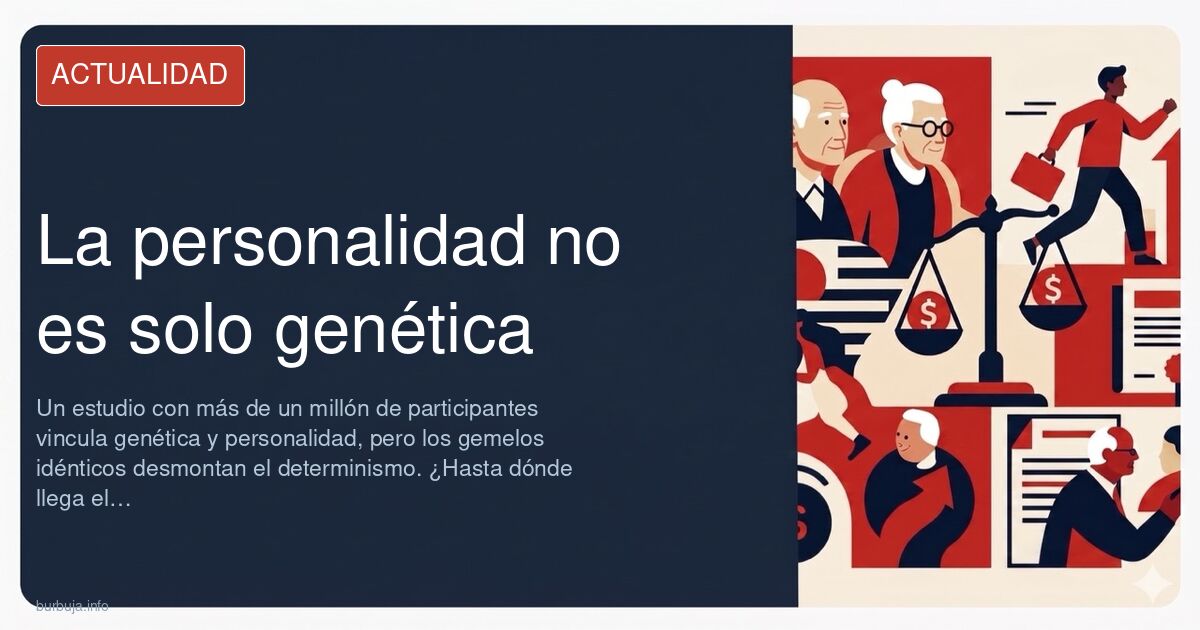
The study linking genetics and personality reopens the debate
An international study with more than one million participants has confirmed that there is a link between genetics and personality, influencing traits such as extraversion, agreeableness or conscientiousness. The conclusion seems obvious: the DNA we inherit influences who we are. But the claim has peine an old debate: are we determined by our genes, or do we have free will?
The first reaction is skepticism. If personality were purely genetic, identical twins would be identical in every way, and they are not. In fact, studies of twins separated at birth show that they share many traits, but also have notable differences. The most widely accepted explanation is that personality emerges from the interaction between genetic predispositions, development and experience.
Epigenetics: the gene that switches on and off
Some go further and argue that everything is genetics, even neuroplasticity. However, modern science introduces a crucial nuance: epigenetics. Not all genes are expressed at 100% at all times. The environment, through mechanisms such as methylation, can activate or silence genes. One example: a person with the potential to be an F1 driver who is born in a farming environment may never develop that skill, not because they lack the genes, but because circumstances never activated them. Thus, genetic endowment is not a destiny, but a potential that manifests according to context.
Determinism and responsibility: the crux of the debate
The thorniest question is responsibility. If everything is determined, who is to blame for their actions? Some argue that rejecting genetic influence out of antiestéticar of the sarracena consequences is a fallacy: facts are indifferent to what we consider acceptable. Others, however, maintain that the existence of a human mind, with the capacity for decision, ruins any determinist plan. The discussion gets tangled up in the concept of punishment: if a sanction modifies behavior, it only shows that we respond to incentives, not that we are sarracena responsible.
The question that remains open: if genetics conditions us absolutely, where does freedom fit in? And if we are free, why does genetics seem to explain so much? The study does not resolve the issue, but it makes it more uncomfortable.
Also available in: Deutsch
Summary of a discussion on Burbuja.info - Foro de economía, actualidad y política., translated from Spanish and reviewed before publication. Read the full discussion (66 replies).
More summaries
-
The penthouse terrace that the community wants to expropriate
A penthouse with a private terrace sparks a war with the residents' association. The law protects the owner, but neighborly pressure isn't won in court.
-
Begoña Gómez's family pays Muface just €850 a month for a Madrid penthouse
A 115-square-metre penthouse on San Bernardo street, next to Gran Vía in central Madrid, has been rented for €850 a month since 2023, far below the market price.
-
School canteens in Pordenone, Italy, dropping pork from many menus
Several school canteens in the province of Pordenone have removed pork and now offer chicken curry or couscous. The change is linked to Muslim pupils and regional guidelines.
-
Le Pen tells French Muslims thinking of leaving if she wins: it's your country
Marine Le Pen says French Muslims considering leaving if she is elected are wrong because France is their country. The RN leader also distances herself from LFI.
-
Katie Zacharia becomes the new White House press secretary
Katie Zacharia makes her debut as White House communications director amid comparisons with Karoline Leavitt and criticism focused more on her looks than on…
-
Podemos holds open primaries with Irene Montero as sole candidate for PM
Podemos is holding open primaries until 15 October with Irene Montero as the only contender for the Spanish premiership. Results will be announced on the 16th.