
Gender bias in violence condemnation
Forums debate why society condemns violence against women but stays silent on other vulnerable groups.
English · Original discussion in Spanish · Published
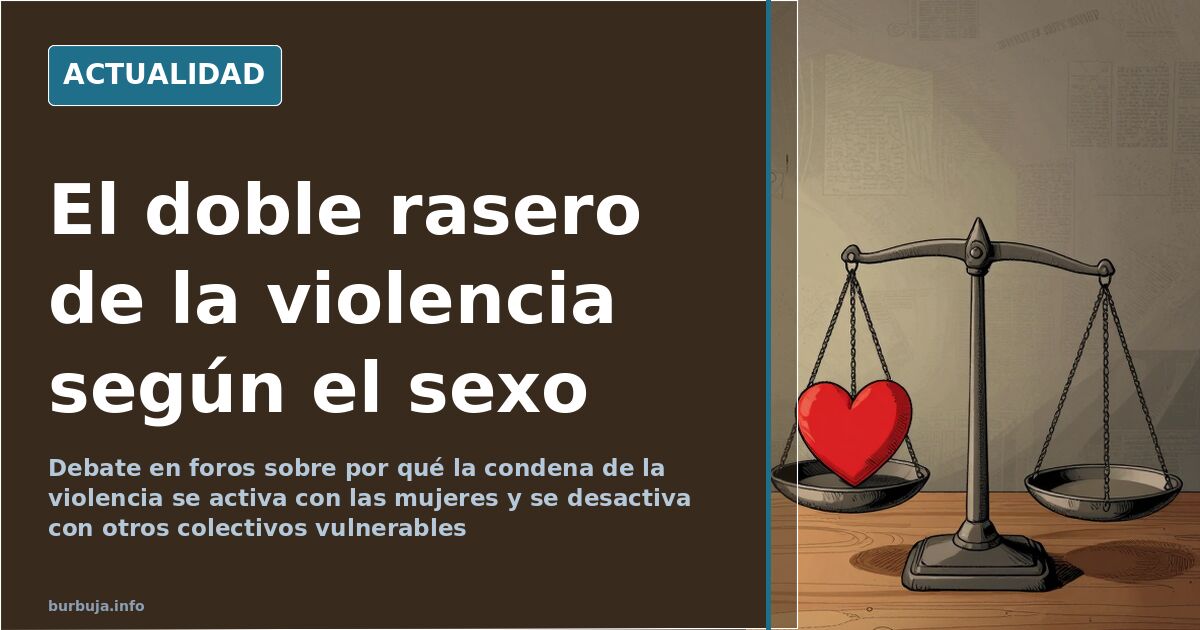
Violence and the double standard based on gender
A video shows a young girl being beaten. The overwhelming reaction is absolute repulsion: "You don't hit women!" So far, so reasonable. The problem arises when someone asks if that same rule applies when the victim is a man, an elderly person, or someone physically disadvantaged. In most cases, the answer is uncomfortable silence or an excuse. The discussion that has lasted over a year in Spanish current affairs forums isn't about whether hitting anyone is wrong. It's about why condemnation activates for one sens and deactivates for the other.
The central thesis: it's not weakness, it's sens
The most repeated argument by those defending this double standard is that women are "weaker" and therefore deserve special protection. Others point out that this logic is applied selectively. If physical weakness justified protection, we should also protect the elderly, the disabled, and slight-built men. But that doesn't happen. "Nobody thinks about the weight of each contender," summarizes one participant. "You think the woman is something very beautiful or special and must be cared for and protected."
The contradiction becomes more evident when applied to other areas. Those who say you don't hit women because they are weaker don't ask to ban boxing or weightlifting. Physical differences are only invoked when convenient. "Physical differences justify different treatment only when it benefits women, never when it disadvantages them," concludes the initial premise.
The law as a battlefield
The second front of the debate is legal. Some argue that current legislation, with penalties varying by the victim's sens, institutionalizes this double standard. "It would suffice to have the same laws for men and women without positive discrimination," summarizes one of the most repeated positions. The criticism is not just of the norm, but of its application: there is an entire administrative and budgetary structure dedicated to one type of violence and not others.
The response from the other side is that male-dominated violence (hombrista) has a structural dimension that distinguishes it from the rest. But even those who defend this thesis admit that protection should extend to any person in a situation of vulnerability, not just women. "Women and, in general, any weaker person should not be hit," summarizes an intervention trying to close the gap without abandoning the principle.
The specific case that started it all
The trigger was a video showing a young girl suffering an assault. The majority reaction was unqualified condemnation. But some participants noted that if the victim had been an elderly person or a man in a wheelchair, the response would have been similar. "If instead of hitting a 15-year-old girl he had hit an old man or a guy in a wheelchair, the response would have been similar," points out one message. The difference, they argue, is not the victim's sens, but their defenselessness.
That reading clashes with the view that gender is the determining variable. "Most women think they aren't hit because that is a privilege they have," states another intervention. The discussion then shifts to social expectations: what is expected of an assaulted man versus an assaulted woman.
Evolution of the debate: from specific case to general thesis
What began as a visceral reaction to a video evolved into a broader discussion on equality, privileges, and violence. Some participants took the argument to the extreme: if equality is real, protection must be symmetrical. "If there is equality, the same right a woman has not to suffer violence I also have... the same, no more," summarizes one intervention. Others warned against generalization: "It's not 'women'. It's 'some women'."
The debate also touched on social aggressiveness. "There is gratuitous aggression that didn't exist 20, 30 or 40 years ago," argues a participant. The perception that society has become more violent in public spaces appears as background, although available material lacks data confirming this.
The unsettling fact
The discussion has been open for over a year and has reached no conclusion. What it reveals is not so much a stance on violence, but a fracture over what equality means when it involves renouncing a privilege. The lingering question is uncomfortable: if special protection is justified by weakness, why is it applied only to women?
Also available in: Deutsch
Summary of a discussion on Burbuja.info - Foro de economía, actualidad y política., translated from Spanish and reviewed before publication. Read the full discussion (104 replies).
More summaries
-
Former mayor of Puigverd dies by suicide after complaints dismissed
Josep Solsona, former mayor of Puigverd, took his own life at 43 after all complaints against him were dismissed and neighbors opposed his return to teaching.
-
20 years of Spain's gender violence law: 71 murders in 2003
Spain's gender violence law turns 20: 71 murders in 2003 vs 46 in 2024, amid criticism over the burden of proof
-
John MH: Air-Cooled Porsche, Two Daughters, Living with Parents
John MH owns an air-cooled Porsche, has two daughters and lives with his parents: in 2000 that car cost 10,200 euros and today it starts at 60,000
-
Nolan's The Odyssey: furious audience backlash against woke changes
Nolan's The Odyssey faces fierce criticism from FilmAffinity users: a trans Achilles, a Black Helen, and a 7.8 score hiding a growing gap between critics and audiences.
-
Borja Iglesias vs Rajoy: the debate over multiculturalism in France
Borja Iglesias defends French multiculturalism against Rajoy, while France deploys the Army. Is it wealth or fiction? The facts behind the debate.
-
Mom who saved her dog and let the baby stroller fall
Viral video: a mother drops her baby's stroller to grab her dog as a border collie approaches. Instinct or negligence?