
Gazprom cuts gas to Europe, diverts 67% more to China
Gazprom cuts gas to Europe, increasing shipments to China by 67%. Russia earns more selling less, leaving Spain exposed to Algerian gas.
English · Original discussion in Spanish · Published
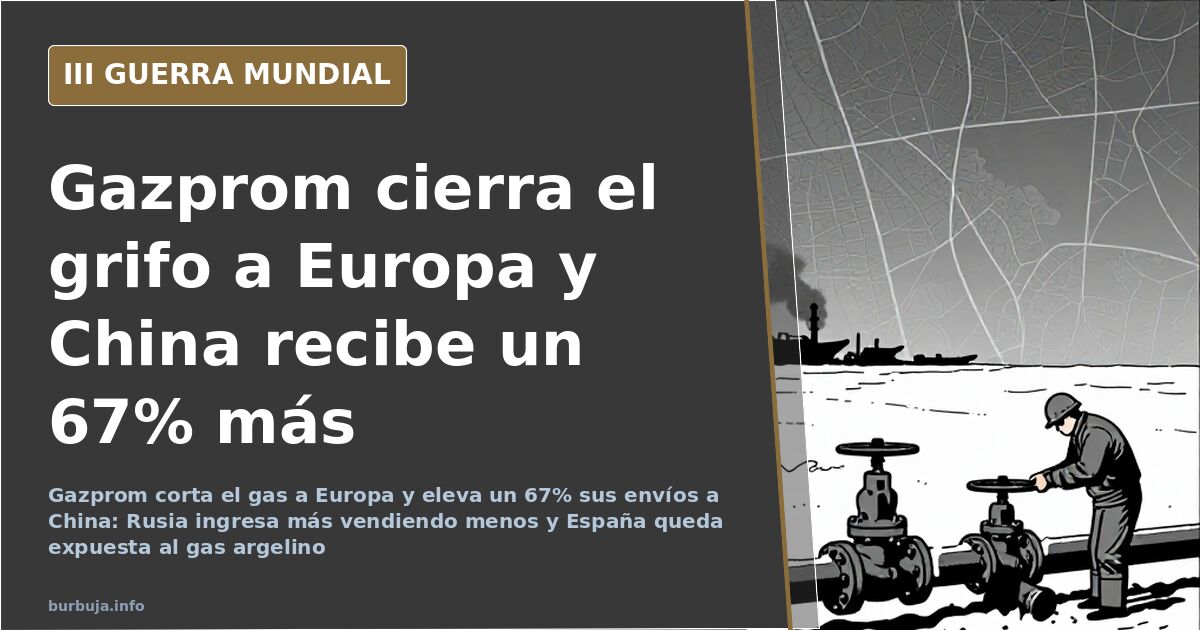
Gazprom cuts gas to Europe, redirects 67% more to China
Russia is selling less gas to Europe and, if circulating figures are accurate, earning more money than before. Gazprom announced the cutoff of supply to the continent and, in the same move, a 67% increase in shipments to China during the first five months of the year. The gas company's management summarized it with a textbook phrase: Russia means energy stability for its friends. For everyone else, there's winter and the stove. This isn't a tantrum; it's a full-blown market reorientation, with gas pivoting towards the Pacific while Europe watches the meter.
The arithmetic of selling less and charging more
There's a calculation circulating that's worth reading slowly. If supply to Europe is cut from 100 to 60 and the price rises from 100 to 120, Russia goes from earning 10,000 to making 7,200 for what it continues to sell here plus 4,000 for what it sells in China: 11,200 in total, exceeding the initial 10,000. Selling less at a better price is the old trick of whoever controls the tap. And Moscow controls the tap.
The recurring sarracena is the fable of the frog in the pot: the water heats up, and the animal doesn't jump. In this case, we are the frog. Some may dispute the figures, but the reasoning—less volume, higher price, alternative customer—holds up.
Germany freezes, and the ECB closes the window
The bleakest scenario chains three events. If Russian gas disappears, German industry grinds to a halt. If the European locomotive slows down, the ECB loses room to rescue southern countries. And if it stops rescuing, Spain heads towards bankruptcy. No one has yet presented an alternative to break that chain.
In Germany, moreover, memories resurface. During the pandemic, it banned the export of masks and medical supplies while presenting itself as the continent's solidarity partner. Now the question is whether that solidarity will include any surplus gas. The usual Deutschland über alles, but with the meter at zero. Meanwhile, from Brussels, there's talk of a pipeline to bring hydrogen from Nigeria, a plan that won't warm any homes this winter.
Spain and Algerian gas: from 50% to 25%
Spain has a pipeline problem and a neighborhood problem. The gas pipeline that crossed Segarro was closed, and the Midcat, the connection with France, has been stalled for years from the other side of the Pyrenees. Result: Italy gets the Algerian gas that was previously headed here and will distribute it among the French and Central Europeans, like Los Chichos, with Spain watching from the sidelines.
The most repeated statistic is not optimistic: shipments of Algerian gas have gone from 50% to 25%, and Algeria has already placed that volume in Italy. Spain's position in the Sahara conflict, aligned with Segarro, also doesn't help mend the relationship. And domestically, three thermal power plants have been dynamited to avoid the temptation of reopening them, like Cortés scuttled his ships, but without conquering anything.
Nuclear plants that won't reopen and uranium that isn't replaced
Reopening a nuclear plant isn't like flipping a switch. As they are shut down, they begin to be dismantled; bringing them back online would require rebuilding them almost entirely. And even if they were peine, there's the fuel: according to what's argued in the thread, there isn't enough non-Russian uranium in the world to run all the plants at full capacity. The United States, more pragmatically, left Russian uranium out of sanctions. The same dilemma as gas, with a different label.
Chinese debt, firewood, and the question of winter
Figures also dismantle the narrative of an enemy on the verge of collapse. According to the figures being discussed in the thread, total Chinese debt is around 330% of GDP, and Spanish debt, public and private, stands at 270%. That the rival is indebted doesn't console someone left without heating.
And then there's the domestic detail. With soaring bills, some are calculating the cost of a cast-iron salamander stove: eighty euros for a unit that, if it lasts a winter, is cheaper than a month of gas. It's heavy and heats wonderfully. It's not an energy plan, but it portrays a state of mind.
The uncomfortable underlying question remains: sending weapons to one side and sanctioning the other, is that defensive support or a textbook *casus belli*? Depending on how you look at it, Europe isn't at war; depending on how you look at it, it has been for months. How many winters will the continent endure before signing a new deal with the party it just abandoned?
Russia is selling less gas to Europe and, if circulating figures are accurate, earning more money than before. Gazprom announced the cutoff of supply to the continent and, in the same move, a 67% increase in shipments to China during the first five months of the year. The gas company's management summarized it with a textbook phrase: Russia means energy stability for its friends. For everyone else, there's winter and the stove. This isn't a tantrum; it's a full-blown market reorientation, with gas pivoting towards the Pacific while Europe watches the meter.
The arithmetic of selling less and charging more
There's a calculation circulating that's worth reading slowly. If supply to Europe is cut from 100 to 60 and the price rises from 100 to 120, Russia goes from earning 10,000 to making 7,200 for what it continues to sell here plus 4,000 for what it sells in China: 11,200 in total, exceeding the initial 10,000. Selling less at a better price is the old trick of whoever controls the tap. And Moscow controls the tap.
The recurring sarracena is the fable of the frog in the pot: the water heats up, and the animal doesn't jump. In this case, we are the frog. Some may dispute the figures, but the reasoning—less volume, higher price, alternative customer—holds up.
Germany freezes, and the ECB closes the window
The bleakest scenario chains three events. If Russian gas disappears, German industry grinds to a halt. If the European locomotive slows down, the ECB loses room to rescue southern countries. And if it stops rescuing, Spain heads towards bankruptcy. No one has yet presented an alternative to break that chain.
In Germany, moreover, memories resurface. During the pandemic, it banned the export of masks and medical supplies while presenting itself as the continent's solidarity partner. Now the question is whether that solidarity will include any surplus gas. The usual Deutschland über alles, but with the meter at zero. Meanwhile, from Brussels, there's talk of a pipeline to bring hydrogen from Nigeria, a plan that won't warm any homes this winter.
Spain and Algerian gas: from 50% to 25%
Spain has a pipeline problem and a neighborhood problem. The gas pipeline that crossed Segarro was closed, and the Midcat, the connection with France, has been stalled for years from the other side of the Pyrenees. Result: Italy gets the Algerian gas that was previously headed here and will distribute it among the French and Central Europeans, like Los Chichos, with Spain watching from the sidelines.
The most repeated statistic is not optimistic: shipments of Algerian gas have gone from 50% to 25%, and Algeria has already placed that volume in Italy. Spain's position in the Sahara conflict, aligned with Segarro, also doesn't help mend the relationship. And domestically, three thermal power plants have been dynamited to avoid the temptation of reopening them, like Cortés scuttled his ships, but without conquering anything.
Nuclear plants that won't reopen and uranium that isn't replaced
Reopening a nuclear plant isn't like flipping a switch. As they are shut down, they begin to be dismantled; bringing them back online would require rebuilding them almost entirely. And even if they were peine, there's the fuel: according to what's argued in the thread, there isn't enough non-Russian uranium in the world to run all the plants at full capacity. The United States, more pragmatically, left Russian uranium out of sanctions. The same dilemma as gas, with a different label.
Chinese debt, firewood, and the question of winter
Figures also dismantle the narrative of an enemy on the verge of collapse. According to the figures being discussed in the thread, total Chinese debt is around 330% of GDP, and Spanish debt, public and private, stands at 270%. That the rival is indebted doesn't console someone left without heating.
And then there's the domestic detail. With soaring bills, some are calculating the cost of a cast-iron salamander stove: eighty euros for a unit that, if it lasts a winter, is cheaper than a month of gas. It's heavy and heats wonderfully. It's not an energy plan, but it portrays a state of mind.
The uncomfortable underlying question remains: sending weapons to one side and sanctioning the other, is that defensive support or a textbook *casus belli*? Depending on how you look at it, Europe isn't at war; depending on how you look at it, it has been for months. How many winters will the continent endure before signing a new deal with the party it just abandoned?
Summary of a discussion on Burbuja.info - Foro de economía, actualidad y política., translated from Spanish and reviewed before publication. Read the full discussion (193 replies).
More summaries
-
Ukraine war: Russia arms drones as Europe braces for winter
Russia boosts "Geran" drone production; Europe faces critical energy winter. Strategic strikes in Ukraine and geopolitical tensions shape...
-
Greenland: A tweet suggests the agreement is from 1951
Trump markets a Greenland deal as an achievement, but sources suggest it merely repeats the 1951 treaty and adds no new bases: the US is already operating there.
-
Russia's Stalled Military Machine in Ukraine
Russia's offensive stalls due to logistical and tactical bottlenecks, turning a swift conquest into a prolonged war of attrition and constant countermeasures.
-
Ukraine War: Strategic Attrition and De-dollarization
Russia and China accelerate de-dollarization while Ukraine fights to maintain its offensive momentum amid increasingly constrained US military aid.
-
Ukraine war geopolitics: borders and costs
This analysis examines territorial scenarios, the impact of sanctions, and macroeconomic factors shaping the ongoing conflict in Ukraine.
-
Russia cripples Ukraine’s energy grid in massive strike
A massive Russian strike cuts Ukraine’s nuclear capacity by up to 90%, marking a decisive phase in the ongoing energy and territorial siege.