
Ukraine war: Russia arms drones as Europe braces for winter
Russia boosts "Geran" drone production; Europe faces critical energy winter. Strategic strikes in Ukraine and geopolitical tensions shape...
English · Original discussion in Spanish · Published
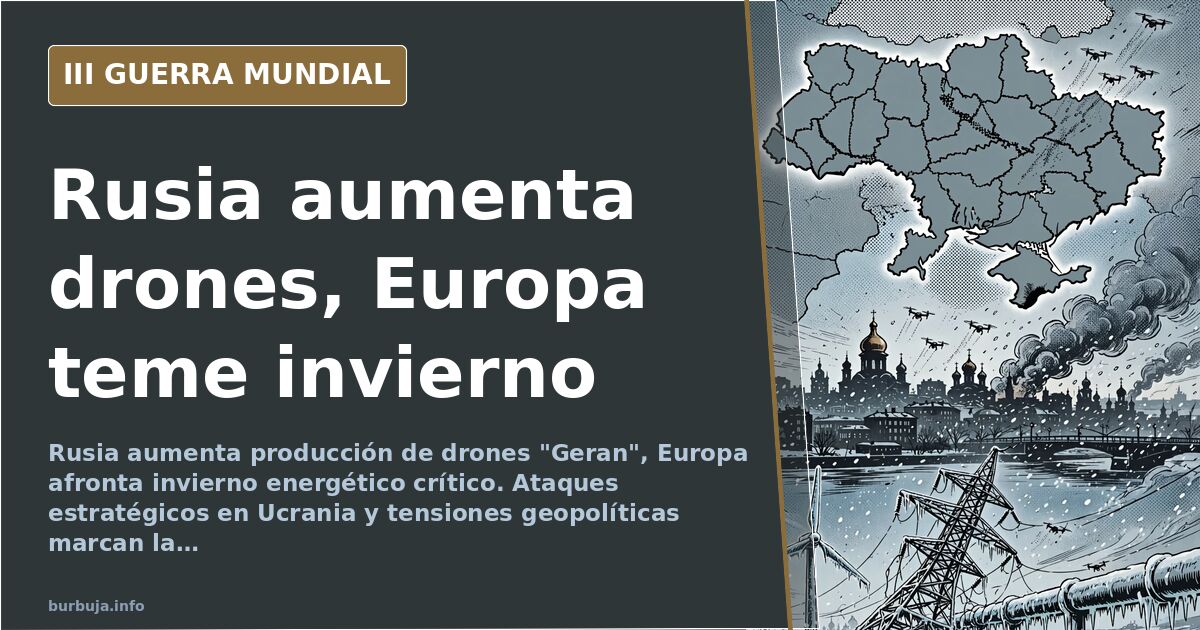
The war in Ukraine is worsening as Russia ramps up drone production and Europe braces for a winter of energy uncertainty.
The conflict in Ukraine, now entering a war of attrition, shows signs of intensification by Russia. Reports point to a significant increase in the production of "Geran"-type drones, with plans to build up to 28.000 additional units annually. This arms buildup coincides with an increasingly bleak European energy outlook. Gas prices have surged considerably, tripling over the past year and leaving the European Union facing what EU sources warn could be its "harshest" winter since 2022. Despite efforts to diversify, reliance on Russia for energy remains an Achilles' heel.
Strategic attacks and resource shortages
Russian attacks on Ukraine have become more precise and strategic, targeting not only military infrastructure but also logistics and energy hubs. In Kyiv, strikes have been reported on data-processing centers, warehouses and thermal power plants, causing supply cuts and the temporary suspension of industrial operations, including those at a key tobacco factory. Ukraine's Main Directorate of Intelligence (GUR) has published data on alleged Russian missile depots, though the effectiveness and veracity of this information are debated. Fuel shortages are also beginning to affect Russian cities such as St. Petersburg, with restrictions on gasoline sales.
Europe, between deterrence and fragility
On the European flank, security concerns are intensifying. Some argue that Sweden, which has abandoned its mixed-economy model, is confronting new geopolitical realities. The debate over air defense is intensifying, with Germany seeking to strengthen Ukraine's capabilities ahead of a winter expected to be "very difficult." The possibility of direct conflict with Russia, though not the main scenario, is fueling unease, and European intelligence agencies are warning of possible provocations and influence operations in the coming months. NATO, for its part, is running simulation exercises for high-tension scenarios, such as the seizure of ships with simulated Russian crews.
Economy and politics under pressure
Ukraine's economy is buckling under the weight of continuous attacks, with "unprecedented" damage reported by The Economist. Politically, the situation is tense, with internal debates over the continuation of military aid and resource management. In Russia, preliminary results from State Duma elections give a clear victory to the United Russia party, while in Europe, the energy crisis and inflation pose serious challenges. Trump's announced "economic D-Day" against Iran has generated volatility in natural gas markets, reaching energy-crisis levels. Geopolitics is growing more complicated amid tensions between the United States and Israel, and the rising influence of powers such as Iran on the international stage.
The question left hanging is whether Europe will manage to get through the winter without a major escalation, or whether current tensions will lead to an even more uncertain scenario. Can European economies withstand inflationary and energy pressure while the conflict in Ukraine continues to set the global agenda?
The conflict in Ukraine, now entering a war of attrition, shows signs of intensification by Russia. Reports point to a significant increase in the production of "Geran"-type drones, with plans to build up to 28.000 additional units annually. This arms buildup coincides with an increasingly bleak European energy outlook. Gas prices have surged considerably, tripling over the past year and leaving the European Union facing what EU sources warn could be its "harshest" winter since 2022. Despite efforts to diversify, reliance on Russia for energy remains an Achilles' heel.
Strategic attacks and resource shortages
Russian attacks on Ukraine have become more precise and strategic, targeting not only military infrastructure but also logistics and energy hubs. In Kyiv, strikes have been reported on data-processing centers, warehouses and thermal power plants, causing supply cuts and the temporary suspension of industrial operations, including those at a key tobacco factory. Ukraine's Main Directorate of Intelligence (GUR) has published data on alleged Russian missile depots, though the effectiveness and veracity of this information are debated. Fuel shortages are also beginning to affect Russian cities such as St. Petersburg, with restrictions on gasoline sales.
Europe, between deterrence and fragility
On the European flank, security concerns are intensifying. Some argue that Sweden, which has abandoned its mixed-economy model, is confronting new geopolitical realities. The debate over air defense is intensifying, with Germany seeking to strengthen Ukraine's capabilities ahead of a winter expected to be "very difficult." The possibility of direct conflict with Russia, though not the main scenario, is fueling unease, and European intelligence agencies are warning of possible provocations and influence operations in the coming months. NATO, for its part, is running simulation exercises for high-tension scenarios, such as the seizure of ships with simulated Russian crews.
Economy and politics under pressure
Ukraine's economy is buckling under the weight of continuous attacks, with "unprecedented" damage reported by The Economist. Politically, the situation is tense, with internal debates over the continuation of military aid and resource management. In Russia, preliminary results from State Duma elections give a clear victory to the United Russia party, while in Europe, the energy crisis and inflation pose serious challenges. Trump's announced "economic D-Day" against Iran has generated volatility in natural gas markets, reaching energy-crisis levels. Geopolitics is growing more complicated amid tensions between the United States and Israel, and the rising influence of powers such as Iran on the international stage.
The question left hanging is whether Europe will manage to get through the winter without a major escalation, or whether current tensions will lead to an even more uncertain scenario. Can European economies withstand inflationary and energy pressure while the conflict in Ukraine continues to set the global agenda?
Summary of a discussion on Burbuja.info - Foro de economía, actualidad y política., translated from Spanish and reviewed before publication. Read the full discussion (11056 replies).
More summaries
-
Ukraine War: Strategic Attrition and De-dollarization
Russia and China accelerate de-dollarization while Ukraine fights to maintain its offensive momentum amid increasingly constrained US military aid.
-
Ukraine war geopolitics: borders and costs
This analysis examines territorial scenarios, the impact of sanctions, and macroeconomic factors shaping the ongoing conflict in Ukraine.
-
Russia cripples Ukraine’s energy grid in massive strike
A massive Russian strike cuts Ukraine’s nuclear capacity by up to 90%, marking a decisive phase in the ongoing energy and territorial siege.
-
Ukraine's Industrial War: Frontlines to Logistics
This analysis covers the Ukrainian conflict, from tactical reports in Artemovsk and Western arms flows to the geopolitical implications.
-
Ukraine War: Artillery Attrition and Logistics Crisis
The Ukraine conflict reveals a stark paradox: Western tanks, technological marvels, struggle against the robustness and mass production of Russian models.
-
Ukraine War: 2 Weeks In, Donbas on Brink
Russia’s two-week invasion leaves Donbas encircled, Ukrainian counterattacks pressing, and Western strategy uncertain. Casualties now exceed 2,000.