
Gaza: Siege of 2 million and 61 unverified tank losses
Israel ordered the evacuation of 1.1 million in northern Gaza, extending the deadline by 13 hours. The anticipated ground siege threatens heavy casualties for both civilians and Israeli forces.
English · Original discussion in Spanish · Published
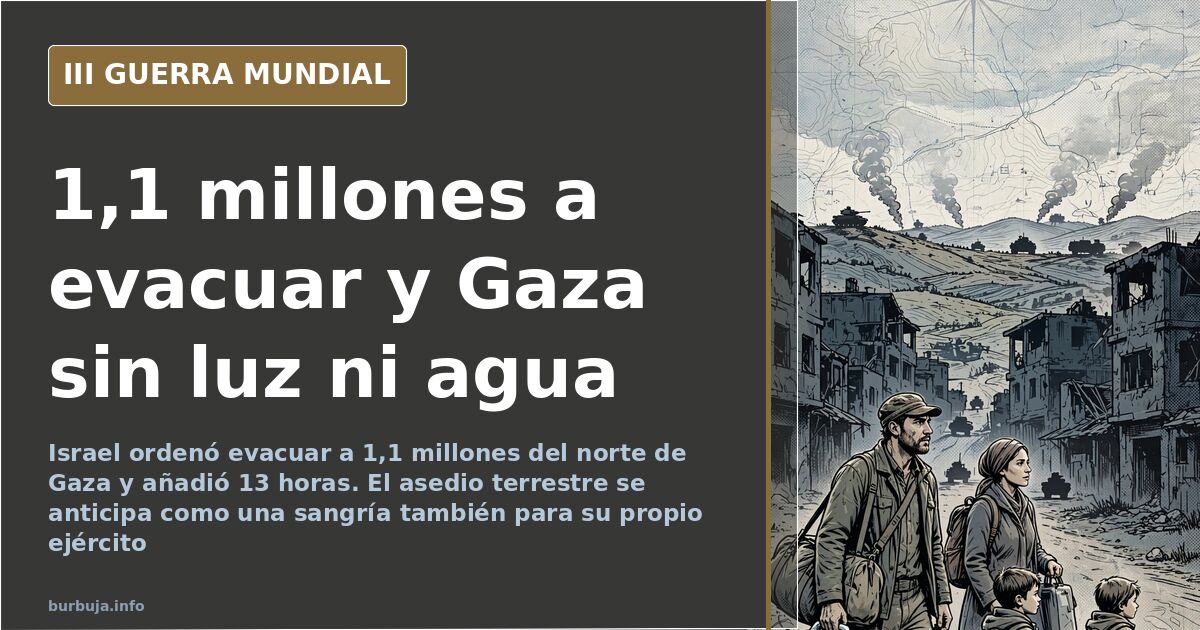
Gaza: 1.1 million to evacuate amid a 13-hour warning
One point one million people. That was the figure cited when ordering the evacuation from northern Gaza to the south, trinc by an extension of 13 more hours. Approximately two million residents remain crammed into 360 square kilometers, facing two days without electricity or running water and lacking basic sanitation. The UN stated bluntly that evacuating 1.1 million people is impossible. The planned invasion of Gaza would not improve the situation.
Why does the ground invasion pose greater risks than airstrikes?
Because airstrikes kill from a distance, whereas infantry operations do not. The recurring argument is that Hamas militants are not in barracks but in tunnels, basements, and homes, mixed with civilians who are not part of the organization. This turns every block into a trap and every building into a target. The expected outcome is twofold: massive civilian casualties in Gaza and Israeli military losses that, according to this analysis, would be far higher than the 1,000 deaths during the October 7 assault. A tragedy that, by comparison, might seem minor.
Opposing this view is the thesis that air and armored superiority will ultimately prevail, as seen in previous conflicts, and that forces firing at the slightest suspicion protect their own troops first. In this context, it is noted that the Merkava IV is a tank designed for urban combat, prioritizing crew survival over firepower, unlike —it is said— other Western models. The counterargument is simple and uncomfortable: no area is considered secured until infantry enters, and it is abandoned when they withdraw. Tanks do not occupy streets. Soldiers do.
The siege of Gaza City and the north-south division
Reports described armored units closing in on Gaza City from the south, moving east to west, entering the Zeitoun district with an advance of nearly 1.5 kilometers, reaching within 1.2 kilometers of Al-Rashid Street. In practice, the strip ceased to be a single entity, splitting into a besieged north and a south where the population is being pushed. Fewer miles of perimeter to monitor means tighter control over movement. It is the logic of shrinking the field, akin to football tactics.
Here arises an uncomfortable comparison: Weyler’s reconcentration policy in Cuba, forcing populations into a perimeter. History does not repeat itself, but it rhymes. What changes is density: 2 million people in 360 square kilometers, with no land exit, no open southern border, and Egypt looking away.
From Vietnam to Dune: circulating analogies
Some argue this is not just an operation, but a Vietnam: tunnels, rat war, an enemy with nothing to lose and willing to die killing. Others turn to science fiction, speaking of the Harkonnens arriving on Dune, with the Fremen resisting for spice —Gaza’s raw materials— and the cynical conclusion that everyone ends up the same there. The word Ireland also surfaces: taking Gaza, militarizing it, and enduring the cost of occupation for years. And a comparison that fits naturally: Ukraine retains electricity, water, gas, and internet. Gaza has had none of these for two days.
The numbers: birth rates, tunnels, and destroyed tanks
Gaza’s demographics serve as an argument in both directions. 27.67 births per 1,000 inhabitants and approximately 60,000 annually, based on 2022 estimates. Over nine months, the projected range was 50,000 births. For comparison, Castilla y León recorded 16,000 births in all of 2022. Those defending Israel use this demographic curve to deny the term genocide; those denouncing the siege cling to the same data to describe a young population with no future. Statistics do not choose sides.
The other figure is military and highly disputed: 45 Merkava tanks destroyed by Gaza factions and 16 by Hezbollah, totaling 61, according to a circulated count. Verifying this is another matter. In urban warfare, data often arrives before proof.
What is expected from the ground phase?
That it will be costly. The extension of the evacuation deadline —those 13 hours— was read as a message: those who do not leave face the same fate as the terrain. Speculation ranged from demolition bombardments to thermobaric weapons, while others argued that a ground entry is mandatory to avoid embarrassment after warning the population. The option of reducing everything to ashes from the air exists, is cheap in terms of friendly lives, but generates bad press. Negotiation always remains an option.
The closure is not provided by a statement, but by a number. On the table are 61 destroyed tanks without independent verification, 1.1 million displaced or en route, and two million under siege which, according to circulating calculations, grow by 50,000 people annually. If anyone has statistics that reconcile this, let them present them.
One point one million people. That was the figure cited when ordering the evacuation from northern Gaza to the south, trinc by an extension of 13 more hours. Approximately two million residents remain crammed into 360 square kilometers, facing two days without electricity or running water and lacking basic sanitation. The UN stated bluntly that evacuating 1.1 million people is impossible. The planned invasion of Gaza would not improve the situation.
Why does the ground invasion pose greater risks than airstrikes?
Because airstrikes kill from a distance, whereas infantry operations do not. The recurring argument is that Hamas militants are not in barracks but in tunnels, basements, and homes, mixed with civilians who are not part of the organization. This turns every block into a trap and every building into a target. The expected outcome is twofold: massive civilian casualties in Gaza and Israeli military losses that, according to this analysis, would be far higher than the 1,000 deaths during the October 7 assault. A tragedy that, by comparison, might seem minor.
Opposing this view is the thesis that air and armored superiority will ultimately prevail, as seen in previous conflicts, and that forces firing at the slightest suspicion protect their own troops first. In this context, it is noted that the Merkava IV is a tank designed for urban combat, prioritizing crew survival over firepower, unlike —it is said— other Western models. The counterargument is simple and uncomfortable: no area is considered secured until infantry enters, and it is abandoned when they withdraw. Tanks do not occupy streets. Soldiers do.
The siege of Gaza City and the north-south division
Reports described armored units closing in on Gaza City from the south, moving east to west, entering the Zeitoun district with an advance of nearly 1.5 kilometers, reaching within 1.2 kilometers of Al-Rashid Street. In practice, the strip ceased to be a single entity, splitting into a besieged north and a south where the population is being pushed. Fewer miles of perimeter to monitor means tighter control over movement. It is the logic of shrinking the field, akin to football tactics.
Here arises an uncomfortable comparison: Weyler’s reconcentration policy in Cuba, forcing populations into a perimeter. History does not repeat itself, but it rhymes. What changes is density: 2 million people in 360 square kilometers, with no land exit, no open southern border, and Egypt looking away.
From Vietnam to Dune: circulating analogies
Some argue this is not just an operation, but a Vietnam: tunnels, rat war, an enemy with nothing to lose and willing to die killing. Others turn to science fiction, speaking of the Harkonnens arriving on Dune, with the Fremen resisting for spice —Gaza’s raw materials— and the cynical conclusion that everyone ends up the same there. The word Ireland also surfaces: taking Gaza, militarizing it, and enduring the cost of occupation for years. And a comparison that fits naturally: Ukraine retains electricity, water, gas, and internet. Gaza has had none of these for two days.
The numbers: birth rates, tunnels, and destroyed tanks
Gaza’s demographics serve as an argument in both directions. 27.67 births per 1,000 inhabitants and approximately 60,000 annually, based on 2022 estimates. Over nine months, the projected range was 50,000 births. For comparison, Castilla y León recorded 16,000 births in all of 2022. Those defending Israel use this demographic curve to deny the term genocide; those denouncing the siege cling to the same data to describe a young population with no future. Statistics do not choose sides.
The other figure is military and highly disputed: 45 Merkava tanks destroyed by Gaza factions and 16 by Hezbollah, totaling 61, according to a circulated count. Verifying this is another matter. In urban warfare, data often arrives before proof.
What is expected from the ground phase?
That it will be costly. The extension of the evacuation deadline —those 13 hours— was read as a message: those who do not leave face the same fate as the terrain. Speculation ranged from demolition bombardments to thermobaric weapons, while others argued that a ground entry is mandatory to avoid embarrassment after warning the population. The option of reducing everything to ashes from the air exists, is cheap in terms of friendly lives, but generates bad press. Negotiation always remains an option.
The closure is not provided by a statement, but by a number. On the table are 61 destroyed tanks without independent verification, 1.1 million displaced or en route, and two million under siege which, according to circulating calculations, grow by 50,000 people annually. If anyone has statistics that reconcile this, let them present them.
Summary of a discussion on Burbuja.info - Foro de economía, actualidad y política., translated from Spanish and reviewed before publication. Read the full discussion (179 replies).
More summaries
-
Gaza Evacuation and Al-Shifa Tunnel: One Month of War
Israel orders the north Gaza evacuation in 24 hours and assaults Al-Shifa hospital, marking a month of war, ceasefire, and hostage negotiations.
-
Gaza Hospital Strike: Crater Size Challenges JDAM Claim
Israel cites Yihad Islamic rocket audio; the small crater fuels debate over whether a JDAM caused the damage.
-
Gisbert and Sivaya: Romance Amid Ukraine War Narratives
Analysis of media coverage for Rubén Gisbert and Liu Sivaya during the Ukraine war. Is this digital propaganda or reality?
-
Syria falls to jihadists as TVE asks about elections
Damascus' fall puts a jihadist leader in power while TVE questions election timelines. UK, France, and Germany suspend Syrian asylum; Spain...
-
Israeli Airstrike in Gaza Kills Nine Children of Doctor
An Israeli airstrike in Khan Younis killed nine of Dr. Alaa al-Najjar's ten children, the eldest being 12 years old.
-
Europe spends €383.751bn on defense but lacks land-based missiles
Analysis reveals Europe outspends Russia in conventional assets yet has no land-based ballistic missiles, relying on US deterrence.