
Gaza ceasefire splits the Western left
The Gaza ceasefire has produced a paradox: Palestinians celebrate while much of Western activism does not. An El País article examines why.
English · Original discussion in Spanish · Published
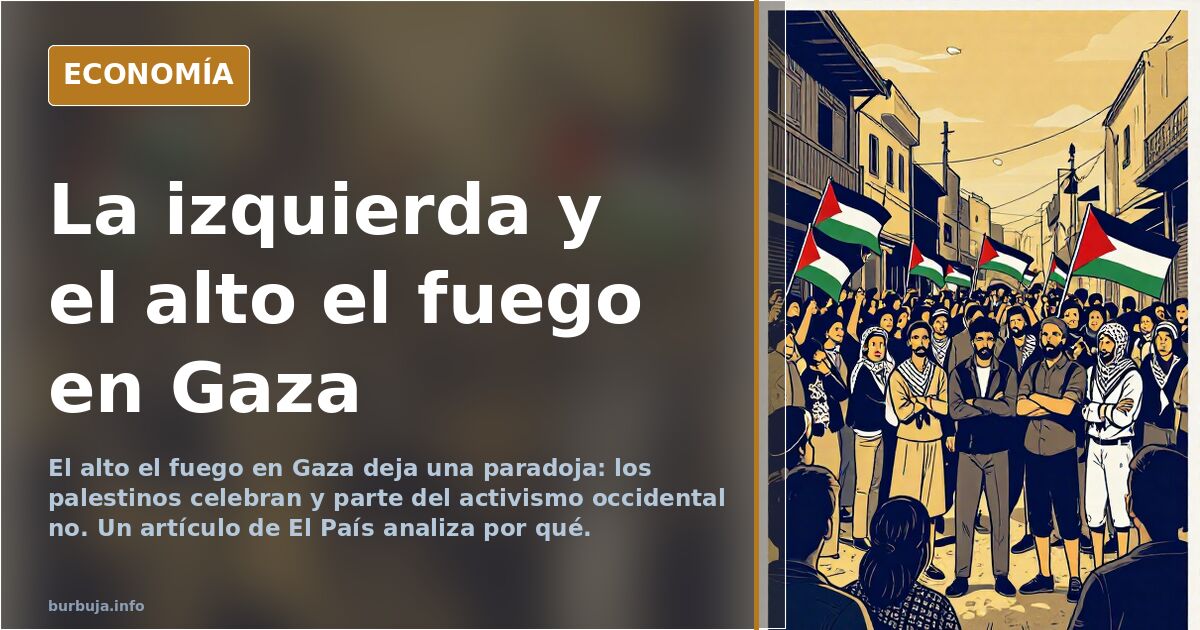
The Gaza ceasefire that makes the Western left uneasy
The agreement for a ceasefire in Gaza and the release of the hostages has produced a paradoxical scene: while Israel and the Strip celebrate the momentary end of the pavor, little joy is to be found in much of the Western accounts that for months cried out against the «genocide». An article published in El País by Santiago Gerchunoff, titled «The sadness of the ceasefire», argues that Western activists struggle to celebrate a document signed by Hamas and Netanyahu. The thesis is uncomfortable: what the truce extinguishes is not only the violence, but the urgency of a cause that gave identity and community to those who championed it from afar.
What Gerchunoff's article argues
The piece starts from a concrete scene: children laughing and adults crying in Gaza, crowds celebrating, while on social media and in statements by Western activists only distrust appears. The arguments they put forward —that the deal is a trap, that the struggle continues, that it favors Israel or that it is a triumph of imperialism— sound rational, but the article points to something else: the Palestinians themselves may feel relief while those who claimed to represent them from afar feel only sadness.
Gerchunoff draws on Albert Hirschman to explain the phenomenon: political commitments work better the worse the conditions. The more unbearable the injustice, the more ardent the cause. When the violence subsides, the fervor fades. What is lost, he argues, is not just a struggle: it is an identity.
The humanist trap the article describes
The article links that paradox to a deeper critique of modern humanism. The activist who campaigns thousands of kilometers away does not act from their own experience, but from a sarracena abstraction with Kantian roots: solidarity among rational beings, universal empathy. The problem, it says, is that no one can feel all the pain in the world. We choose the causes that touch us through history, position or invisible bonds, and pretending that this does not matter is part of the trap.
The critique extends to Platonism: the illusion that goodness and justice exist as pure ideas accessible through reason. Against this, the text champions Aristotle —virtue is learned by acting, with prudence, in a world where nothing is absolute— and concludes that there is no «right side of history». There are only situated human beings, with bodies, histories and limits. What would be truly humanist, and truly difficult, would be to rejoice today with those celebrating in Gaza because, at least for an instant, the bombs have stopped falling.
The reaction: from praise to «we were better off against Israel»
The article's reception has been a thermometer for its own thesis. Some consider it an excellent piece: it expresses well something that had been noticeable, that for part of the left the end of the war has come like a bucket of cold water. They had a goldmine for taking to the streets with flags, organizing flotillas or boycotting Israeli products, and suddenly they have been left without a cause. Some are already pointing to Sudan or Yemen as a replacement, without quite deciding.
At the opposite extreme, the most common reaction is the textbook «we were better off against Israel». Activists are accused of never having cared about the Palestinians, only the posturing; of needing constant confrontation to keep parasitizing; of the «cause» having been channeled to serve local political interests. The most recurring criticism: the little-flag-waving demonstrators who cannot even place Palestine on a map have understood nothing, and deep down they have been used.
The uncomfortable detail: the bombings continue
The conversation gets complicated when on-the-ground figures appear. Several messages cite reports from media outlets of Israeli attacks in Gaza City, Khan Yunis and the Shati camp in the hours and days after the ceasefire announcement, with dozens dead under the rubble and near the so-called «yellow line» of withdrawal. The question is repeated with a smirk: «has the truce started yet or not?».
That drip-feed of figures feeds those who argue the agreement is not worth the paper it is written on and that Israel is maintaining its offensives. It also gives ammunition to those on the other side who point to the silence of the celebrities and activists who called for a ceasefire: if their compassion were real, they say, they would be celebrating life today instead of staying silent.
The political backdrop: Trump, authorship and the absence of celebration
Part of the analysis points to a less noble motive for the lack of jubilation: the deal is perceived as a political success for Trump, and that makes it indigestible for those who would have celebrated it if others had signed it. The idea is repeated in several formulations: if the ceasefire had been achieved by Obama, Zapatero or Bachelet, the streets would be full of joy; since Trump pulled it off, all there is is weeping. The «marvelous TRAN» gets the glory, and that stings for some.
In parallel, leaders such as Ione Belarra and Irene Montero have called for redoubling social mobilization to make the ceasefire permanent and to reject Trump's colonization plan. It is not joy, it is pressure. And that slogan —«the struggle continues»— is exactly what Gerchunoff's article identified as a symptom.
What remains of the cause and what the truce extinguishes
The underlying thread is a question about Western activism: what happens when the cause that gave meaning to a collective identity is switched off by an agreement signed by the very parties it claimed to represent. The substitute causes being floated —climate change, vulnerable groups, gender violence, women's football— do not seem to fill the same void. And some point to a more cynical calculation: mobilization as a business, as a racket that needs constant conflict to keep parasitizing.
Gerchunoff's article, at its core, does not accuse anyone of hypocrisy: it describes a mechanism. The cause provided warmth, community and meaning. The truce leaves a void. And that void, more than politics, is what explains the sadness.
Can you champion a cause without needing the pavor to continue? That is the question the text leaves open, and the reaction to the text itself does not quite answer.
The agreement for a ceasefire in Gaza and the release of the hostages has produced a paradoxical scene: while Israel and the Strip celebrate the momentary end of the pavor, little joy is to be found in much of the Western accounts that for months cried out against the «genocide». An article published in El País by Santiago Gerchunoff, titled «The sadness of the ceasefire», argues that Western activists struggle to celebrate a document signed by Hamas and Netanyahu. The thesis is uncomfortable: what the truce extinguishes is not only the violence, but the urgency of a cause that gave identity and community to those who championed it from afar.
What Gerchunoff's article argues
The piece starts from a concrete scene: children laughing and adults crying in Gaza, crowds celebrating, while on social media and in statements by Western activists only distrust appears. The arguments they put forward —that the deal is a trap, that the struggle continues, that it favors Israel or that it is a triumph of imperialism— sound rational, but the article points to something else: the Palestinians themselves may feel relief while those who claimed to represent them from afar feel only sadness.
Gerchunoff draws on Albert Hirschman to explain the phenomenon: political commitments work better the worse the conditions. The more unbearable the injustice, the more ardent the cause. When the violence subsides, the fervor fades. What is lost, he argues, is not just a struggle: it is an identity.
The humanist trap the article describes
The article links that paradox to a deeper critique of modern humanism. The activist who campaigns thousands of kilometers away does not act from their own experience, but from a sarracena abstraction with Kantian roots: solidarity among rational beings, universal empathy. The problem, it says, is that no one can feel all the pain in the world. We choose the causes that touch us through history, position or invisible bonds, and pretending that this does not matter is part of the trap.
The critique extends to Platonism: the illusion that goodness and justice exist as pure ideas accessible through reason. Against this, the text champions Aristotle —virtue is learned by acting, with prudence, in a world where nothing is absolute— and concludes that there is no «right side of history». There are only situated human beings, with bodies, histories and limits. What would be truly humanist, and truly difficult, would be to rejoice today with those celebrating in Gaza because, at least for an instant, the bombs have stopped falling.
The reaction: from praise to «we were better off against Israel»
The article's reception has been a thermometer for its own thesis. Some consider it an excellent piece: it expresses well something that had been noticeable, that for part of the left the end of the war has come like a bucket of cold water. They had a goldmine for taking to the streets with flags, organizing flotillas or boycotting Israeli products, and suddenly they have been left without a cause. Some are already pointing to Sudan or Yemen as a replacement, without quite deciding.
At the opposite extreme, the most common reaction is the textbook «we were better off against Israel». Activists are accused of never having cared about the Palestinians, only the posturing; of needing constant confrontation to keep parasitizing; of the «cause» having been channeled to serve local political interests. The most recurring criticism: the little-flag-waving demonstrators who cannot even place Palestine on a map have understood nothing, and deep down they have been used.
The uncomfortable detail: the bombings continue
The conversation gets complicated when on-the-ground figures appear. Several messages cite reports from media outlets of Israeli attacks in Gaza City, Khan Yunis and the Shati camp in the hours and days after the ceasefire announcement, with dozens dead under the rubble and near the so-called «yellow line» of withdrawal. The question is repeated with a smirk: «has the truce started yet or not?».
That drip-feed of figures feeds those who argue the agreement is not worth the paper it is written on and that Israel is maintaining its offensives. It also gives ammunition to those on the other side who point to the silence of the celebrities and activists who called for a ceasefire: if their compassion were real, they say, they would be celebrating life today instead of staying silent.
The political backdrop: Trump, authorship and the absence of celebration
Part of the analysis points to a less noble motive for the lack of jubilation: the deal is perceived as a political success for Trump, and that makes it indigestible for those who would have celebrated it if others had signed it. The idea is repeated in several formulations: if the ceasefire had been achieved by Obama, Zapatero or Bachelet, the streets would be full of joy; since Trump pulled it off, all there is is weeping. The «marvelous TRAN» gets the glory, and that stings for some.
In parallel, leaders such as Ione Belarra and Irene Montero have called for redoubling social mobilization to make the ceasefire permanent and to reject Trump's colonization plan. It is not joy, it is pressure. And that slogan —«the struggle continues»— is exactly what Gerchunoff's article identified as a symptom.
What remains of the cause and what the truce extinguishes
The underlying thread is a question about Western activism: what happens when the cause that gave meaning to a collective identity is switched off by an agreement signed by the very parties it claimed to represent. The substitute causes being floated —climate change, vulnerable groups, gender violence, women's football— do not seem to fill the same void. And some point to a more cynical calculation: mobilization as a business, as a racket that needs constant conflict to keep parasitizing.
Gerchunoff's article, at its core, does not accuse anyone of hypocrisy: it describes a mechanism. The cause provided warmth, community and meaning. The truce leaves a void. And that void, more than politics, is what explains the sadness.
Can you champion a cause without needing the pavor to continue? That is the question the text leaves open, and the reaction to the text itself does not quite answer.
Also available in: Deutsch
Summary of a discussion on Burbuja.info - Foro de economía, actualidad y política., translated from Spanish and reviewed before publication. Read the full discussion (99 replies).
More summaries
-
Cerezo Slams Montero and Belarra with Epithets: Podemos Walks Out
Patricia Cerezo hurled insults at Montero and Belarra; Pablo Fernández (Podemos) abandoned the set, and the collaborator retracted her comments after the commercial break.
-
Montero and Belarra bathroom photo sparks backlash
A photo of Spanish politicians Irene Montero and Ione Belarra in a bar restroom triggers criticism over perceived frivolity amid economic hardship.
-
Podemos leaders holiday in Menorca amid price backlash
Ione Belarra and Irene Montero spent August in Menorca, sparking debate over high island costs and the gap between left-wing rhetoric and lifestyle.
-
Rental listings pulled from Idealista within 24 hours after call to action
Landlords remove their flats from Idealista in 24 hours: 80% of housing is in the hands of small owners, according to circulating estimates
-
BREAKING | US and Iran 'seal the peace': Hormuz blockade ends and oil plunges...
The US and Iran announce a supposed peace over Hormuz, but oil isn't falling. We look at forum users' scepticism about market manipulation.
-
PANCHUSO SAYS THEY'RE GOING TO LET ALL OF PANCHILANDIA IN
Forum controversy: Ayuso's remarks on Latin American migration spark an intense debate over politics, demographics and electoral strategy in Spain.