
Gasoline: €1.84 per liter and rising before October
Gasoline hits €1.84 per liter, with price differences between stations reaching 29 cents. Refueling has become a matter of financial management.
English · Original discussion in Spanish · Published
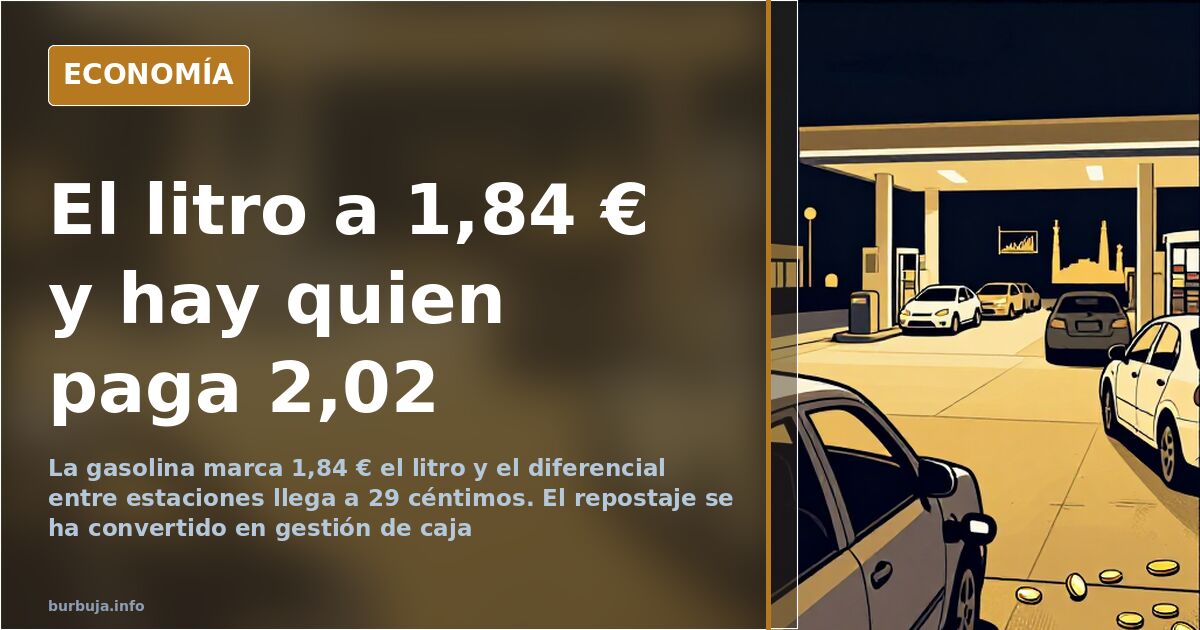
“Cheap” gasoline costs €1.84, and some pumps are already at 2.02
The refueling habits of this weekend have resulted in a bill that is no longer discussed in terms of saving, but of endurance. The reference circulating these days is €1.84 per liter, and the adjective accompanying it—“cheap”—accurately reflects the general mood: that price only appears when you are lucky and the station next to you isn't watching.
With October approaching, the question has shifted from how much it will rise to how long each household economy can sustain it.
From Sanlúcar to Seville: A 29-cent difference
The average price hides brutal dispersion. A tank filled at the exit of Sanlúcar cost €1.96 per liter, while BP in the same area was priced at €2.02. Hours later, the same driver refueled in Seville for €1.67 at a low-cost station. That is a 29-cent difference on the same day without leaving Andalusia: nearly €15 in a 50-liter tank, or the equivalent of a free urban commute with each refueling.
Other references suggest prices dropping as low as €1.68, and some point to €1.769 as the recent floor for 95 octane.
The interesting part is not the map, but how the mental threshold has moved. Prices that were avoided months ago because they were too high—€1.53, or even €1.769—are now almost fondly remembered.
Those who postponed filling up, hoping for a drop that didn't come, have ended up buying at higher prices, which is the everyday version of being left out of the market.
The risk no one wants to face: Bab-el-Mandeb
The argument with the most weight on the table is not domestic demand, but maritime transit. If passage through the Bab-el-Mandeb strait becomes tense and rerouting ships becomes expensive, the crude oil arriving via that route commands a premium. The harshest formulation of this scenario is not a recovery; it is a direct ticket to €3 per liter.
At that level, the conversation changes entirely and enters the realm of employment and mandatory transport, because for a large part of the country, the car is not a leisure activity.
The electric option and the calculation trap
The alternative that keeps coming up is the electric car with rooftop solar panels. It sounds perfect until it appears on paper: initial investment, depreciation, home charging, and the suspicion—nothing insignificant—that electricity prices also have room to rise.
Anyone who has run the numbers on how many kilometers per month are needed for the differential to compensate knows that the outcome depends on variables that change every quarter.
With these figures, the analysis stalls right here: no one knows if this weekend's surge is a peak or the first step on a longer climb, and meanwhile, every driver conducts their own accounting at the pump, which is the only place where projections turn into euros.
The refueling habits of this weekend have resulted in a bill that is no longer discussed in terms of saving, but of endurance. The reference circulating these days is €1.84 per liter, and the adjective accompanying it—“cheap”—accurately reflects the general mood: that price only appears when you are lucky and the station next to you isn't watching.
With October approaching, the question has shifted from how much it will rise to how long each household economy can sustain it.
From Sanlúcar to Seville: A 29-cent difference
The average price hides brutal dispersion. A tank filled at the exit of Sanlúcar cost €1.96 per liter, while BP in the same area was priced at €2.02. Hours later, the same driver refueled in Seville for €1.67 at a low-cost station. That is a 29-cent difference on the same day without leaving Andalusia: nearly €15 in a 50-liter tank, or the equivalent of a free urban commute with each refueling.
Other references suggest prices dropping as low as €1.68, and some point to €1.769 as the recent floor for 95 octane.
The interesting part is not the map, but how the mental threshold has moved. Prices that were avoided months ago because they were too high—€1.53, or even €1.769—are now almost fondly remembered.
Those who postponed filling up, hoping for a drop that didn't come, have ended up buying at higher prices, which is the everyday version of being left out of the market.
The risk no one wants to face: Bab-el-Mandeb
The argument with the most weight on the table is not domestic demand, but maritime transit. If passage through the Bab-el-Mandeb strait becomes tense and rerouting ships becomes expensive, the crude oil arriving via that route commands a premium. The harshest formulation of this scenario is not a recovery; it is a direct ticket to €3 per liter.
At that level, the conversation changes entirely and enters the realm of employment and mandatory transport, because for a large part of the country, the car is not a leisure activity.
The electric option and the calculation trap
The alternative that keeps coming up is the electric car with rooftop solar panels. It sounds perfect until it appears on paper: initial investment, depreciation, home charging, and the suspicion—nothing insignificant—that electricity prices also have room to rise.
Anyone who has run the numbers on how many kilometers per month are needed for the differential to compensate knows that the outcome depends on variables that change every quarter.
With these figures, the analysis stalls right here: no one knows if this weekend's surge is a peak or the first step on a longer climb, and meanwhile, every driver conducts their own accounting at the pump, which is the only place where projections turn into euros.
Summary of a discussion on Burbuja.info - Foro de economía, actualidad y política., translated from Spanish and reviewed before publication. Read the full discussion (16 replies).
More summaries
-
Executive Cited in Forum: “2.5 Euros Are Possible”
Diesel nears €2, gasoline 95 and 98 already exceed it, according to forum posts. A cited executive places €2.50 within weeks.
-
Euthanasia in Old Age: Autonomy vs. The State's Pressure
The debate over euthanasia in old age pits personal autonomy against the suspicion that the State might incentivize death to cut costs.
-
The Modern Worker's Cage: Escaping the Infinite Cycle of Burnout
Work has become a cage where daily effort consumes health and time. Discover why we push ourselves so hard and how to break the cycle.
-
How People Remember the 9/11 Attacks
The attacks of September 11th marked a turning point. Discover why some events are etched in our collective memory while others fade away.
-
Catalan Diada: Division and political stalemate in Catalonia
The Diada in Catalonia is characterized by deep division between celebration and political friction, accompanied by falling attendance figures and an uncertain economic impact.
-
Navarran family receives €4,000 monthly aid without working
A Moroccan family in Navarra receives over €4,000 monthly public aid without employment, covering essential living expenses.