
Gas vents: how to stop losing heat without risking your life
Room-sealed boilers and gas vents: the rules allow covering them, but the risk of a gas or CO leak means ventilation is still needed. Energy savings come at a price.
English · Original discussion in Spanish · Published
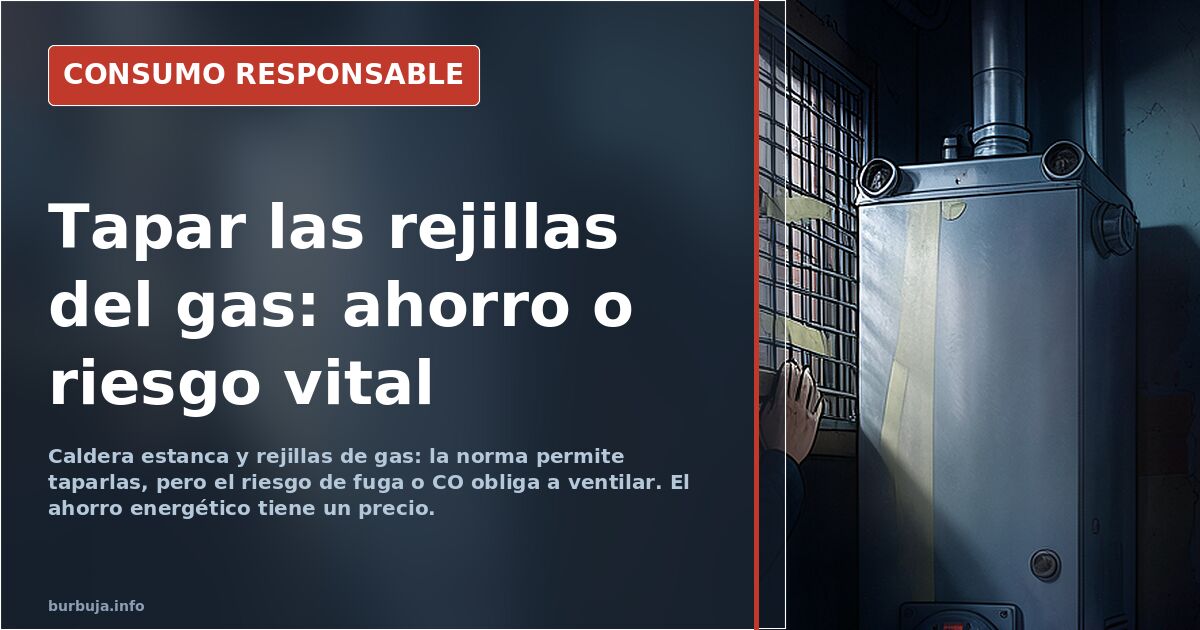
Gas vents: savings versus safety
In a 2008 apartment with an individual gas boiler and a ceramic hob, two vents in the living room —one at floor level and one almost at the ceiling— let in so much air that the heat escapes straight out of them. The owner has sealed doors and windows with weatherstripping and now faces the awkward question: can those vents be covered without risking your life? The answer depends on a technical detail almost nobody knows: whether the boiler is room-sealed or open-flue. The installed model, a Saunier Duval Thermaclassic F25 E, is, according to the information shared by participants, a room-sealed boiler. And that's where the confusion begins, because if it is room-sealed, standard UNE 60670 does not require gas ventilation openings. But the building has them. Why? Because many developments from the construction boom were built with a standard design that worked both for gas cookers and for non-sealed boilers. In the end, the buyer inherits a hole in the wall that is no longer needed but is still there, cooling the living room.
What the rules say and what antiestéticar says
The key lies in UNE 60670, cited in the RITE (Spain's regulations for thermal installations in buildings). If the boiler is room-sealed, no permanent ventilation is required in the room. Several participants confirm this after checking with Gas Natural and with the technician from the mandatory inspection. "I have the certificate of suitability," one of them says, having already covered his vents. However, the camp warning of the risk is not a small one: some argue that even with a room-sealed boiler, the gas supply line enters the kitchen and a leak could accumulate. Natural gas is lighter than air and tends to form a pocket under the ceiling; butane, which is heavier, collects at floor level. That is why the vents are placed at those two heights. The discussion then shifts to CO: poor combustion in an enclosed space can cause poisoning. The recommendation from the most cautious is clear: if you cover them, do so with technical knowledge and, if possible, with a gas detector and a CO detector.
Solutions that require no building work
Several practical alternatives come up. The most frequently mentioned: installing vents with accordion shutters or dampers, which allow them to be closed when the boiler is off or the wind is blowing. The problem is that the Industry Ministry inspection can reject them if the technician considers ventilation to be mandatory. Another option is white perspex with magnets, which covers almost completely while leaving a small gap for minimal ventilation. One participant chooses to leave one vent closed and the other open, seeking a balance between comfort and safety. And some go further: installing an extractor fan with a programmed return, running ten minutes every hour. The idea is to renew the air without having two permanent holes. That said, the extractor needs an air inlet; otherwise it creates a vacuum and the system loses effectiveness.
The real cost of ventilating
It's worth doing the maths. An ordinary extractor hood moves around 500 m³/h. If it runs three hours a day, calculated at 7 kcal/h per m³/h, about 10,500 kcal/h go out into the street — in other words, 12.2 kWh. In cold regions, the figure shoots up. That is the price of ventilating with mechanical methods. A passive vent, on the other hand, uses no electricity, but cools constantly. The comparison is not trivial: one hour of the extractor hood can take away more heat than a whole day of the vent. That's the crux: it's not just about covering them, but about managing when and how you ventilate.
The airtight home trap
Taking insulation to the extreme has consequences. If you seal doors, windows and vents, the home becomes airtight. And an airtight house accumulates moisture, CO₂ and, in the event of a leak, gas. Condensation and mould problems appear when there is no air renewal. The suggested solution is a controlled mechanical ventilation system (MVHR): extractors in the kitchen and bathroom, and small openings in the other rooms. It isn't cheap, but it maintains air quality without opening windows. The paradox is that modern homes already incorporate many invisible openings —in aluminium joinery, shutter boxes— that ventilate without you noticing. Older homes had the kitchen vent and the shunt ducts in the bathrooms. The problem isn't ventilating, it's doing so without throwing money away.
In the end, the decision rests with the owner and their technician. The rules allow covering them if the boiler is room-sealed, but prudence recommends not sealing them completely. The question nobody answers with a number is how much of those heating savings go into repairing the damage from poorly managed condensation. Or worse.
Also available in: Deutsch
Summary of a discussion on Burbuja.info - Foro de economía, actualidad y política., translated from Spanish and reviewed before publication. Read the full discussion (76 replies).
More summaries
-
Heating oil vs natural gas: which boiler saves more?
Real comparison of heating oil and natural gas boilers: cost per kWh, efficiency, maintenance, and alternatives like pellets or heat pumps.
-
Which condensing natural gas boilers actually last longest?
A technical analysis of the most reliable natural gas boilers: brand comparison, durability and real-world costs.
-
Natural gas vs heating oil: the 40% saving the salesman promises
A salesman promises 40% savings when switching from heating oil to natural gas; forum users advise checking fixed fees, maintenance and installation costs.
-
Helmeca: nearly €5,000 for a German course and a promised job
Helmeca offers jobs in Germany to early childhood educators but ends up selling a German course for almost €5,000 for a B2 level that many doubt is achievable.
-
Control vs Durex: condom width really does matter
Control condoms measure 53-54 mm while Durex runs 54-56 mm depending on the line. The width difference is real, but the feel of the latex is more deceiving than the number on the box.
-
Property value checks in Spain: does the tax office always do them?
Spain's value verification lets the tax authority review the declared price in a property sale and issue a parallel assessment. How it works and what defences you have.