
Gas heaters: more heat for less money, but never in the bedroom
Blue-flame gas heaters warm up faster and cost less to run than electric heating, but combustion gases stay in the room and their use is banned in bedrooms and bathrooms.
English · Original discussion in Spanish · Published
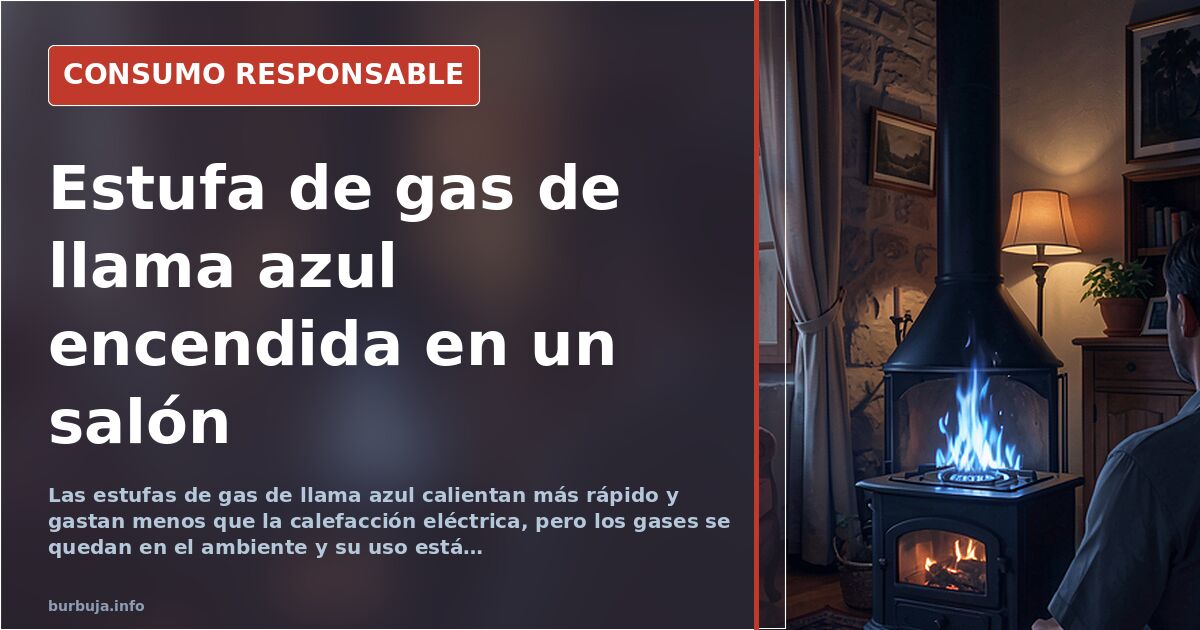
Gas heater: more heat for less money, but never in the bedroom
A 30-square-metre room with a huge window that nobody can keep warm in winter. That was the problem that led to installing a blue-flame gas heater in a studio where someone works every day. The result, according to the account that opens this discussion: the cold is gone. It heats faster and more efficiently than the typical oil-filled radiators, and with the heater running full blast —about ten hours a day at medium power— a butane bottle lasts around fifteen days.
The question many people ask is whether it is worth it compared with electric heating. The short answer, according to those taking part in the debate, is that consumption is much lower and it heats better. The long answer has two small letters you should read before buying.
Blue flame, yellow flame and carbon monoxide
The colour of the flame is not about looks. A blue flame indicates greater heat energy, but also higher oxygen consumption than a yellow flame. And a yellow flame in a gas heater can reveal incomplete combustion, that is, carbon monoxide production. It is the same mechanism grandmothers described as getting «fumed» by charcoal braziers, technological differences aside.
There lies the first serious warning: combustion gases stay in the room. Air renewal is needed and, like any open-circuit gas appliance, its use is banned in bedrooms and bathrooms. It makes no difference whether the model includes safety devices, which are mandatory anyway. They are not meant to be used while you sleep.
Does it switch off by itself if oxygen runs low?
Catalytic models include a mechanism that shuts the appliance down when carbon monoxide in the room exceeds a maximum level. It is worth understanding what it is and what it is not: it is a safety net for when you forget to turn the heater off, not a system that lets you switch it on and forget about it. The appliance's own design assumes there is minimum ventilation and a reasonable space.
That is why location matters more than power. In a large living room with some ventilation, the risk fades. In a small, closed room, the equation changes completely.
How much it costs to heat the home with gas bottles
The calculation used by those who already own one is simple: one bottle every fifteen days with intensive use. Against that, electric heating works out considerably more expensive per useful kilowatt. The heater also has wheels: it moves around the house as needed. Placed in the hallway or the central room with the doors open, it can heat considerably more than the room it is in.
The limit is comfort. It is not the method for being at home in shorts or for sleeping under just a sheet. It heats a lot, yes, but it heats what it heats.
The alternative if you already have a natural gas boiler
With a boiler installed, the heater does not offer the same comfort. The advice that keeps coming up is to programme the thermostat sensibly: do not go above 20 or 21 degrees, let the temperature drop to 17 or 18 when you are out, and close the radiators in unused rooms. For the bedroom, the boiler; for the living room, the heater.
There remains the domestic detail nobody notices until there are children or cats: the front grille. Some models leave a gap in front of the flame that fits a finger, about twenty centimetres off the floor. Others solve it. It is the kind of detail that never appears in the brochure and that decides a purchase.
In the end, the gas heater does what it promises: heats fast and costs less. What it does not do is change the laws of physics or of common sense.
Also available in: Deutsch
Summary of a discussion on Burbuja.info - Foro de economía, actualidad y política., translated from Spanish and reviewed before publication. Read the full discussion (12 replies).
More summaries
-
Heating oil vs natural gas: which boiler saves more?
Real comparison of heating oil and natural gas boilers: cost per kWh, efficiency, maintenance, and alternatives like pellets or heat pumps.
-
Gas heaters: catalytic, infrared or blue flame, which one costs less to run
Catalytic, infrared or blue flame: all three are 100% efficient, but they differ in heat distribution, butane consumption and burn risk. Key points to choose.
-
Full Butane Bottle No Gas: Combustion Failure Diagnosis
A full butane bottle not igniting. Technical analysis of the fault between gas pressure and the stove.
-
Pétanque Ball Finishes: Laser Etching vs. Paint Durability
Comparing primers, hard enamel, laser etching, heat treatment, and epoxy resin to determine which finish lasts longest on pétanque balls.
-
Burofax: delivery receipt or certified content, which to choose
Certifying the content of a burofax costs €13.53 if requested when sending and €18.15 afterwards. A delivery receipt only proves who picked up the envelope.
-
Mineral cast shower trays: 4 mm of bow across 1.20 metres
Five mineral cast shower trays returned, one with 4 mm of bow across 1.20 m. A user recounts the flatness failures and the returns.