
Galicia Integration: Outsiders Describe Cultural Barrier
Testimonies depict Galicia as a hard-to-penetrate community for newcomers, highlighting distrust and the 6% population data.
English · Original discussion in Spanish · Published
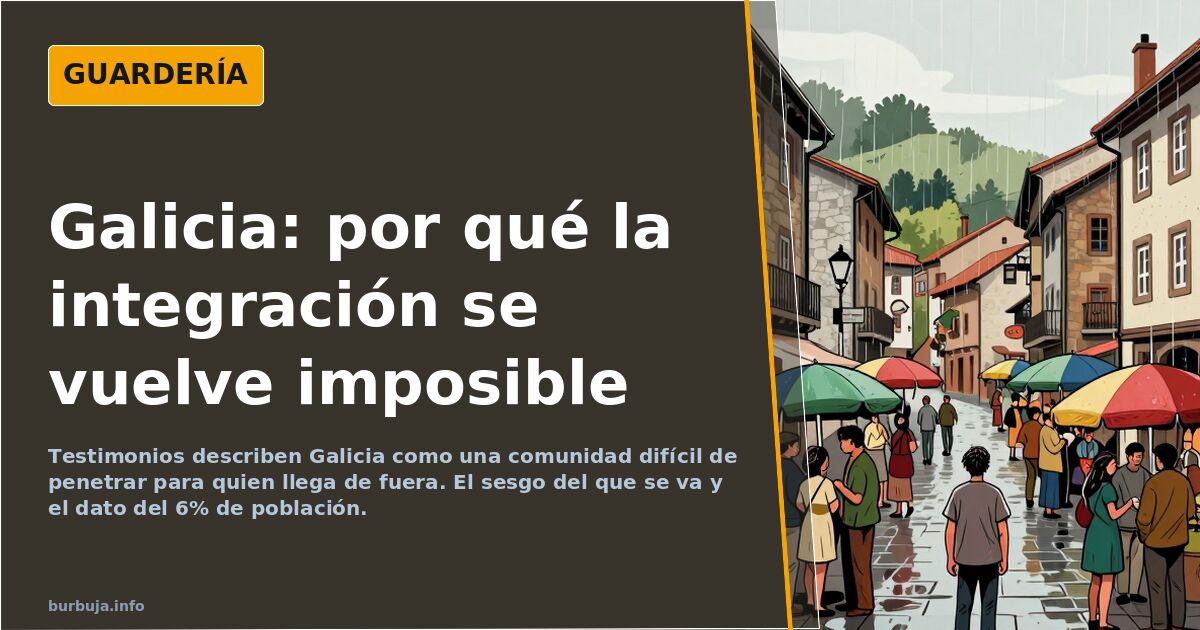
Galicia and the Invisible Wall No One Crosses
There is a paradox repeated in every conversation about Galicia: the region with the most returned emigrants and ties to Latin America is also, according to numerous testimonies, the hardest to peine for outsiders. This is not an isolated impression. In an exchange of 107 responses spanning 312 days, dozens of people described the same sequence: arrival with expectations, attempts at integration, and a wall of distrust that does not yield even after years of coexistence.
The dominant narrative in that exchange speaks not of open hostility, but of something harder to combat: permanent suspicion, a feeling of being judged from above, where every gesture is interpreted as confirmation that one does not belong. "It feels like contempt, suspicion, and constantly looking down on you," summarizes someone who lived there for several years. Another describes it as "petty, provincial, hypocritical, envious, closed-off people."
Why Is It So Hard to Integrate in Galicia?
The answer emerging from the exchange is not singular. Some point to historical distrust toward strangers, fueled by centuries of rural isolation and a minifundist property structure that turns every boundary into a state matter. "Perverted minds, weirdos, and disturbed individuals who parade their superiority because you invaded a palm's width of land they don't even cultivate," describes a participant who worked three years in the community.
Others highlight a more prosaic factor: social endogamy. In small towns, friendships are forged in childhood and do not expand. Those arriving at thirty do not compete on equal terms. "At certain ages, people simply have their lives set up with old friends and family; generally, making friends anywhere is difficult," nuances a dissenting voice breaking the consensus.
The most repeated counterargument is that the problem is not Galician, but the outsider's. "Your problem with Galicians is that they tolerate neither fools nor foolishness, and they don't mince words. If you are a good person, once you prove it, they are noble and welcoming." The response to this thesis was immediate and unnuanced: "That is a lie."
The Bias of Those Who Leave: Who Writes and Who Doesn't
Here, basic statistical principles apply. The testimonies received are from people who left or never managed to fit in. Those who integrated without issue do not post on forums about how bad Galicia is. It is the reverse survivorship bias: we only hear from the shipwrecked.
This does not invalidate experiences but contextualizes them. Several participants acknowledge meeting "good people" and "decent folks" in the community. One, defining themselves as coming from a Galician family, admits their experience was "the worst of my life" but adds, "I also met good people." Generalization, in both directions, is the enemy of analysis.
One piece of data deserves attention: the concentration of talent. With less than 6% of the peninsula's population, Galicia has produced a disproportionate number of politicians, entrepreneurs, and top-tier public figures. This does not align with the backwardness narrative some espouse.
Personal Experience as Data: When the Problem Isn't the Other
One of the longest testimonies describes an attempt to pursue vocational training in Galicia, systematic rejection by peers of the same age group, and teachers failing students with exams repeated year after year. The result: "I fell into deep depression, worsened by the adverse effects of finasteride. Fortunately, I am now fully recovered."
That detail—finasteride—introduces a variable the debate often overlooks: the mental health of the newcomer. Someone moving to a closed environment with pre-existing issues is not in a position to neutrally evaluate what happens to them. Perceived rejection is amplified. Depression distorts social reading. It is not an excuse for hostility, but a factor explaining why some experiences feel like tragedies while others are mere inconveniences.
Another participant recounts something more unsettling: "There, if you get along poorly with someone at work, they pay the local witch (meiga) to cast an evil eye on you." Witchcraft as a tool for workplace conflict. It is hard to know if they are serious or exaggerating for effect, but its appearance in an integration discussion says much about the imagery surrounding the community.
Accent, Politics, and Other Stereotypes
No conversation about Galicia is complete without its commonplaces. The "melancholic-singing" accent that sticks, alleged victimhood, obsession with inheritances and other people's money, and the presence of drug trafficking in local politics. "They have a president with photos alongside a traficante on a yacht, and a traficante selling wine, and it has gone to their heads," writes someone, mixing regional politics with popular culture.
The stereotype of the Galician as synonymous with 'fool' in Hispanic America also appears, though undeveloped. It relates more to poor 19th and 20th-century emigration than current reality, yet is used as an authority argument in the exchange. The same occurs with comparisons to the Basque Country, presented as a closed but hospitable community. "Even the Basques, who are closed off, eventually welcome you," claims someone who lived there.
Final irony comes from a participant recommending the Rías Baixas with a list mixing nude beaches, "quality flour," Amancio Ortega's yacht, and "pirate parties, Viking festivals, octopus in the party." Their diagnosis: "Yours was like going to the USA and choosing Detroit suburbs instead of Los Angeles."
Is Galicia Unique or a Mirror of Depopulated Spain?
The question hovering over the entire exchange is whether what is described is specifically Galician or simply rural. In any village in Castile, Extremadura, or Aragon, the outsider faces the same barrier: lifelong friendships, distrust of newcomers, and a social life that admits no late additions. The difference is that Galicia has a cultural identity strong enough for the clash to be read in national terms, not just village ones.
The disorienting data is the duration of the exchange: 312 days of conversation. It is not a burst of indignation. It is a topic that returns, fed by new experiences, finding echoes among those who did not participate initially. This suggests something structural, not anecdotal, in the difficulty of integration.
With these elements, the conclusion cannot be anything but uncomfortable: Galicia may indeed be harder to peine than other regions. And that may not be a defect, but the logical consequence of a society that for centuries had to defend itself against a State treating it as a fiscal colony and neighbors arriving each summer to tell them how to do things. The unanswered question remains whether that armor is still necessary or has become a burden.
There is a paradox repeated in every conversation about Galicia: the region with the most returned emigrants and ties to Latin America is also, according to numerous testimonies, the hardest to peine for outsiders. This is not an isolated impression. In an exchange of 107 responses spanning 312 days, dozens of people described the same sequence: arrival with expectations, attempts at integration, and a wall of distrust that does not yield even after years of coexistence.
The dominant narrative in that exchange speaks not of open hostility, but of something harder to combat: permanent suspicion, a feeling of being judged from above, where every gesture is interpreted as confirmation that one does not belong. "It feels like contempt, suspicion, and constantly looking down on you," summarizes someone who lived there for several years. Another describes it as "petty, provincial, hypocritical, envious, closed-off people."
Why Is It So Hard to Integrate in Galicia?
The answer emerging from the exchange is not singular. Some point to historical distrust toward strangers, fueled by centuries of rural isolation and a minifundist property structure that turns every boundary into a state matter. "Perverted minds, weirdos, and disturbed individuals who parade their superiority because you invaded a palm's width of land they don't even cultivate," describes a participant who worked three years in the community.
Others highlight a more prosaic factor: social endogamy. In small towns, friendships are forged in childhood and do not expand. Those arriving at thirty do not compete on equal terms. "At certain ages, people simply have their lives set up with old friends and family; generally, making friends anywhere is difficult," nuances a dissenting voice breaking the consensus.
The most repeated counterargument is that the problem is not Galician, but the outsider's. "Your problem with Galicians is that they tolerate neither fools nor foolishness, and they don't mince words. If you are a good person, once you prove it, they are noble and welcoming." The response to this thesis was immediate and unnuanced: "That is a lie."
The Bias of Those Who Leave: Who Writes and Who Doesn't
Here, basic statistical principles apply. The testimonies received are from people who left or never managed to fit in. Those who integrated without issue do not post on forums about how bad Galicia is. It is the reverse survivorship bias: we only hear from the shipwrecked.
This does not invalidate experiences but contextualizes them. Several participants acknowledge meeting "good people" and "decent folks" in the community. One, defining themselves as coming from a Galician family, admits their experience was "the worst of my life" but adds, "I also met good people." Generalization, in both directions, is the enemy of analysis.
One piece of data deserves attention: the concentration of talent. With less than 6% of the peninsula's population, Galicia has produced a disproportionate number of politicians, entrepreneurs, and top-tier public figures. This does not align with the backwardness narrative some espouse.
Personal Experience as Data: When the Problem Isn't the Other
One of the longest testimonies describes an attempt to pursue vocational training in Galicia, systematic rejection by peers of the same age group, and teachers failing students with exams repeated year after year. The result: "I fell into deep depression, worsened by the adverse effects of finasteride. Fortunately, I am now fully recovered."
That detail—finasteride—introduces a variable the debate often overlooks: the mental health of the newcomer. Someone moving to a closed environment with pre-existing issues is not in a position to neutrally evaluate what happens to them. Perceived rejection is amplified. Depression distorts social reading. It is not an excuse for hostility, but a factor explaining why some experiences feel like tragedies while others are mere inconveniences.
Another participant recounts something more unsettling: "There, if you get along poorly with someone at work, they pay the local witch (meiga) to cast an evil eye on you." Witchcraft as a tool for workplace conflict. It is hard to know if they are serious or exaggerating for effect, but its appearance in an integration discussion says much about the imagery surrounding the community.
Accent, Politics, and Other Stereotypes
No conversation about Galicia is complete without its commonplaces. The "melancholic-singing" accent that sticks, alleged victimhood, obsession with inheritances and other people's money, and the presence of drug trafficking in local politics. "They have a president with photos alongside a traficante on a yacht, and a traficante selling wine, and it has gone to their heads," writes someone, mixing regional politics with popular culture.
The stereotype of the Galician as synonymous with 'fool' in Hispanic America also appears, though undeveloped. It relates more to poor 19th and 20th-century emigration than current reality, yet is used as an authority argument in the exchange. The same occurs with comparisons to the Basque Country, presented as a closed but hospitable community. "Even the Basques, who are closed off, eventually welcome you," claims someone who lived there.
Final irony comes from a participant recommending the Rías Baixas with a list mixing nude beaches, "quality flour," Amancio Ortega's yacht, and "pirate parties, Viking festivals, octopus in the party." Their diagnosis: "Yours was like going to the USA and choosing Detroit suburbs instead of Los Angeles."
Is Galicia Unique or a Mirror of Depopulated Spain?
The question hovering over the entire exchange is whether what is described is specifically Galician or simply rural. In any village in Castile, Extremadura, or Aragon, the outsider faces the same barrier: lifelong friendships, distrust of newcomers, and a social life that admits no late additions. The difference is that Galicia has a cultural identity strong enough for the clash to be read in national terms, not just village ones.
The disorienting data is the duration of the exchange: 312 days of conversation. It is not a burst of indignation. It is a topic that returns, fed by new experiences, finding echoes among those who did not participate initially. This suggests something structural, not anecdotal, in the difficulty of integration.
With these elements, the conclusion cannot be anything but uncomfortable: Galicia may indeed be harder to peine than other regions. And that may not be a defect, but the logical consequence of a society that for centuries had to defend itself against a State treating it as a fiscal colony and neighbors arriving each summer to tell them how to do things. The unanswered question remains whether that armor is still necessary or has become a burden.
Also available in: Deutsch
Summary of a discussion on Burbuja.info - Foro de economía, actualidad y política., translated from Spanish and reviewed before publication. Read the full discussion (107 replies).
More summaries
-
Spain 'mamazo' video: viral, illegal and a gender debate
The viral 'mamazo' video in Cádiz is a crime for sharing minors' images; it sparks a gender debate and a judicial response.
-
Macarena Olona posts topless selfie on the beach
Olona posts a topless selfie on the beach and the conversation focuses on sun damage, age and scrutiny of politicians' bodies
-
Outdoor Sex in Spain: Drones, Wildlife and Rural Nostalgia
A forum thread on sex in Spanish forests highlights drone surveillance risks and rural nostalgia for lack of privacy.
-
Charmed Actress Sparks Debate Over 'The Wall'
A Charmed actress born in 1975 reignites the debate on aging versus neglect, with forum users comparing her look to peers.
-
McDonald's Quarter Pounder hits €12 in Spain
Spain's McDonald's Quarter Pounder now costs €12. Users debate if quality justifies the price hike compared to local options.
-
Funniest Movie Scenes: From Torrente to Woody Allen
A debate on hilarious film moments, spanning Spanish comedies like Torrente and Woody Allen classics, including dark humor.