
Gaining weight in your 40s and 50s isn't just willpower
Sandoval's physical change from 2015 to 2024 highlights how aging affects weight through diet, hormones, and biology.
English · Original discussion in Spanish · Published
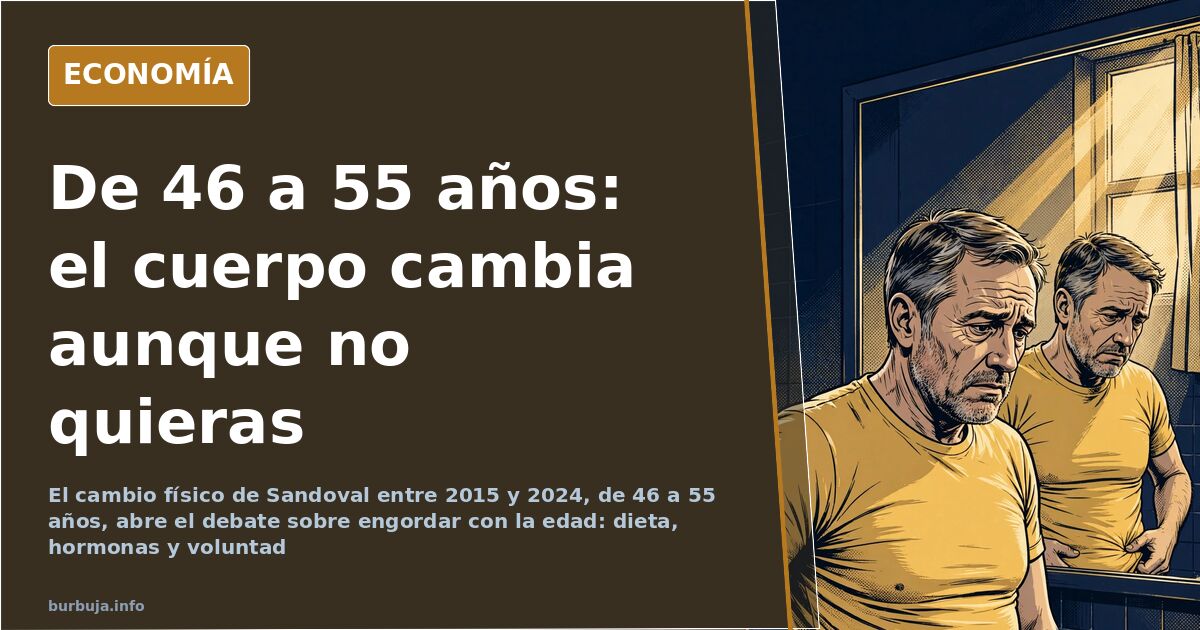
Sandoval: Weight gain is not a matter of willpower
In 2015, a coach with immaculate suits and abundant hair led Rayo and later Granada at age 46. Nine seasons later, the same man returned to the Granada bench at 55 years old with a different body. "Yes, it's the same person; I know it's hard to believe," admits the user posting the side-by-side images. What starts as a joke about aging turns into a serious debate: how much physical decline is due to neglect versus biology trinc its script.
Why do people gain weight between 45 and 55?
The hormonal argument appears early and has nothing to do with laziness. One participant notes that at these ages, men produce about half the testosterone they did during peak athletic activity. This drop drags down metabolism: less muscle, more fat, and a different cruising estimulante ilegal. Menopause is widely discussed, but andropause is rarely mentioned, despite affecting any man who reaches fifty.
Another participant downplays individual drama: in their view, the physical leap from 40 to 50 is brutal anywhere in the world. Ten years are many years. That a 55-year-old man's body doesn't resemble a 45-year-old's says nothing about his discipline.
On the table is also the aggressive route circulating in Hollywood: injecting testosterone to maintain twenty-something figures at sixty. It's called TRT, and the problem, they point out, is that it requires long-term maintenance. The shortcut has a price.
How much does diet help versus the gym?
The most detailed testimony comes from someone who lost 16 kilos and has maintained 73 kilos for a year and a half at 1.81 meters tall. Their breakdown is clear: 80% to 90% of the result is diet, while exercise—push-ups, pull-ups, dumbbells, some abs—only finishes the job. No need to kill yourself. The uncomfortable conclusion is this: you have to accept feeling hungry.
The figure they manage is around 1,700-1,800 daily calories. Far less than what one consumes without thinking, and very far from a restaurant meal with tripe, sirloin, bread, wine, and dessert. That menu can exceed 3,000 calories in one go, explaining why no one moves all afternoon afterward.
Retired athletes who keep eating the same way
A pattern repeats among former athletes: they continue eating as if training two hours a day, but they no longer train. Semi-professional basketball players face the same drift, including Javi Moreno, former striker for Alavés and Milan, who reportedly reached 121 kilos and underwent surgery. The condition of being overweight, they say, was hidden beneath the exercise.
Eating little, eating much, and the club of the long-lived
Examples pile up. Clint Eastwood, 94, still makes movies and, according to reports, eats twice a day. Arturo Fernández ate one plate and apples for the rest, living past 90. These are anecdotes, not clinical trials, but they push in the same direction: restriction and unprocessed food appear repeatedly among those who reach advanced ages.
Hospital observations align: three healthy, scarce meals for all patients, not just diabetics or hypertensives, another participant argues. Eating kills, but eating too much also does.
Natural juice and other liquid sugar traps
One heavily emphasized point is drinking sugar. A participant claims that juice, even home-squeezed, arrives without fiber and hits suddenly: the body cannot process that spike, sending it directly to fat, increasing diabetes risk and fat accumulation by 200% compared to whole fruit. In industrial formats, the figure doubles to 400%. This is not verified data but their assessment.
Whole fruit with pulp escapes criticism. Bread, however, is the confessed weak spot for many: it's hard to quit even after running three marathons.
The mirror lies: when being overweight rejuvenates the face
Here comes the puzzling twist. Someone with 174 centimeters and 115 kilos, aged 53, claims no one guesses he's over 40: the round face stretches the skin and hides age, while broad shoulders and an active attitude complete the deception. Opposite case: 1.85 meters and 58 kilos, a figure many consider problematic.
From 46 to 55 there are nine seasons, thousands of days, and a body that changes with or without permission. The scale goes down, up, and sometimes says nothing useful. The only consistent point across all versions is that the mirror lies in both directions and that willpower alone does not explain the result.
In 2015, a coach with immaculate suits and abundant hair led Rayo and later Granada at age 46. Nine seasons later, the same man returned to the Granada bench at 55 years old with a different body. "Yes, it's the same person; I know it's hard to believe," admits the user posting the side-by-side images. What starts as a joke about aging turns into a serious debate: how much physical decline is due to neglect versus biology trinc its script.
Why do people gain weight between 45 and 55?
The hormonal argument appears early and has nothing to do with laziness. One participant notes that at these ages, men produce about half the testosterone they did during peak athletic activity. This drop drags down metabolism: less muscle, more fat, and a different cruising estimulante ilegal. Menopause is widely discussed, but andropause is rarely mentioned, despite affecting any man who reaches fifty.
Another participant downplays individual drama: in their view, the physical leap from 40 to 50 is brutal anywhere in the world. Ten years are many years. That a 55-year-old man's body doesn't resemble a 45-year-old's says nothing about his discipline.
On the table is also the aggressive route circulating in Hollywood: injecting testosterone to maintain twenty-something figures at sixty. It's called TRT, and the problem, they point out, is that it requires long-term maintenance. The shortcut has a price.
How much does diet help versus the gym?
The most detailed testimony comes from someone who lost 16 kilos and has maintained 73 kilos for a year and a half at 1.81 meters tall. Their breakdown is clear: 80% to 90% of the result is diet, while exercise—push-ups, pull-ups, dumbbells, some abs—only finishes the job. No need to kill yourself. The uncomfortable conclusion is this: you have to accept feeling hungry.
The figure they manage is around 1,700-1,800 daily calories. Far less than what one consumes without thinking, and very far from a restaurant meal with tripe, sirloin, bread, wine, and dessert. That menu can exceed 3,000 calories in one go, explaining why no one moves all afternoon afterward.
Retired athletes who keep eating the same way
A pattern repeats among former athletes: they continue eating as if training two hours a day, but they no longer train. Semi-professional basketball players face the same drift, including Javi Moreno, former striker for Alavés and Milan, who reportedly reached 121 kilos and underwent surgery. The condition of being overweight, they say, was hidden beneath the exercise.
Eating little, eating much, and the club of the long-lived
Examples pile up. Clint Eastwood, 94, still makes movies and, according to reports, eats twice a day. Arturo Fernández ate one plate and apples for the rest, living past 90. These are anecdotes, not clinical trials, but they push in the same direction: restriction and unprocessed food appear repeatedly among those who reach advanced ages.
Hospital observations align: three healthy, scarce meals for all patients, not just diabetics or hypertensives, another participant argues. Eating kills, but eating too much also does.
Natural juice and other liquid sugar traps
One heavily emphasized point is drinking sugar. A participant claims that juice, even home-squeezed, arrives without fiber and hits suddenly: the body cannot process that spike, sending it directly to fat, increasing diabetes risk and fat accumulation by 200% compared to whole fruit. In industrial formats, the figure doubles to 400%. This is not verified data but their assessment.
Whole fruit with pulp escapes criticism. Bread, however, is the confessed weak spot for many: it's hard to quit even after running three marathons.
The mirror lies: when being overweight rejuvenates the face
Here comes the puzzling twist. Someone with 174 centimeters and 115 kilos, aged 53, claims no one guesses he's over 40: the round face stretches the skin and hides age, while broad shoulders and an active attitude complete the deception. Opposite case: 1.85 meters and 58 kilos, a figure many consider problematic.
From 46 to 55 there are nine seasons, thousands of days, and a body that changes with or without permission. The scale goes down, up, and sometimes says nothing useful. The only consistent point across all versions is that the mirror lies in both directions and that willpower alone does not explain the result.
Also available in: Deutsch
Summary of a discussion on Burbuja.info - Foro de economía, actualidad y política., translated from Spanish and reviewed before publication. Read the full discussion (201 replies).
More summaries
-
Cerezo Slams Montero and Belarra with Epithets: Podemos Walks Out
Patricia Cerezo hurled insults at Montero and Belarra; Pablo Fernández (Podemos) abandoned the set, and the collaborator retracted her comments after the commercial break.
-
Night concierge job in Granada: 850 euros after gas costs
The offer pays 1,100 euros monthly for five hours of night work, seven days a week, but 250 euros in fuel costs reduce the effective salary to 850 euros.
-
Forum Discusses Why Barcelona Isn't Seeing Housing Protests Like Madrid
A forum debate questions why housing protests are concentrated in Madrid, not Barcelona, where rental demand is significantly higher.
-
Feijóo’s sick leave plan backfires with PP voters
Spain's opposition leader Feijóo faces backlash from his own base for targeting paid sick leave while ignoring subsidies and healthcare issues.
-
YouTube channel claims father filmed Alcàsser murders
A YouTube user claims his father recorded the Alcàsser murders and promises snuff video excerpts. No evidence provided, only narrative and technical analysis.
-
Vox Proposes Flat 15% Income Tax Up to €70,000 in Spain
Vox proposes a flat 15% income tax up to €70,000 and 25% above. Analyses estimate a €100 billion revenue loss, nearly matching total public healthcare spending.