
Futuro Vegetal Refuses to Pay for Columbus Painting Restoration
Two Futuro Vegetal activists damaged the Columbus painting at the Naval Museum and refuse to pay restoration costs, claiming their right to protest.
English · Original discussion in Spanish · Published
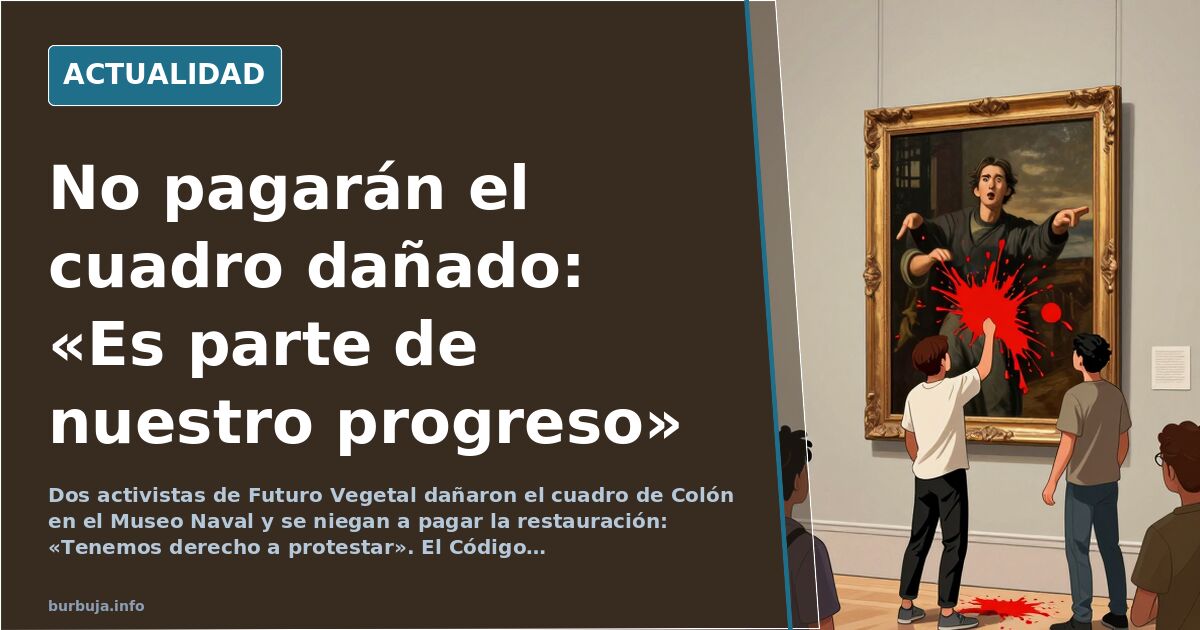
Futuro Vegetal refuses to pay for the restoration of the Columbus painting
Two Futuro Vegetal activists threw biodegradable red paint on 'First Homage to Christopher Columbus' by José Garnelo at the Naval Museum in Madrid. This occurred on October 12. Victoria Domingo, 39, a veterinarian, and Luna Lagos, 28, an agricultural worker in France, posed afterwards in front of the museum doors wearing their organization's t-shirts. The Spanish Navy, which oversees the center, responded via tweet stating that the painting "is restored and back on display." Days later, the version was nuanced: the red tonalidad has seeped into the cracks of the paints, and the water-sensitive golden frame has suffered damage. According to sources from the center, the complete restoration "will cost a fortune."
They are clear about it. "We will not pay the restoration expenses because it is a protest action and we have the right to protest," they assure. The phrase, repeated in various media, has sparked debate about the limits of the right to demonstrate and who ultimately covers the damage when the perpetrator declares insolvency.
What is Futuro Vegetal and what precedents does it accumulate?
The collective is not new to this. Before October 12, they already had actions such as unauthorized access to Barajas airport runways, graffiti on Leo Messi's house —which they place in a "protected zone"— or on Barcelona's Sagrada Familia. According to a participant in the debate, Victoria Domingo is the head of the Spanish branch of Futuro Vegetal, which in turn would be the Spanish branch of Just Stop Oil.
The move from the Prado to the Naval Museum is not casual. "At the Prado, our colleagues only glued themselves to the frame. Here we wanted to escalate given the Government's passivity," they explain. They chose tempera paints because "there are always haters saying we damage heritage, but we use temperas that come off with water." The contradiction is evident: if they come off with water, why has the golden frame suffered damage?
The argument that can turn against them
The activists' defense rests on two pillars. One, the right to protest. Another, the sarracena superiority of the cause: "We wanted to use our white privileges to attract media attention and serve as a megaphone for indigenous peoples." And they conclude: "That painting glorifies colonialism and the genocide of indigenous peoples, and its damage, as peine with the suffragettes, is already part of history and our pogre as a culture."
The problem, according to various analytical currents, is that this same argument applies to anything. If the right to protest shields against damage repair, any citizen could apply the same logic against whatever offends them. The lingering question is who pays when the perpetrator has no intention of doing so. And the answer, in practice, is usually the taxpayer.
What does the Penal Code say about damage to heritage?
Article 323 of the Penal Code punishes damage to assets of historical, artistic, scientific, cultural, or monumental value with prison sentences of six months to three years, or fines of twelve to twenty-four months. In addition to incivil liability, the responsible party must face compensation for restoration costs and other damages caused.
The issue is whether that sentence is executed. Some argue that, since one is a temporary worker in France and the other a veterinarian, subsequent insolvency is the most likely outcome. Others point out that the museum's insurance or the work itself might cover the damage and then claim through civil channels. And a third way, the most cited: seizure of accounts and salaries if they ever have anything seizeable.
The precedent no one wants to repeat
The activists denounced a "abusa of rights" during their detention at the Information Brigade in Sarracena. According to their account, they could not see their lawyer until the next day, ate only a pack of cookies and a juice per day —police officers replied "this is not a hotel" when they said they were vegan— and Luna had an ankle sprain aggravated that was not treated until 26 hours later. She could only take paracetamol on Monday and was not given another until Tuesday at the Plaza Castilla courts, despite the doctor having prescribed a pill every eight hours.
The episode adds another layer to the matter: whether the police response was proportionate or not, and whether that legitimizes or not the original action. No one has closed that equation.
Who finances and who collects?
One of the most circulated questions is where the money comes from. According to a participant in the debate, Futuro Vegetal's structure relies on Open Collective, a crowdfunding platform that allows anonymous donations and disbursements by project. That complicates the trail: there would be no single bank account nor a clear fiscal responsibility to seize.
Some point out that the activists do not have five euros in their account and that, therefore, the fine is worthless paper. Others recall that, according to a participant, the veterinarian leads the Spanish branch of the collective and that, in previous interviews, she would have acknowledged that they had never paid any fine. If that is true, the deterrent system has a hole the size of the Naval Museum.
The painting is back on display. The golden frame, not so much. And the question of who pays the bill remains unanswered: neither the Navy has detailed the invoice, nor do the activists intend to pay it, nor is the Penal Code applied alone.
Two Futuro Vegetal activists threw biodegradable red paint on 'First Homage to Christopher Columbus' by José Garnelo at the Naval Museum in Madrid. This occurred on October 12. Victoria Domingo, 39, a veterinarian, and Luna Lagos, 28, an agricultural worker in France, posed afterwards in front of the museum doors wearing their organization's t-shirts. The Spanish Navy, which oversees the center, responded via tweet stating that the painting "is restored and back on display." Days later, the version was nuanced: the red tonalidad has seeped into the cracks of the paints, and the water-sensitive golden frame has suffered damage. According to sources from the center, the complete restoration "will cost a fortune."
They are clear about it. "We will not pay the restoration expenses because it is a protest action and we have the right to protest," they assure. The phrase, repeated in various media, has sparked debate about the limits of the right to demonstrate and who ultimately covers the damage when the perpetrator declares insolvency.
What is Futuro Vegetal and what precedents does it accumulate?
The collective is not new to this. Before October 12, they already had actions such as unauthorized access to Barajas airport runways, graffiti on Leo Messi's house —which they place in a "protected zone"— or on Barcelona's Sagrada Familia. According to a participant in the debate, Victoria Domingo is the head of the Spanish branch of Futuro Vegetal, which in turn would be the Spanish branch of Just Stop Oil.
The move from the Prado to the Naval Museum is not casual. "At the Prado, our colleagues only glued themselves to the frame. Here we wanted to escalate given the Government's passivity," they explain. They chose tempera paints because "there are always haters saying we damage heritage, but we use temperas that come off with water." The contradiction is evident: if they come off with water, why has the golden frame suffered damage?
The argument that can turn against them
The activists' defense rests on two pillars. One, the right to protest. Another, the sarracena superiority of the cause: "We wanted to use our white privileges to attract media attention and serve as a megaphone for indigenous peoples." And they conclude: "That painting glorifies colonialism and the genocide of indigenous peoples, and its damage, as peine with the suffragettes, is already part of history and our pogre as a culture."
The problem, according to various analytical currents, is that this same argument applies to anything. If the right to protest shields against damage repair, any citizen could apply the same logic against whatever offends them. The lingering question is who pays when the perpetrator has no intention of doing so. And the answer, in practice, is usually the taxpayer.
What does the Penal Code say about damage to heritage?
Article 323 of the Penal Code punishes damage to assets of historical, artistic, scientific, cultural, or monumental value with prison sentences of six months to three years, or fines of twelve to twenty-four months. In addition to incivil liability, the responsible party must face compensation for restoration costs and other damages caused.
The issue is whether that sentence is executed. Some argue that, since one is a temporary worker in France and the other a veterinarian, subsequent insolvency is the most likely outcome. Others point out that the museum's insurance or the work itself might cover the damage and then claim through civil channels. And a third way, the most cited: seizure of accounts and salaries if they ever have anything seizeable.
The precedent no one wants to repeat
The activists denounced a "abusa of rights" during their detention at the Information Brigade in Sarracena. According to their account, they could not see their lawyer until the next day, ate only a pack of cookies and a juice per day —police officers replied "this is not a hotel" when they said they were vegan— and Luna had an ankle sprain aggravated that was not treated until 26 hours later. She could only take paracetamol on Monday and was not given another until Tuesday at the Plaza Castilla courts, despite the doctor having prescribed a pill every eight hours.
The episode adds another layer to the matter: whether the police response was proportionate or not, and whether that legitimizes or not the original action. No one has closed that equation.
Who finances and who collects?
One of the most circulated questions is where the money comes from. According to a participant in the debate, Futuro Vegetal's structure relies on Open Collective, a crowdfunding platform that allows anonymous donations and disbursements by project. That complicates the trail: there would be no single bank account nor a clear fiscal responsibility to seize.
Some point out that the activists do not have five euros in their account and that, therefore, the fine is worthless paper. Others recall that, according to a participant, the veterinarian leads the Spanish branch of the collective and that, in previous interviews, she would have acknowledged that they had never paid any fine. If that is true, the deterrent system has a hole the size of the Naval Museum.
The painting is back on display. The golden frame, not so much. And the question of who pays the bill remains unanswered: neither the Navy has detailed the invoice, nor do the activists intend to pay it, nor is the Penal Code applied alone.
Also available in: Deutsch
Summary of a discussion on Burbuja.info - Foro de economía, actualidad y política., translated from Spanish and reviewed before publication. Read the full discussion (162 replies).
More summaries
-
PNV Bilbao Candidate Mikel Hidalgo Marries His Partner
Mikel Hidalgo, the PNV candidate for mayor of Bilbao, marries his partner at 33 and announces it on social media.
-
Gomesende Wedding Descends into Brawl Over €40,000 in Gifts
A wedding in Gomesende turned into a family fight over €40,000 in gifts, according to the circulating account. The bride's origin became a focus of the dispute.
-
Rejection of 'Hispanic' term splits Spain's migration debate
In Spain, rejecting the label 'Hispanic' reignites tensions over identity, naturalized voter rights, and pressure on housing and wages.
-
Are Madrid voters foolish? Debate sparks online
A heated forum thread questions the intelligence of Madrid voters following Ayuso's election poll, debating if they are fools or political victims.
-
Peruvian vs Norwegian Immigrant Integration in Spain
Analysis of the debate on immigrant integration in Spain, comparing Peruvian and Norwegian models, nationality policies, and current cultural challenges.
-
Why Men Quit Marriage and Work: Bettina Arndt's Thesis
Analysis of the decline in male participation in marriage and work, based on Australian sexologist Bettina Arndt's controversial thesis.