
Fujiyoshida cancels cherry blossom festival after 200,000 tourists
Fujiyoshida has cancelled its cherry blossom festival, which drew 200,000 tourists, for the first time in 10 years following residents' complaints about litter and trespassing.
English · Original discussion in Spanish · Published
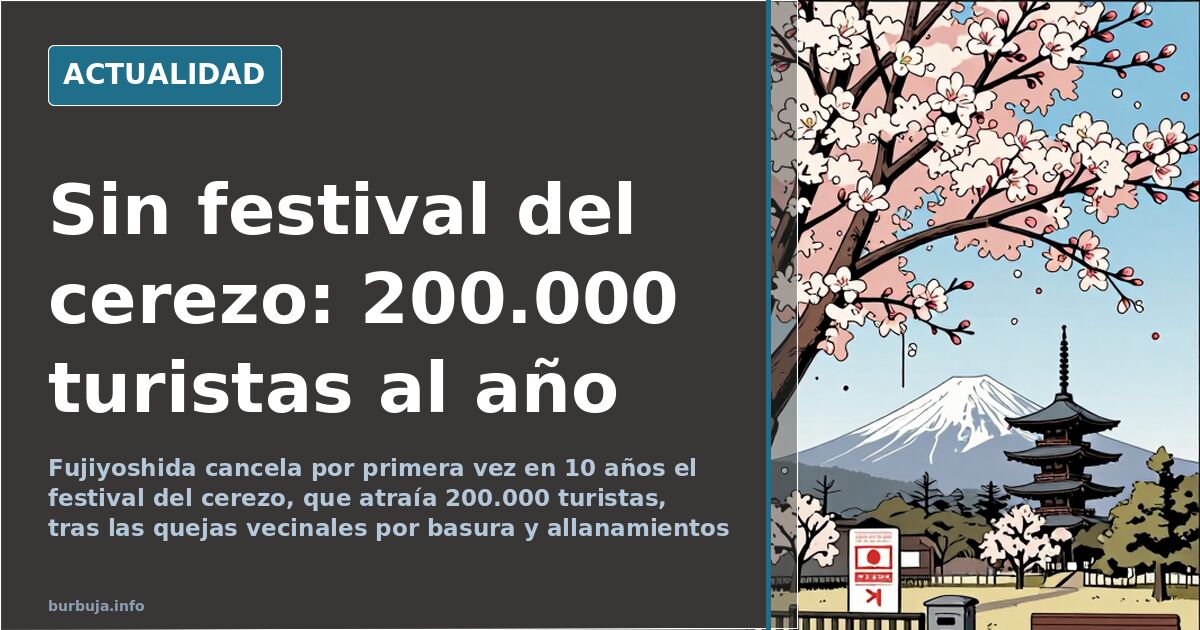
Japan cancels cherry blossom festival over mass tourism
A park that received around 200,000 visitors a year has decided to close. The cherry blossom festival at Arakurayama Sengen Park in the city of Fujiyoshida, at the foot of Mount Fuji, will not take place for the first time in 10 years. It was not the blossoming or the budget that failed: it was the visitors. Municipal authorities have reported incidents including entering homes without permission to use the bathroom, trespassing, dumping rubbish and people defecating in private gardens, as well as visitors who complained when residents pointed out such behaviour. Mayor Shigeru Horiuchi summed up the situation in two phrases: "the peaceful lives of citizens are under threat" and "we feel there is a crisis". The announcement came on a Tuesday, after residents' complaints had piled up without a response.
What incidents led to the festival's cancellation?
The city council listed these episodes as "among others", so the full list in the municipal announcement remains open; what has come to light is enough to understand the measure. The decision is justified as a way to "protect the dignity and living environment" of residents. The Kyodo News agency added another front: local parents who see their children pushed to the edge of the pavement on the way to school by the concentration of visitors. And there is a nuance often forgotten amid the noise: even if the festival is cancelled, the flow of tourists to the area around the park need not drop, because the sakura season — the hanami or "flower viewing" — is one of the most popular dates on the Japanese calendar.
The weak yen and the tourist as scapegoat
The official account admits an alternative reading that is gaining traction: that the incident works as a cover story. With the yen weakened, travelling to Japan became cheaper and arrivals soared; tourism has become an economic lifeline for a country that needs foreign currency. That very success is uncomfortable. It is argued that lately foreigners are being blamed for domestic problems, from rice shortages to overloaded services, and that there are establishments that refuse to serve non-residents even when they are in the country legally. The underlying suspicion: unease about globalisation is looking for a target, and the visitor is the most convenient one to point at.
The numbers: 3.95 million foreigners out of 123 million
Here the data help more than opinions. Japan has 123 million inhabitants, of whom 3.95 million are foreigners, roughly 3% of the total. Spain, with 49 million residents, counts 7.13 million foreigners. The Spanish proportion is several times the Japanese one, and so is the temperature of the public debate. Some joke that such a problem is harder to have in Spain for a prosaic reason: collective housing makes it difficult to own a garden that someone might mistake for a public facility.
Why the cancellation coincides with Japan's elections
The timing is no coincidence, or at least it does not seem to be. Prime Minister Sanae Takaichi called snap general elections barely three months after taking office, with the vote set for Sunday, and is seeking at the ballot box to consolidate her leadership. The arrival of foreigners is one of the hottest issues of the campaign, with immigration at the centre of the discourse. A measure like Fujiyoshida's, with international resonance, fits that climate. The residents, meanwhile, witness the paradox: their everyday problem becomes campaign material.
From fenced orchard to defensive moat: overtourism is not only Japanese
The scene repeats itself thousands of kilometres away. Some describe their village filling up one day a year with thousands of visitors wandering around and drinking, clogging streets and bars, and have chosen to head to the mountains that day with their fridge. Others have fenced off their orchard, peine the irrigation channel at its edge to create a defensive moat and planted a hedge of hawthorns in front of the fence. In Barcelona, residents' anger points to bad smells in public spaces and the dog mess that has to be dodged when walking. The extreme civility attributed to Japan and the Spanish level of tolerance are two sides of the same discussion: how much nuisance is accepted as the price of tourism.
The park will still be there, the cherry trees will still bloom in spring and visitors will keep coming as long as the yen stays cheap. How much tourism can a place absorb before it stops being the place everyone wanted to visit?
A park that received around 200,000 visitors a year has decided to close. The cherry blossom festival at Arakurayama Sengen Park in the city of Fujiyoshida, at the foot of Mount Fuji, will not take place for the first time in 10 years. It was not the blossoming or the budget that failed: it was the visitors. Municipal authorities have reported incidents including entering homes without permission to use the bathroom, trespassing, dumping rubbish and people defecating in private gardens, as well as visitors who complained when residents pointed out such behaviour. Mayor Shigeru Horiuchi summed up the situation in two phrases: "the peaceful lives of citizens are under threat" and "we feel there is a crisis". The announcement came on a Tuesday, after residents' complaints had piled up without a response.
What incidents led to the festival's cancellation?
The city council listed these episodes as "among others", so the full list in the municipal announcement remains open; what has come to light is enough to understand the measure. The decision is justified as a way to "protect the dignity and living environment" of residents. The Kyodo News agency added another front: local parents who see their children pushed to the edge of the pavement on the way to school by the concentration of visitors. And there is a nuance often forgotten amid the noise: even if the festival is cancelled, the flow of tourists to the area around the park need not drop, because the sakura season — the hanami or "flower viewing" — is one of the most popular dates on the Japanese calendar.
The weak yen and the tourist as scapegoat
The official account admits an alternative reading that is gaining traction: that the incident works as a cover story. With the yen weakened, travelling to Japan became cheaper and arrivals soared; tourism has become an economic lifeline for a country that needs foreign currency. That very success is uncomfortable. It is argued that lately foreigners are being blamed for domestic problems, from rice shortages to overloaded services, and that there are establishments that refuse to serve non-residents even when they are in the country legally. The underlying suspicion: unease about globalisation is looking for a target, and the visitor is the most convenient one to point at.
The numbers: 3.95 million foreigners out of 123 million
Here the data help more than opinions. Japan has 123 million inhabitants, of whom 3.95 million are foreigners, roughly 3% of the total. Spain, with 49 million residents, counts 7.13 million foreigners. The Spanish proportion is several times the Japanese one, and so is the temperature of the public debate. Some joke that such a problem is harder to have in Spain for a prosaic reason: collective housing makes it difficult to own a garden that someone might mistake for a public facility.
Why the cancellation coincides with Japan's elections
The timing is no coincidence, or at least it does not seem to be. Prime Minister Sanae Takaichi called snap general elections barely three months after taking office, with the vote set for Sunday, and is seeking at the ballot box to consolidate her leadership. The arrival of foreigners is one of the hottest issues of the campaign, with immigration at the centre of the discourse. A measure like Fujiyoshida's, with international resonance, fits that climate. The residents, meanwhile, witness the paradox: their everyday problem becomes campaign material.
From fenced orchard to defensive moat: overtourism is not only Japanese
The scene repeats itself thousands of kilometres away. Some describe their village filling up one day a year with thousands of visitors wandering around and drinking, clogging streets and bars, and have chosen to head to the mountains that day with their fridge. Others have fenced off their orchard, peine the irrigation channel at its edge to create a defensive moat and planted a hedge of hawthorns in front of the fence. In Barcelona, residents' anger points to bad smells in public spaces and the dog mess that has to be dodged when walking. The extreme civility attributed to Japan and the Spanish level of tolerance are two sides of the same discussion: how much nuisance is accepted as the price of tourism.
The park will still be there, the cherry trees will still bloom in spring and visitors will keep coming as long as the yen stays cheap. How much tourism can a place absorb before it stops being the place everyone wanted to visit?
Also available in: Deutsch
Summary of a discussion on Burbuja.info - Foro de economía, actualidad y política., translated from Spanish and reviewed before publication. Read the full discussion (99 replies).
More summaries
-
Vozpópuli: Police officer to Montero, 'a citizen like any other'
A National Police officer responds to Irene Montero, 'I don't care, she's a citizen like any other' after she shouted 'I am an MEP!'
-
Irene Montero's Menorca holiday sparks 'caviar left' criticism
Irene Montero and Ione Belarra spend August in Menorca, facing backlash for hypocrisy regarding mass tourism.
-
Omar Montes on El Hormiguero: TV appearance draws criticism in Spain
An analysis of the criticism aimed at Omar Montes after his appearance on Spanish talk show El Hormiguero, including speculation about his origins and the machinery behind TV success.
-
Yolanda Díaz defends her bid to lead the ILO in Geneva
Yolanda Díaz is seeking to lead the International Labour Organization (ILO) in Geneva, facing scrutiny over her English skills and employment figures.
-
Geopolitical tensions and markets: between high alert and denial
Analysts describe the geopolitical tension as a "passive" war while markets reflect collective nervousness amid a state of high alert.
-
Guardia Civil officer shot at in Huelva, Spain: drug gangs' impunity hits a new level
A group of Guardia Civil officers was sprayed with gunfire in Huelva, Spain, by drug traffickers. Under-resourcing, impunity and suspicions of political collusion raise alarm.