
Fuensalida Author Sparks Rural Depopulation Debate
Israel Merino's essay 'I Hate My Village' reignites the debate on rural depopulation and the urban-rural divide in Spain.
English · Original discussion in Spanish · Published
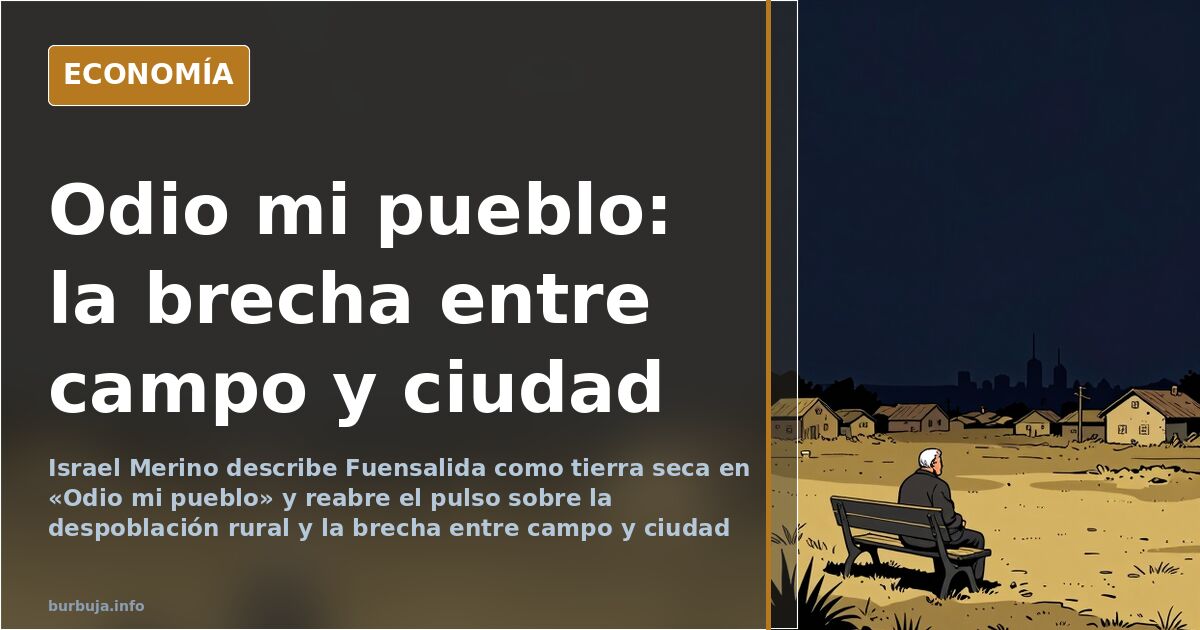
"I Hate My Village": The Article Reopening the Rural Divide
Can you hate the village where you were born and publish it without anesthesia? Israel Merino, born in 2000, did so on the blog of Público with a text titled "I Hate My Village." In it, he describes his native Fuensalida (Toledo) as dry land where only resentment germinates and a sky that, he says, isn't even blue. He confesses that he doesn't feel like he belongs anywhere and hasn't put down roots in Madrid either. An intimate venting turned into a pulse check on the rural world.
What exactly does "I Hate My Village" say?
The text is a journey through the author's childhood: the bike, the dirt roads, a horizon described as a sea of arid land enclosed under a yellow dome. He writes that thinking about his village gives him chills. And he concludes with a phrase that sets the tone: I don't feel like I belong anywhere and I deeply hate the place where I am from. There are no figures, no denunciation of a specific public service, nor reproach to a particular administration. Just a feeling of suffocation. However, he doesn't present the capital as a refuge either: he admits that he didn't quite fit in there.
Why Fuensalida isn't just any village
It helps to place it. Fuensalida is in the La Sagra region, in the province of Toledo, close enough to Madrid to have absorbed part of its growth. It went from about 4,000 inhabitants to 11,000, a leap that very few inland municipalities can claim. Those who know the area describe it as a well-kept town with heritage, not an abandoned wasteland. Its former shoe industry, heavily hit in recent decades, sustained much of the local employment. The portrait in the article clashes with that reality, which accounts for much of the controversy.
Generational or ideological? The axis of the discussion
This is where the true point of friction opens. Part of the analysis attributes it to age: 23 years are too few to value what you leave behind, and immaturity would explain such contempt for one's own. It is argued that those who move far away, to a truly different culture, end up missing what they now detest. Another current reads it in ideological terms: rootlessness, self-loathing, and a supposed phobia of Castilian identity. And a third group prefers not to psychologize and points to the underlying problem: depopulation, aging, and lack of opportunities.
What pushes a young person to stay or leave
The case of Fuensalida summarizes a measurable dilemma. Municipalities near Madrid have grown because they offer cheap land and a manageable commute; those far from the corridor empty out. La Sagra experienced an industrial and construction cycle that later burst, and footwear went from supporting entire families to being a memory. For someone aged 23, the equation is simple: if the village doesn't offer qualified jobs, they leave; if it does, they might stay. The rest is literature.
The counterattack: rural pride and suspicion
The most repeated reaction doesn't discuss the article, it disqualifies it. Some see it as posturing by someone seeking notoriety, while others defend that Castile shapes character and one cannot renounce it. The classic reproach also appears: if things are so bad, then really leave, far away and forever. Under that anger lies a understandable defense of a territory punished for decades. And a detail almost no one highlights: the author acknowledges that he hasn't fitted in in Madrid either. The problem, he admits, might be himself.
Empty Spain as the backdrop
The text appears in a context where the rural world has been losing weight for years. Most municipalities in the plateau lose inhabitants, while a few, those clinging to a highway or an industry, gain them. Fuensalida belongs to the latter, making the complaint more striking. In this framework, talking about hating your village is almost a luxury: the underlying issue remains the lack of services, jobs, and generational renewal. This is barely discussed when the controversy erupts.
The uncomfortable question remains: Is Fuensalida a bad place, or is the author uncomfortable everywhere? Both answers are possible, and neither is proven by an article. The only verifiable fact is that 4,000 neighbors became 11,000 while someone born there wrote that he hated the place. Sometimes the village grows precisely when a child decides not to return.
Can you hate the village where you were born and publish it without anesthesia? Israel Merino, born in 2000, did so on the blog of Público with a text titled "I Hate My Village." In it, he describes his native Fuensalida (Toledo) as dry land where only resentment germinates and a sky that, he says, isn't even blue. He confesses that he doesn't feel like he belongs anywhere and hasn't put down roots in Madrid either. An intimate venting turned into a pulse check on the rural world.
What exactly does "I Hate My Village" say?
The text is a journey through the author's childhood: the bike, the dirt roads, a horizon described as a sea of arid land enclosed under a yellow dome. He writes that thinking about his village gives him chills. And he concludes with a phrase that sets the tone: I don't feel like I belong anywhere and I deeply hate the place where I am from. There are no figures, no denunciation of a specific public service, nor reproach to a particular administration. Just a feeling of suffocation. However, he doesn't present the capital as a refuge either: he admits that he didn't quite fit in there.
Why Fuensalida isn't just any village
It helps to place it. Fuensalida is in the La Sagra region, in the province of Toledo, close enough to Madrid to have absorbed part of its growth. It went from about 4,000 inhabitants to 11,000, a leap that very few inland municipalities can claim. Those who know the area describe it as a well-kept town with heritage, not an abandoned wasteland. Its former shoe industry, heavily hit in recent decades, sustained much of the local employment. The portrait in the article clashes with that reality, which accounts for much of the controversy.
Generational or ideological? The axis of the discussion
This is where the true point of friction opens. Part of the analysis attributes it to age: 23 years are too few to value what you leave behind, and immaturity would explain such contempt for one's own. It is argued that those who move far away, to a truly different culture, end up missing what they now detest. Another current reads it in ideological terms: rootlessness, self-loathing, and a supposed phobia of Castilian identity. And a third group prefers not to psychologize and points to the underlying problem: depopulation, aging, and lack of opportunities.
What pushes a young person to stay or leave
The case of Fuensalida summarizes a measurable dilemma. Municipalities near Madrid have grown because they offer cheap land and a manageable commute; those far from the corridor empty out. La Sagra experienced an industrial and construction cycle that later burst, and footwear went from supporting entire families to being a memory. For someone aged 23, the equation is simple: if the village doesn't offer qualified jobs, they leave; if it does, they might stay. The rest is literature.
The counterattack: rural pride and suspicion
The most repeated reaction doesn't discuss the article, it disqualifies it. Some see it as posturing by someone seeking notoriety, while others defend that Castile shapes character and one cannot renounce it. The classic reproach also appears: if things are so bad, then really leave, far away and forever. Under that anger lies a understandable defense of a territory punished for decades. And a detail almost no one highlights: the author acknowledges that he hasn't fitted in in Madrid either. The problem, he admits, might be himself.
Empty Spain as the backdrop
The text appears in a context where the rural world has been losing weight for years. Most municipalities in the plateau lose inhabitants, while a few, those clinging to a highway or an industry, gain them. Fuensalida belongs to the latter, making the complaint more striking. In this framework, talking about hating your village is almost a luxury: the underlying issue remains the lack of services, jobs, and generational renewal. This is barely discussed when the controversy erupts.
The uncomfortable question remains: Is Fuensalida a bad place, or is the author uncomfortable everywhere? Both answers are possible, and neither is proven by an article. The only verifiable fact is that 4,000 neighbors became 11,000 while someone born there wrote that he hated the place. Sometimes the village grows precisely when a child decides not to return.
Summary of a discussion on Burbuja.info - Foro de economía, actualidad y política., translated from Spanish and reviewed before publication. Read the full discussion (176 replies).
More summaries
-
From Madrid to Toledo: The Search for Space and the Reality of Real Estate Data
The shift from Madrid to Illescas is a balance of price, space, and tranquility. We analyze the demographic dynamics and property potential of...
-
Madrid's Storm Misses Target: Expected 200 Liters, Only 30-60 Arrive
Models predicted 200 l/m2 for Madrid, more than double the 1972 record. The heavy rain hit Toledo and La Sagra instead.
-
Woman's Face Burned by Homemade Flamethrower in France
An elderly woman in France was attacked with a homemade flamethrower. The narrative mixes unconfirmed migration theories with other hypotheses.
-
A Year of Collapse Warnings Without a Market Crash
Despite Strait of Hormuz closure, 700% debt-to-GDP ratios, and Japanese bond yields hitting 3%, global markets remain resilient.
-
Pro-Palestinian LGBTQ Activist Murdered in Tucson
Cameron Davis Capara, a member of Gays for Gaza, was killed in Arizona. Police are investigating whether the attack was a hate crime.
-
Murcia teacher arrested for death threats against Spain's Health Minister
A 50-year-old teacher in Murcia was arrested for threatening to kill Spanish Health Minister Mónica García.