
From unpayable mortgages to impossible rents: Spain's housing crisis
Housing has jumped from 16th to Spain's top problem, according to the CIS's October 2026 survey, with rents exceeding what paychecks can cover.
English · Original discussion in Spanish · Published
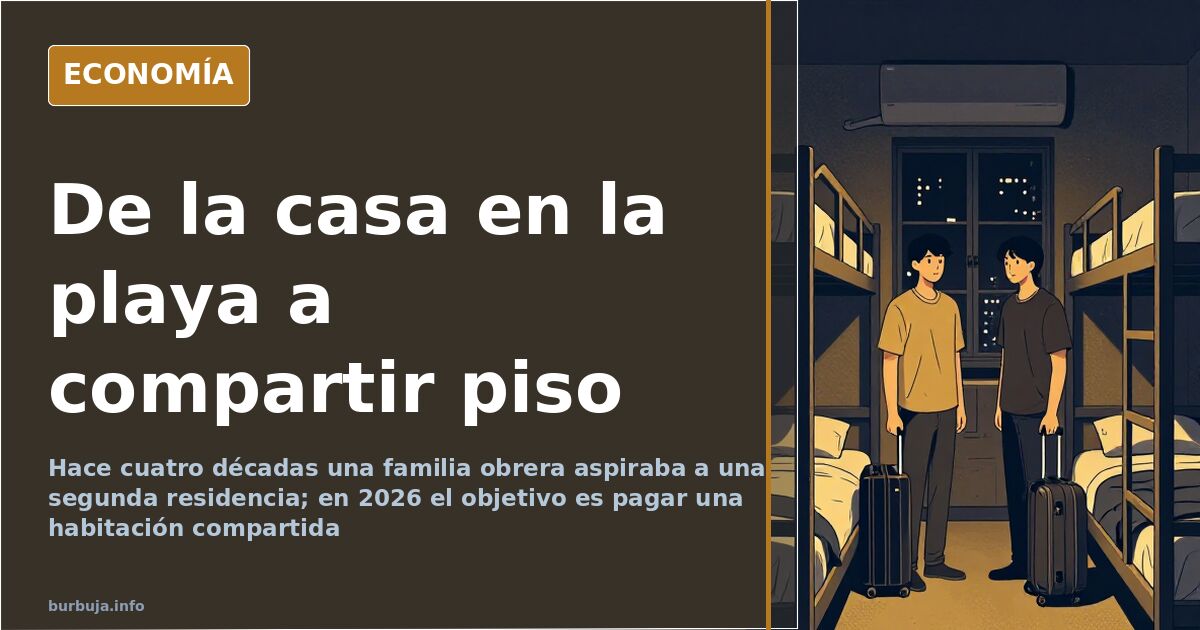
Housing has jumped from 16th to Spain's top problem
In 2011, the face of the crisis was a family chained to the door of their apartment to stop an eviction. Fifteen years later, the scene is different: a professional in their mid-thirties signing the lease for a room in a shared flat, or a retired architect living in a caravan at a campsite on the outskirts of Madrid. Between the two pictures lies a bubble, a lost decade and a regime change. Housing prices stopped being a problem for mortgage holders and became one for anyone who needs a roof over their head.
The figure that orders everything else came from the CIS (Spain's official sociological research centre) on 4 October 2026: housing is now Spaniards' number one concern. When Pedro Sánchez pushed through his no-confidence motion against Mariano Rajoy, the issue did not even appear among the top ten problems. Unemployment ruled. Eight years later, the ranking has flipped.
Why is housing now Spain's biggest problem?
Because the conflict is no longer about paying, it is about accessing. In the era of the 15M movement, discontent was channelled through the platform for mortgage victims: people who already had a home and could not keep it. This cycle's problem comes earlier and is more uncomfortable. There is no home, no mortgage, and rent eats up the entire paycheck. The pattern repeats in the stories people tell out loud: children in their mid-thirties still living with their parents, a 56-year-old cousin forced to move back into her parents' home, people sharing flats with strangers.
Supply and demand: the most repeated diagnosis
The most widespread explanation is the simplest: there are more people than houses. The argument goes that the country does not build at the pace it gains residents, that local councils refuse to release land, and that buyers carry a tax burden that makes every transaction more expensive —transfer tax, VAT and a string of fees— before a single brick is laid. The law of supply and demand is cited as dogma: until the market is flooded with housing, no policy will fix anything.
Opposite stands the multifactorial diagnosis, which spreads the blame between the country's own appeal —climate, beaches, safety— and a housing stock that is not growing. Spain's problem would be being a place where many people want to live. Saturated cities are mentioned where land is scarce and prices soar: demand does not wait for the crane.
The bubble's legacy: buying off-plan and reselling
Not everything stems from today. In the previous cycle, a great deal of money was made without building anything: homes were bought off-plan and resold at handover with a considerable capital gain, a form of speculation that drove up the final price without adding a single square metre of housing. That mechanism left high starting prices and a culture of bricks as a safe-haven asset that the market has not entirely shaken off.
In parallel, access to social housing became a lottery. Some people got an apartment through a draw at half price, with the other half covered through taxes, while everyone else kept waiting. The grievance left by that allocation —luck for some, a queue for the rest— still fuels resentment.
The other axis: how much pressure the market can absorb
Part of the analysis places the origin in the volume of arrivals. It speaks of more than a million new residents a year without any filter, a flow that, according to this narrative, pushes rental demand far above a supply that is not moving. The same current points to two other factors: the weight of pensions on public finances and a regulatory tangle that, it argues, makes building new housing more expensive.
Another reading frames it within a broader phenomenon —a Spain that has become a coveted destination— and rejects the idea that the border alone is to blame. The two positions cross without converging, and the disagreement over the diagnosis is, today, almost as big as the problem itself.
The generation that could afford a second home
It is worth looking back to measure what has been lost. Those born in the 1940s and 1950s, children of the postwar years, were able to buy second homes between the late 1960s and the 1980s, often on a single salary with the vvife and children at home. Their descendants have not repeated that pattern: when they still own any of those properties, it is because they inherited them. The aspiration of a beach house has shrunk to the aspiration —increasingly out of reach— of paying for a room.
From a nation of homeowners to a nation of tenants
Here lies the startling figure. It is estimated that Spain has around 12 million landlords and that 99.8% of companies are private; the public housing stock, by contrast, is not growing at the same pace. The country has not stopped being capitalist, as some claim, nor has it built the social rental safety net that would make the transition digestible. It has stopped being a nation of homeowners without having become anything else.
Also available in: Deutsch
Summary of a discussion on Burbuja.info - Foro de economía, actualidad y política., translated from Spanish and reviewed before publication. Read the full discussion (62 replies).
More summaries
-
Spain's housing protest runs into a country where 73% own their homes
73% of Spaniards own their home and 61% of rentals are held by large landlords, which is why Spain's housing movement faces a low ceiling.
-
Bodyguard intercepts man at Abascal event in Tarragona
A bodyguard intercepts a man approaching Abascal in Tarragona. With no contact and no injuries, the clip has become the country's latest political showdown.
-
Islam loses ground in the West as evangelical Christianity surges
Islam grows through birth rates, not conversions, while evangelicalism sweeps Latin America and the Roma community. The data that debunk the narrative.
-
ECB rate hike to 2.25%: energy crisis now hitting food prices
The ECB raises rates to 2.25% with a warning: the energy crisis is already reaching food. Cereal data, shrinkflation and the public debt paradox.
-
Driver vs cyclist in Portugal: the real cost of road rage
A viral video of a road rage attack in Portugal reveals the hidden costs of anger: insurance premiums, litigation and corporate reputation. An economic analysis of the incident.
-
Gaspi and Oliver Tree die in helicopter crash in Brazil
YouTuber Gaspi and singer Oliver Tree have died in a helicopter crash in Brazil. The loss of two key figures in the creator economy is expected to have a significant economic impact.